Showing posts with label The music industry. Show all posts

Saturday, 24 May 2025

The Saturday List #485 - Ten difficult things I believe to be true about the music industry and music media

 I've long thought about saying this, but have bit my tongue. I cannot stay quiet any longer. I just think it's too important for the whole planet that things change. I know that a blog on my little hyper local blog is not likely to change the world, if anything at all, but if no one ever says anything, then we lose. If I can start a debate, great, if I can't, well at least I tried.

1. I believe that the primary function of the music industry is to make teenagers politically disengaged and keep them stupid, until they have financial commitments and have to behave themselves and play the game that the powers that be make us play to control us. People in their late teens & early twenties are at their most idealistic, passionate and also their most physically powerful. They see that things need changing and want to enact that. This is why when Jeremy Corbyn became Labour leader, young people flocked to him. You may feel they were naive or mislead, but you cannot deny that their motivation was they believed he may actually change things. The Labour party let all of those dreaming teenagers down. I have come to believe that the Music Industrie's job is to keep the lid on such things. This is why it subliminally promotes recreational drug use and hedonistic attitudes. If people are stoned or partying, they are not on the streets causing problems for the establishment. Occasionally this all breaks down, but the industry does everything it can to subvert it. In the 1960's, artists such as Country Joe McDonald, who came to prominance for the anti Vietnam "Fish Cheer" were marginalised, whilst manufactured bubblegum pop acts such as the Monkees were plugged to death. The same was true of Punk, where anarchist bands such as Crass (who were one of the best live acts I ever saw) with their mantra of fight war not wars, were completely ignored by the mainstream industry, whilst bands that were prepared to drop the politics and play power pop, angst teen anthems were given the full backing of the industry. I've seen thousands of bands over the years and probably a couple of hundered artists that were amazing, but completely off message. They did there stuff, but you never hear them on the radio and they never get the support of major labels etc.

2. I believe that the gate keepers of the music media (not the presenters but the people who employ them) have created an environment where it is genuinely impossible to be a radical artist and have commercial success. There are artists that are successful that promote subcultures (hard drug use, etc) that get played, but artists writing songs about genuine change don't get played on air.

3. Far more songs have been banned than you can imagine. Nearly all are relatively innocuous, but the government of the day deemed them in some way politically subversive. Almost none have been banned for promoting drug use. Clearly some songs are banned for rude words etc, but check out the list on Wikipedia and see wh wikipedia.org/wiki/List_of_songs_banned_by_the_BBC 

4. The UK government spent decades clamping down on people running pirate radio stations, which solely played music. Why? Because they knew that they couldn't control them. Governments only spend money on things they think are important and in policing only on things that they think threaten their power.

5. The music industry loves drug addled stars, as they can control them. I once heard an interview with Lousiana voodoo Jazz legend Dr John, where he stated the first thing the label did when he was signed was get him hooked on heroin, so they could control him. It made me realise that the myth that hard drugs are subversive is a lie put around to screw up people who are creative. If you want to be truly subversive and creative, stay clean and write about what you care about.

6. The music industry positively discriminates against new artists and new material, as established artists are far cheaper, more profitable and easier to control. When a band like the Rolling Stones releases a new album, they get a massive boost in sales on old material. This costs the labels nothing. New material and new artists are expensive to promote.

7. The media and the music media in particular, are not interested in promoting up and coming artists. If you watch a show such as Graham Norton, he will chat endlessly with big stars. At the end, a new act might be reeled on, play a tune, then get 30 seconds to say something. I am not having a pop at Norton, who does not produce the show. The one person who bucks the trend is Jools Holland. Needless to say, the BBC puts his show on at a time that is pretty inaccessible. The BBC dropped the TOTP show, where new artists did get played. They maintanined the brand though, endlessly showing old repeats, that are free to produce. 

8. When musicians speak, it can make a difference. If this was not true, Donald Trump would not have posted this about Bruce Springsteen.
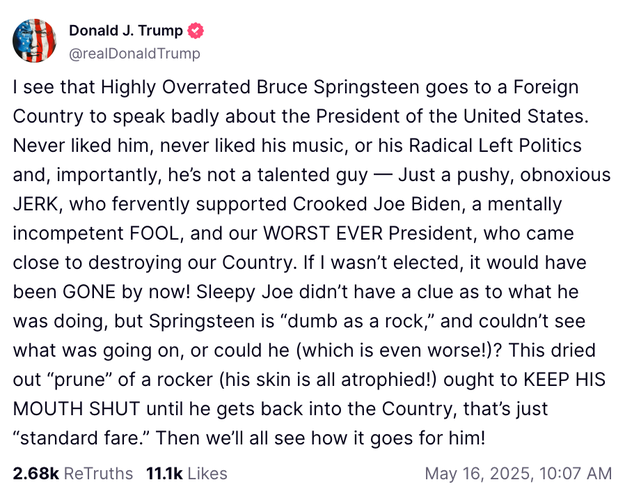

Springsteen is in the lucky position of being established and not giving a flying ****. The media ridicules "pop stars who dabble in politics". Why do you think this is? Succeeding in music is perhaps the most difficult thing in the world. No one gets handed success on a plate, yet musicians are always portrayed as being lazy substance abusers. When someone such as  Britney Spears has mental health issues, the media glory in it. Why? Because it is a useful tool in undermining the credibility of people like Springsteen who are eloquent, articulate and highly intelligent. To what purpose? To protect the likes of Trump IMHO.

9. The people who control the music industry are two faced liars, who pretend to support the grassroots music scene but in truth hate it and just see it as a breeding ground for talent, to be robbed of its riches with no payback. I was shocked to learn that my band, The False Dots are second only to Madness in the number of times we've played the Dublin Castle. We've been around for 46 years. How could this be? The answer is simple, apart from Madness, who come back for the odd small show, most bands either split up or the industry swallows them up and they move to larger venues. The smaller venues get nothing back. There was talk of a ticket levy from major labels. I personally think the PRS should also pay a 2% levy on all artists who earn more than £100,000 a year in royalties back to the the grassroots industry. They'd have no career without the likes of the Dublin Castle. But this will only happen if theya are dragged their kicking and screaming. 

10. The music industry actually likes it when young stars die. This may sound horrific, but I've heard it said dozens of times, when an artists tragically passes away that "It's good for sales". The first few times I heard this, I just took it as a joke, but I realise that labels actively have plans made and teams ready to plug the music of artists when they die. There is the mythology around artists dying at 27. There is nothing a label loves more than when an artist has passed the peak of their career, the label is considering dropping them and they drop dead. That way, the label doesn't have to invest in new material that won't sell and they'll turn a quick buck on the old material, as fans have one last hurrah. 

I'm only pleased that I rarely have to deal with big labels and big players in the music industry in my business area. We are just part of the business that work our nuts off helping artists get a foot on the ladder, so the industry can take advantage of them. I've spent my life, since I became a punk rocker in 1977, hoping things would change. The only way they will is when artists can control their own fate. The sad truth is that all manner of people make billions from music, but artists at the bottom get no support at all and if they show any creativity at all, they will get squashed.

One of the saddest things for me, is I am actually glad that my band never became superstars. We had and are still having a blast and doing the music we love, and there is a bit of a message in there. The nearest the band ever got to a deal was in 1984, when Venessa Sagoe was singing. The key song we presented was Action Shock, which is a song that is deeply critical of politicians who destroy young people in the pursuit of war and and also looks at the challenges that a young man faces when he has to kill a fellow human being for reasons he doesn't fully understand. Oddly we didn't get a deal. Although Venessa doesn't sing with us anymore, we still peform the number albleit in a different way. You can hear it tomorrow at The Dublin Castle, we are plaing a matinee show (Click here for details) to launch our new, independently released single Groovetown.

Venessa Sagoe sings Actions Shock in 1984


The False Dots perform Action Shock in 2024


Have a great weekend!


Monday, 11 November 2024

The harsh truth about the music business and why you should never give up on your dreams

Hold on tight to your dreams.....

So you want a career in the music industry (or one of your offspring does). You want them to have the best advice and you want someone to mentor them. There are two ways to mentor such a person. There are two methods. I don't subscribe to the first, but you can make a mint doing this, if you are well connected and unprincipled.

You charge them a lot of money, draw up a plan with aims and goals and work with them to achieve them. If you are crafty, and they or their parents are wealthy, you get them to work with the best people, play the best places and record at the best studios (mine or Abbey Road, depending on your budget). If it works, you are a genius and you get a handsome cheque. Basically you take the cash to open a few doors that they don't have the key for. If it fails, you just get a fat cheque and you blame everyone else for not pulling their finger out. There is a lot of money advising the untalented offspring of the wealthy on how to get on in music. 

Then there is the other way.  The way I prefer. You do this if the person is talented, you like them and they don't want to pay you a fortune. What do you do with them? Sit them down and tell them the harsh truth. There are three questions I ask. 1. What do you want out of a career in the music industry? 2. What will you be doing in five years if your career takes off. 3. Do you like Pot noodles. 

If you want to know the correct answer, then you'll have to pay me a lot of money, but if the answer is wrong, there is no conversation to be had. The fourth thing I tell them, if they get the answers to the first three right,  is to come back when they have three tracks that are absolute killers. The reason? Unless you have an absolute killer track in you, then it doesn't matter how pretty, how versatile a musician you are or how rich Daddy is, you are wasting your time. If there is a killer track, then the next thing is to see it performed live. If you've got a killer track and you can deliver it live, then you are in business.

The most successful person ever to pass through our doors at Mill Hill Music Complex was Amy Winehouse, who started her career rehearsing in our studios. When I saw Amy work, I didn't need to ask the first two questions. It was obvious what she wanted and that she had no plan B. She was up for the rock and roll life of pot noodles at 3AM after a drive from Hull in the rain. We mentored Amy unofficially in her early career as we do many musicians. Not by sitting down and drawing up plans, but by providing an environment where she could do what she needed at that stage in her career. The difference with Amy and most other kids who walk through the door was that it was her asking the questions. She'd walk through reception and stop and say "Who is that your playing?" We'd reply "Joni Mitchell". She'd say "What's the track I'll check that out". Sometimes she'd pick up a guitar when she was waiting, strum a song and say "I don't think it sound right". We'd say something like "Try a passing note of B, when you change chord from C to Am". She do it and say "Yeah that sounds cool". She'd ask about which venues the more established bands were saying had the best buzz. She wanted to get the best musical influences, write the best songs and play the venues with the best vibe. I told her that if she wanted a local gig, it had to be The Torrington and if she was looking for a gig in town, it had to be The Dublin Castle in Camden to start. She listened. She played both. She wanted to be a step ahead of the game and she got that it isn't just about play songs and doing gigs, you play the best songs you can and you do the gigs at the venues that will be best for you. I wasn't unique, she asked anyone if she thought they may have an insight. She was also pretty humble with it and would chat about the why's and wherefores. 

The truth about the music industry is that if you want to succeed, you need to know your own mind. You need to have a clear idea of where you want to play and why. You need to play songs that you think are amazing. You need to play gigs with an audience that you know will connect with them. You want the audience to go home and tell all there mates you were amazing and to bring them back next time. So many artists miss this all. They think that something will magically happen and all of a sudden you'll be the next Lady Gaga or Rolling Stones. I hear lots of musicians of my age sneer at both. The thing is that the likes of Gaga and The Stones do what Amy did before she'd even started gigging. They get the best out of their talents, they put the best shows on in the right venues and they play to an audience that will like them. It doesn't matter what level you are at, this is the secret.

Which brings me on to your dreams. We have two main groups of customers. The up and coming ones who are full of dreams and old crusty ones like me, trying to glue back together a few fragments of our dreams to have a bit of fun with, before the grim reaper carts us off to Hades. This Sunday, my band launch our debut album after 45 years. We will be launching it at The Dublin Castle, far and away my favourite grassroots venue in London. A loyal bunch of friends and fans will turn up for the show. For me, it is an important statement. Not just for me, but for every old geezer like me, who's ever looked up at the stars and had a dream. Back in 1990, I put my guitar down for a decade and vowed that "I was done with all of that".  I'd had ten years of broken dreams and I just ran out of energy. We got the band back together in 2000, but it was just for fun. Having my own recording studio, inspired me to "record a few numbers, for my own enjoyment". A few gigs followed. In 2009, an amazing female vocalist turned up at the studio and we roped her in for a year or two. From playing The Three Hammers and The Mill Hill Sports club, we found ourselves back onstage in Camden and getting some serious interest (in her not the band). She got a gig as a backing singer with an international star and we went back to the Mill Hill Sports club!

But it gave me a real taste. We started working on an album, with a singer we worked with in 1985. Some of the songs were good, we were enjoying it, but we weren't setting the world alight and I wasn't 100% happy with the songs. Then lockdown hit. Our singer departed, our drummer had a massive crisis when his son took his own life and we had a new mission. The band became his support mechanism, to get him through lockdown. How? I set myself a task to write songs that made him smile and laugh. Niot cheesy joke/comedy songs, but Ian Duryesque observations on life. I took up singing duties that I'd put down 40 years before. 

And then something odd happened. It all fell into place. To my amazement, the energy we'd had in 1983/4 had returned. An added bonus was that the songs were really hitting the spot. We made a video of The Burnt Oak Boogie and within a week, it had 3,000 views. We did a gig at The Adam and Eve and people loved it. Then we did a gig at The Dublin Castle, just for fun as I fancied it, and it was brilliant. A residency followed and Sunday will be our tenth gig in two years at London's best venue. The final piece in the jigsaw was when trumpet player Tom Hammond joined. Tom was born the year Graham our drummer joined, but it feels like he's been here for ever now. 

We recorded most of the album at my mate Boz Boorer's studio in Portugal. It was a good excuse for a few days in the Sun with the boys. And now, to my amazement my dream is materialising.  Each of the songs is a story. 


We all love a party - Our last Single/video release.  Started life as a reminiscence about the parties my parents used to have when we were kids. Drunken Irish relatives, workmates and drinking buddies of my Dad, jokes, whiskey and punch ups. Always a laugh. Mum always vowed "never again" when they finished. She hated clearing up the debris and the embarrassing incidents. The rest of us loved it. It has become our anthem. The crowd knows the words better than me!


Wacky Races  - Started life when I was reminiscing about the go cart races we used to have as kids in Millway, getting old prams, making go carts and also when my mate Pete fell down a manhole on his new bike and nearly died. I then sprinkled a few other tales of our youth in and observed that kids aren't allowed to have fun anymore. It has a slow, dub reggae vibe. 

Bubble Car - I found a picture of my brother Frank in his bubble car in Manchester in 1967 with his mates. I commented that it would make a great album cover. It morphed into a song about a dodgy band leader trying to seduce a pretty girl by getting her to become the singer in the band. Something that happened a couple of times when we started the band, although we didn't actually have a bubble car. The song has a bouncy a Ska feel, I wanted the song to shout 1968!


Longshot didn't die  - I wrote this song as a Ska song. I wanted Lee Thompson from Madness and Jenny Bellstar to to sing it. I played it to Lee and he said "Why don't you sing it yourself? I'd not thought of it, that was possibly the moment that this iteration of the band was cemented. It is the starting point for the post 2022 sound of The False Dots. It is a re-imagination of what the true story of the Pioneers Ska hit from 1968 was. I love the song. 

The Burnt Oak Boogie -  I wrote this for a laugh. I went to Orange Hill School, we used to bunk off out and go for a cup of tea at The Betta Cafe on Watling Avenue. Somethimes, I'd nip arround to my surrogate Grandma, Annie O'Keef'e's place on Homefield Road for a cup of tea and a slice of cake. A lovely old Irish lady, married to a caretaker called Joe. HE did actually breed budgies and have a dog called Beauty. Dedicated to Annie and Joe.  The Burnt Oak I knew has disappeared. I miss them and I miss the old days.


Buy Me a Bottle of Jack -  A song about dark, suicidal thoughts, prompted by my struggle with prostate cancer and facing up to the life changing effects I've had,  but told with a very dark humour. After I drafted it, I gave the subject some more thought. Three times in my life, I've seriously thought about ending it all. Each time, something has made me laugh, something very dark, but it pulled me back from the brink. There is an absolute plague of young people killing themselves, our Graham's son being one. We need to talk about it. When I have a dark music, I sing myself the song in my head. Here's a live version. 


Don't be scared of a finger up the bum -  An impassioned plea to my mates and men everywhere to get a prostate check. It is a fun song, with a serious message. Regular blog readers will know that I had my prostate removed last year after ten years of living with Prostate Cancer hanging over me.  The album name is a play on this, as well as a reference to the sunshine at Boz's place in the mountains of Portugal. 

Not all She Seems - This and the next songs are over 40 years old. All of the other songs up to now are (relatively) new. This one was written in 1979. The guitar lick was donated to us by Hank Marvin of The Shadows. His son Paul was our drummer for six months in 1980. It is about a transsexual prostitute on the run from a pimp and a Tory MP who is besotted with her. Like many False Dots songs, it is a mash up of two true stories, with a bit of artistic license. We met a transexual girl at the Moonlight Club in 1978. She was in a mess, totally alone and without a friend in the world, only really feeling accepted in the local punk scene. It was also based on a story a prostitute told me at a decorating job I had, I conflated the two.  We wrote it very sympathetically. We wanted to write a song telling the story of someone at the margins, abused by everyone. I am amazed we did so good a job as sixteen year olds.

Action Shock -  This was written in 1982. A mate was a Marine in the Falklands. I saw him six months after he came back. He was a mess, suffering from bad PTSD and was really unpleasant. Six or seven years later, I met him again. He was back to himself. He told me that he'd been to Nepal and spent three years up a mountain smoking dope. He was back to normal. I feel that I should write a follow up, but I've failed to get the right vibe and given up every time I've tried. It was written as a punk thrash. We never played it. When Venessa Sagoe joined in 1983, she insisted we play it. It has been a highlight ever since. It stubbornly refuses to die.

Sci Fi Girls - I used to be obsessed with TV Sci Fi series UFO and I liked Dr Who until Tom Baker took over. I wanted a really rip roaring 70's Bolan/Glam sound to end the album. Boz Boorer, who produced this totally got the vibe. If ever we get any money. I'll remake the video with all of the Sci Fi clips I wanted to use but couldn't get permission.
The song is very much about this pre teenage obsession and the music I was listening to. I wanted it to sound a bit like The Sweet, but my voice is a bit too punk so it ended up a glam / punk mash up. It was on 365  Radio's Juke Box Jury and ace producer said I should try singing. If ever I bump into him, I'll tell him that he should try doing a Crass/Sweet mash up. 


So that's what's on the album. Watch this space, We'll put links to it on Sunday. Hold on to to your dreams. Without them the night is just a dark abyss. You may ask "Why would a 62 year old bloke want to release records and play gigs in trendy Camden Town?" My response "Why wouldn't he!". Please come along if you are free, Tickets from here Falsedots Album Launch Party

Thursday, 28 March 2024

What makes you have a hit record?

Having run a music studio and played in a band for 45 years, I've done a few gigs, seen a few artists come and go, at close quarters and seen a hell of a lot of gigs. I wish I'd kept a diary of all of them. These days, I take a snap and put it on Instagram to remind myself, but I actually remember very few details of any. The first few gigs I saw, I have pretty clear memories of, but for most, there may be a snippet. I was fully engrossed at the time, but when the gig finished, that was that really. Onto the next one. What I did remember were the bands that were good and the ones that were bad. The ones that were sort of OK ended up being forgotten. That is why I have no recollection of seeing some of the biggest bands in music. In fairness, when I saw them was before they really got their act together. I saw U2 supporting Modern Jazz at the Moonlight and Pulp at Pindar of Wakefield in Kings Cross and have no recollection at all. It takes bands a while to get top the point where you think "Wow, that is amazing". The gigs I saw were very much at a time before they became what we recognise as having their sound together.

Sometimes, I've seen bands that were brilliant that sunk without trace. Usually personal differences emerge before the bands get established. I was reminded of this by a tweet posted by the rather marvellous Gary Crowley.

I never saw the band Gary mentioned, but his post reminded me of a couple of bands that I'd been listening to earlier. As Mrs T was away, I had a little vinyly 45 frenzy. One band I mentioned in my response, was Cowboys International. I saw them at a Virgin records sponsored gig. They were pretty good and we were given a free copy of their single "The aftermath" which is a pretty good pop song. I thought they'd do well at the time. I never heard of them again, despite some heavy hype from Virgin Records for the single. 

There is an saying that success in music is 80% hard work, 10% luck and 10% talent. I am not convinced of the percentages, but the theory is sound. Sometimes, what I thought were surefire hits, got nowhere because the week they were released, something else by a bigger artist hogged the media attention. Sometimes, the timing is wrong. It is worth noting that Roxanne by The Police didn't trouble charts when it was first released in the UK. It was re-released and became a hit later. For whatever reason the timing was wrong. There are many songs that didn't get the re-release and were overlooked. One band that I'm a massive fan of, who had a string of what I thought were surefire hits in the 1970's that did nothing were Art Punks Wire, with only Outdoor Miner making the outer reaches of the charts. 

That was in the days when it was tangible to say what a hit single was. It was released on vinyl and an auditable number of copies were sold. Now? The charts are made up of all manner of stats, Vinyl/CD's/Downloads. WIth platforms like TikTok, something can have millions of plays, often with no one knowing what they are listening to. 

So what makes you have a hit single in 2024? Well a chart position is always something that is measurable. However, you'll make more money if your music is featured in a TV production than a UK chart placement. Just having people hear your music is no guarantee of success though. In 2011, a track I co wrote and performed called Spotlight was used by Manchester City FC for the backing music for their website goal of the month show. It got 11 million hits, but I am not driving a limo on the proceeds!

If you want to have a hit record, it helps to understand how the chart is compiled. This article details the process. To have a hit, you need to make your music attractive enough to buy a copy, download or watch on a video app. This can be quite daunting. Getting featured on popular radio shows or the Jools Holland show are still the best way to get a hit, although there is always the prospect of getting something to go viral on social medial. In my experience, a new band, with the best song ever written is unlikely to get a viral hit, unless they have a bit of clever attention grabbing marketing. This does not have to be expensive. If you are making a video, make it so that people circulate it and tell their friends. This will be a different process for every genre. In this era, getting noticed by social media influencers is absolutely key. 

So how do you do this? The best way is to find some sort of angle that makes it interesting and unique and impossible to ignore. What works well for a Country and Western track will be rather different to a Rap track. Often people see a great video and are inspired, but end up just doing a bad copy. My advice is to think what makes your track unique and any publicity pics, videos, clips etc you do, make sure you bring out the uniqeness of the music. A bit of originality will go a long way. Before you release it, test it on friends. If they aren't interested but tell you it's great, try something else. Try and make any video as dynamic as possible. If you can cut in things people talk about and get interested in, that works well. Quite by accident, my band had a mini hit a couple of years ago with a track called "The Burnt Oak Boogie". The plan was to film lots of scenes around Burnt Oak, then splice in the band being silly, but we ran out of time and just put the Burnt Oak scenes in. Within a couple of days of release, it had thousands of views. The reason?  The people who lived in Burnt Oak were excited to see their hometown in a video. There was a lesson there. The fact the song also mentioned places with a resonance helped. There was an old adage that if you wanted a hit, write a song with a girls name in. That way, everyone who knows a girl with that name will buy it. Van Morrison went one better and did "Brown Eyed Girl" that appealed to about 80% of the population. Artists like Morrissey go the other way. They go for a niche market appeal. If 98% of the UK population hates you, but  2% loves you, then you'll sell a million records. Morrissey connects with his audience, which when it comes down to it, is what sells records.

So the rule is to make music that connects with an audience. If people get you then you have a chance. 

Since releasing The Burnt Oak Boogie, our audiences have been great. There is a connection. What is your connection?

You can see The False Dots at the following gigs. Click the gig for tickets and details


Monday, 20 November 2023

"Too fat and too black" - How I lost my faith in the UK music industry

 I've nearly written this blog a few times. I started, but couldn't say what I wanted to say in language which wouldn't offend people who are friends of mine. I realised recently that this wasn't entirely true. It was more out of cowardice, not being able to justify the fact that I hadn't said this a very long time ago. Let me take you back to the late 1970's. The False Dots were just an idea, in the mind of myself and a local hooligan called Pete Conway. We both attended Rock Against Racism gigs and despised Eric Claptons racist comments. Our first act setting up the band was to write a charter that any new members would have to sign. The idea was that if you were a member of The False Dots, you were signing up to a full, political charter. There was a full list of causes we supported, a list of things you could and couldn't do. There was a list of bands that you had to like and list of artists that you had to hate. In truth we put more energy into writing the band charter, than we did learning our instruments. Pete carefully wrote it out and I sneaked into the school photocopying room and got ten copies made (it was when photocopies were purple, anyone else remember that). Two of the principles were that the band would be non sexist and non racist. The Clash were a big inspiration at the time. We made attempts to try and play reggae (failing miserably), we wanted a mixed line up, but this never materialised. By the time we'd learned to play well enough to recruit other members, we'd lost the charter. But we felt it was important to be more than just a band playing a few nice tunes. 

As the band developed, Pete left, new members came in. We developed. In 1983, Venessa Sagoe joined as our singer. Venessa was a force of nature. She was born of Nigerian/Jewish heritage. I'd never heard anyone sing as well as Vanessa. She could literally sing anything. As soon as she joined, we developed a brand new set. We just felt that the old material wasn't good enough for her. Venessa was quite shy on a one to one basis. Our only concern was that when she got up on a stage she might get stage fright. After 3 seconds of her first gig, we realised that our concerns were misplaced. As often happens when a football team uncovers a star, everyone raises their game. In February 1984, the band played at Dingwalls. I couldn't really see any scenario where we wouldn't get a deal and become rich and famous (unless someone pinched Venessa). The songs were great, the band was good and we could blow audiences away. 

We were approached by an A&R scout from a major and someone who wanted to manage us. It seemed like the world was at our feet. We recruited a keyboard player, the final piece in the jigsaw, recorded a demo and followed the managers advice, to let him deal with the label. Then....

Nothing happened. I couldn't understand what was going on. The manager stopped answering my calls. He'd said "leave all the business to me, I'll get you a blinding deal". By chance, I bumped into the A&R scout at another bands gig. He saw me and looked embarrassed. I asked him directly what was going on. He was a decent guy and asked "Is the band still with your mananger?". I realised that the only way to get a straight answer was to say "No, he didn't really come up with anything". I then heard the full story. He'd presented the demo, which the band had paid for (on my inistance as I wanted to own the recordings) as a demo for Venessa. No mention of the band. The label, who had initially been interested in the idea of the band, had told him "She's too fat and too black to be a successful pop artist". I was horrified. The A&R guy told me he'd got the band, but his bosses didn't get Venessa as a solo artist at all. The manager had told the label that the band were not up to scratch and that was the end of that. As there was no quick buck to make, the manager had simply cut us dead.

At the time I was 20 years old and lacked the life experience I had no. Myself and my then girlfriend were sharing a flat with Venessa and her boyfriend. I went home and was met by a smiling household. I was furious. But how could I tell Venessa what had happened. What should I tell the rest of the band? I believed that the label was absolutely wrong on every level, but we had lost momentum. I confided some of the details with our bassplayer Paul Hircombe. He was equally horrified and also took the whole thing badly. He decided to move to France with his girlfriend. I felt I'd failed everyone and also that the music industry was fundamentally crap. I'd spent my adult life trying to make a successful band and had what I thought was one of the best up and coming bands, but it had been made clear that the industry wasn't interested in bands that don't 'follow a formula'. I simply didn't know what to say to Venessa. I believed that she deserved better. When we'd written our charter, it was to break down the walls that meant great artists like Venessa found in their way. The whole thing fell apart. I felt incredibly angry about it. In hindsight, I wish I'd called a band meeting and told everyone the truth and said "if you are up for it, lets prove the F**kers wrong", done an independent release and used what allies we had to have a go. Instead, it all just fell apart and I felt resentful of everyone. If anyone had said "You are no good", it might have been different, but all we were told was that our singer was too fat and the wrong colour. Being good didn't matter. As for the manager, I had my doubts almost immediately. I was angry with muself for not acting earlier. I feel out of love with the industry. 

Fast forward to 2009. The band was doing a few gigs, mostly for charities and benefits. We weren't trying to get a deal. I was quite comfortable with playing the odd gig and just enjoying having a nice night with a few mates. Then a young Sudanese singer, Connie Abbe turned up. I had a few songs that Venessa had sung, that I'd never recorded. I asked Connie to sing them. I was blown away when I heard her. She, like Venessa, was immense. Although it was the last thing I intended, we started to play gigs in Camden and write new material. It was fun and it felt great. I knew that Connie's future lay beyond The False Dots, but I thought that we could enjoy writing a chapter. We recorded the material and got a gig at The Purple Turtle in Camden Town. I asked a few music industry contacts. We were brilliant, if I say so myself. I was elated, until I got the feedback. 35 years after Venessa, I got exactly the same response. Connie had a job with rapper Emmanual Jal, she took off on a world tour. I realised that nothing had changed in the UK music industry. 

I asked myself, how can it be that two of the best singers I've ever heard cannot rustle up any interest at all in the industry? The sad truth is that if I'd have sung the songs myself in 1984, in my Ian Dury-esque monotone voice, we'd have had more chance of success. If we'd just had Venessa and Connie as backing singers, maybe they could have snuck in through a side door? I was asked by a mate recently if I had any regrets in life. I have few, but I do regret not having a proper plan to circumvent the racist/sexist record labels that control UK music. 

If you don't believe me, consider a few facts. Before the rise of Bob Marley, Judge Dread, a white bloke from the black country was the biggest selling reggae/ska artist in the UK, despite all of his records being banned by the BBC. Of the top 20 selling UK singles, the only black artists to make an appearance are Pharell Williams and Boney M make an appearance. When you consider that Robson & Jerome, Aqua and WIll Young are in there, you can draw your own conclusions. When you consider that US giants Marvin Gaye, Otis Redding, Aretha Frankin and Gladys Knight didn't make the list it shows what the industry wants to promote, and how hard it is for homgrown UK black artists. When you watch the Jools Holland show, you see amazing singers like Ruby Turner, but they've never been seriously promoted by the industry. The likes of Pauline Black and Joan Armatrading have amazing catalogues, huge respect, but the sad truth is that the industry has never been interested in doing more than marketing them on the back of feeding frenzys such as the 79 British Ska explosion or as a niche artist. 

How can you love and industry that neglects its biggest assets. I'm an average guitarist at best, I play in a decent band, but the likes of Venessa and Connie had real talent and no one was interested. I was sounding off about this and a friend said "What about Lizzo?". Is she a sign things are changing? Not in the UK, she's American. It seems to me that there was a gleeful press ready to crucify her when she got into a dispute with her backing singers. When I see the success of Adele, I realise that it isn't the physical shape of an artist that defines success. The gatekeepers simply don't want certain people to succeed and this demonstrably racist. 

One of the reasons I loved the punk era was we could have singers like Poly Styrene emerge, who were not stereotypical. I believed things had changed. I now realise that was simply because the labels saw Punk as a short term fad to cash in on. When such things happen, the rules get stretched for a while. Then as soon as the labels decide the cash has dried up, the trapdoor slams shut again. I was asked why I felt The False Dots didn't achieve the success that at times, we seemed to be on the brink of. It is horrific to have to answer "Because the industry was too ignorant and racist to sign an unknown band with a lead singer who was not a stereotypical body type and colour". I'm not saying no black singers ever got signed or promoted by labels, but they were always marketed in niches and never given the support that some of their white peers got. Generally, they'd made their name as part of other set ups, where they were backing singers etc. 

The real proof of this is that the one track that The False Dots got released in the 1980's was not with Venessa, but another female singer, a year before she joined. It wasn't great, but there was interest. That says it all. 

And what hurts most is that it has taken me so long to say it how it is. 

This was Connie with the band back in 2010. She is rather good, isn't she?