Showing posts with label ULEZ. Show all posts

Wednesday, 19 March 2025

ULEZ, NI hikes, Brexit, Business Rates hikes, etc - God help you if you are trying to run a post Covid small business!

Pic Courtesy of Daily Telegraph, click for article
Over the past couple of weeks, I've found myself, rather unexpectedly, as a minor star of the anti ULEZ movement. I've done TV interviews with ITV, BBC, had an article in the Daily Telegraph and even had a request from GB News to have a chat with Andrew Pierce today about the issue. Unlike most ULEZ opponents, I am not rabidly anti Sadiq Khan. I do not like the way he runs City Hall, but it is not a personal thing and nothing to do with his racial origins. He is just pretty useless as a Mayor and doesn't listen. His only real talent is being very astute at assembling an electoral majority in London. He's been helped by the complete inability of the Tories to pick a candidate who has a Scooby Doo!

But Sadiq Khan and ULEZ is just one element of a very hostile environment for anyone trying to run a small business. My business is facong multiple existensial threats. After 46 years of successfully running a music studio business, April could well see the end. We will not go down without a fight, but at what stage does a man who is 62 say "Sod this for a game of soldiers". So lets look at each of these threats and how they affect us.

First of all, our business has not fully recovered from the pandemic. Looking  at the year so far, our turnover is 16% down on what it was for the equivalent period in 2019, which was the last full pre covid year. In 2020, as the pandemic hit, we were 6% down, In 2021, when lockdowns were in place for some, we were 70% down, in 2022 it was 30% down, in 2023, it was 20% down, in 2024 it was 8% down and this year, it has dipped again. The first quarter is always a strange one. The day of the week the year starts on affects the turnover in January and also the day of the week that Valentines day falls on (musicians don't rehearse, so you lose a days turnover. Also, we tend to do maintenance in the 1st quarter, as we did this year, which closes studios etc and affects turnover. But even so, we are nowhere near back to pre pandemic levels. There is simply less work for musicians and this has a knock on effect with a lack of need for rehearsals. The only real saving grace is that most of our competetors, who were around in 2020 have ceased trading. 

So what are the challenges. 

Business rates. The chancellor announced that Business Rates relief for leisure and retail busnesses will reduce from 75% to 40%. With the rates increases to these, that means that our rates bill will double from 2024. Barnet council only collect rates for ten months, we get some respite in February and March, but we will have huge bills in April. If we trade at the same level as last year, this will gobble up all of our profit.

NI hikes. The government has changed the thresholds for NI. It is unclear to me at this point how this will affect us. It may be that we can partially mitigate this, but it is a tax on employing people. We have changed our staffing patterns, we may have to rejig things further, amend our opening hours, so we are not paying people at quieter times. We've always opened, even if there is only one band rehearsing and it doesn't pay wages. As these wages and NI costs have spiralled, we need to review this. 

Minimum wages. Historically, the studio has always paid above minimum wage. We did this as we wanted the best staff. As the government realised they can cut benefit bills for people in work by raising this, they've massively hiked employment costs. Up until 2019, this wasnt' so much of a problem. Now with the business on life support, it puts a huge strain on our budget. We've cut two members of staff and run single man shifts at quiet times. Cutting staff costs is just about the only tool a business such as ours has. The government makes these changes, businesses like us cut staff costs and the government gets less tax. It means that they can't balance the books. It is basic econmics.

Brexit. This has affected our business in three ways. The first way is that tier 4/5 bands (bands playing small venues, working professionally) used to survive by touring Europe. Brexit has made this almost unfeasable for small bands. The tax rules around selling merchandise and getting paid make it impractical. Less work means less rehearsals. The second way is that less musicians are coming to London to work from EU countries. That also means less work. The third way is that our music equipment company has stopped selling in Europe. It is just too much hassle for the rewards.

ULEZ - We are on the edge of the ULEZ zone. For bands and musicians living in Hertfordshire, rehearsing, or buying strings, etc, if they have a non compliant vehicle it adds £12.50 to the bill. If you are a guitarist and you want to buy a new E string  for £1.50, as you have a gig tonight, will you pay that money or will you drive to Hatfield/Watford and buy them there, even if it's three times as far and it costs a couple of quid in petrol and parking (parking is free at our place). There is also the hassle of paying the charge. Around 40% of our customers are based outside of London. Of these 25/30% have non compliant vehicles. Our tracking of booking data indicates that we are seeing 10-15% less bookings due to ULEZ at a conservative estimate. Being on the edge of the zone, it effects us disproportionately. The same is true of pubs, restaurants and other businesses on the boundary.

Energy costs. Like everyone, we've been clobbered by rising utility costs. UK businesses pay the highest energy costs in Europe. We have largely moved to energy efficient bulbs, etc and are looking at other savings, but I suspect we've drank this well dry. 

So what can we do to survive?

Staff - As mentioned above, we are looking at our staffing patterns and opening hours. Should we trim these? Do our opening hours really suite our customers and our business model? Is there scope for reorganising things.

Advertising -  We've done very little advertising in the last two years. We've recently run some rather innovative campaigns, that have delivered a great response. For years we sinply relied on Google adwords to bring in new customers. We've moved away from this. It has saved money and we are using far more targetted advertising. We've also realised that targetting Hertfordshire is pretty much a waste of time.

New income streams - Attracting different types of business, which have not traditionally used the studio. We've done OK at this historically. Adding dance and photography studios has paid dividends. We are also used for things such as casting. The tuition side of the business has also brought in a reasonable amount of income, as well as building a strong base of future customers.

Add ons - this is making sure our customers spend more money when they are in the studios.  We recently installed a better coffee machine. We hope this will increase our drinks turnover by £1-2,000. Not a huge amount in the scheme of things, but such small margins make can be the difference some months, between paying the bills or not.

Raising studio costs - We did this in January in anticipation of the cost hikes in April. It is a double edged sword. Price rises always make customers review their arrangements. There seems to be a movement towards shorter sessions. Bands book 3 hours where they previously booked four, etc. As they use less electricity etc, you make a bit more per session in profit, and it frees space at busy times, but it takes a year before you really appreciate the effects.

Other cost savings -  There are always savings to be made. It is a question of seeing the wood for the trees. Energy contracts, insurance costs etc are always worth looking at.

So where are we? The rest of this month, I will be spending my time looking at all of this. When you've run a business for 46 years, you don't just throw the towel in. In 2020, my expectation would be that by 2025, we'd either have shut or we'd be making a fortune. In truth, we are doing neither. We are just about breaking even and I suspect that this is what we will continue to do. I wouldn't advise anyone to start a music business now. The Mayor won't support you, the government won't support you, your utility suppliers will shaft you and everyone is out to screw you. 

Here's a song that sort of sums up how I feel about it all right now, as we crunch the numbers. I am sure that by the end of the month, I'll feel better!



Wednesday, 28 August 2024

ULEZ One year on for business - All downside, no upside

Our business
 We are coming up to the 1st anniversary of the implementation of ULEZ on the 29th August. At the time I raised many concerns as to it's effect on my business and the sector we work in, the music industry. I wrote a blog giving my thoughts on the matter last July. I also wrote to the Mayor (no reply) and raised concerns with my assembly member Anne Clarke (no reply). In fact, I was indirectly insulted by the Mayor of London, who simply said that anyone complaining didn't care about the lungs of vulnerable children. If I was a millionaire, this may be a fair criticism, as a business owner, struggling to recover from the pandemic and who's cash reserves have been wiped out, it is a bit rich from a man on a big salary, funded by my taxes. 

So how has ULEZ affected my business and my customers. What are the upsides and what are the downsides? Lets look at a few effects and start by looking at our business and customers.

My business, Mill Hill Music Complex is a music studio based in Mill Hill, North West London, on the edge of the ULEZ zone. Historically, our customer base is around a 15 mile radius North into Hertfordshire (Borehamwood, St Albans, Watford, etc) and a five mile radius south (down to the North Circular generally). Historically, approx 65% of customers are south based and 35% are based north (outside of ULEZ).

Our customers are by and large working pro, semi pro and amatuer musicians. The pro and semi pro musicians generally have their own equipment, which they transport to rehearsals and gigs in large cars and vans. The vast majority of such musicians are not particularly wealthy and so drive non compliant vehicles historically. The ubiquitous Ford Transit is a big part of the story of most bands, ferryingthem to rehearsals and gigs. The economics of the music industry means most of these are old an battered. It may be a cliche, but it is, by and large true.

Many have stopped playing in London as the tiny margins they operate on have been severely affected by ULEZ. If you are doing a gig in London, often you will have to pay ULEZ twice, as you go home after midnight. This means that the first £25 you earn from a gig goes to TFL. If youa re a four piece getting £600 for a gig, then by the time you pay ULEZ and parking you've lost a third of your fee. The less bands gig, the less they rehearse. 

Whilst many of our customers from the south will use public transport, this is not practical for many in Hertfordshire, unless they are close to Thameslink. When a band has four members and live in Hertfordshire, travelling by public transport to rehearsals is not partcularly feasible.  This means that when a band books a reheasal in Mill Hill, on top of the room booking fee, they have an extra £12.50 per vehicle to add to the cost. This makes us uncompetetive with studios based elsewhere in Hertfordshire. Loyal customers who have been coming for years have moved on. Of course not all have old bangers, and for some there is convenience etc, but as a rough estimate, we've lost around 35% of our business from North of ULEZ. This means that we've lost around 15% of our income, directly from the change. Our business has tried to operate on a 25% profit margin after costs. We try very hard to keep costs down to the musicians who use our business. Over the last two years, with the rises in energy prices, minimum wage and rates increases, we have seen a 15% increase in base costs. Combine this with ULEZ and we have the 25% completely gobbled up. 

The only saving grace is that since lockdown, most of our competetors have gone. This has partially mitigated this loss, but if we do better than break even this year it will be an achievement.

Then there is the effect on the business. I own a non complaint Ford Galaxy, that we use for deliveries and collecting supplies from the cash and carry. Every time I use this, it costs the business £12.50. Ford do not make the model anymore, and the ULEZ compliant later models are expensive. We have made our cash and carry visits bi weekly, which has cut the ULEZ chare from £625 to £312.5 per annum, but it is still an expense. We pass on the cost to customers for delivery of PA systems, which again makes us less competetive, but is hard to quantify. Many of our PA hire customers are schools and charities. They are picking up the costs. A ULEZ compliant Galaxy costs around £8,000. It is actually c heaper to pay the charge as it would take five to ten years to get our money back. So we still pump out fumes and the Mayor makes his money.

Then there are the people who work for us. Window cleaners, plumbers, decorators, etc. Many who have old vans and plenty of work and are based inHertforshire, have stopped working in the ULEZ zone. They simply consider it too much hassle. This means we have had to engage new suppliers, who are invariably more expensive. 

Every business I know in Mill Hill has suffered some sort of impact from ULEZ, all are struggling after the Pandemic. The sad truth is that the Mayor of London does not care at all about the health of businesses. Money we could be investing in growning our business, employing more staff and helping keep London at the forefront of the worlds music scene has simply disappeared. If you raise it with anyone in the Labour party, you just get insulted for your efforts. I've not had a pay rise for the last five years from my business. all the cash is just keeping us afloat. I am lucky that I can still take a wage at all, this is only possible by trimming everything in the business to the bone. If we raise prices too high, then many of our customers simply can't afford to rehearse and record. Of course we have plenty of customers who can afford to pay higher rates, but if we squeeze out the young musicians, without a secondary source of income, we are not doing our job and we didn't start the business only to serve those with deep pockets. London has a nightime Tzar called Amy Lame, who the Mayor appointed when he got the gig. She has done nothing to raise these concerns. One day, we will find that London has no music scene. You will know who to blame.

Monday, 24 July 2023

Why ULEZ is not the solution to London's air quality problems - Environment Monday

 On Thursday, the Labour Party was taught a well deserved lesson in what happens when you ignore your core voters. The voters of Uxbridge astounded just about everyone and elected a Conservative MP. The reason? Everyone agrees that it is Sadiq Khan's ULEZ policy. This has hit Labour on two fronts. The first was the soft Tory vote, who in the other two by elections stayed at home, to show their disgust at the chaos in the Tory Party. ULEZ gave them a reason to vote. The second was Labour voters, who own old cars affected by ULEZ. I doubt too many well off Tories in Uxbridge actually drive old bangers that are affected. People who drive pre 2006 petrol cars are by and large people who can only afford to run something that is cheap and cheerful. When you upset a significant lump of your core vote, then don't be surprised if you lose a seeming slam dunk. 

There are three things that I simply cannot understand about Mayor Khan's policy. The first is his lack of understanding of who drives old bangers. People don't own rustbukets because they like cars. They own them because they need one to survive and they simply can't afford anything better. Hitting them with huge charges is not something a party claiming to be standing up for working people should do. One of the most perverse things about Mayor Khan's policy is that if it succeeds, it will mean that owners of vintage, classic cars, who can afford to drive them in London, will have a better experience on the road, whilst key workers will be taxed off them.

 The second thing is that he's done little to provide alternatives to using the car. In our Borough, Barnet, almost nothing has been done to provide safe cycling provision. There have been no new rail, light rail or tube lines. The bus network has not improved and stations such as Mill Hill Broadway still do not have step free access. How can Sadiq Khan reasonably expect modal shift when it is genuinely not an option for many. 

The third thing that he does not seem to understand is the plight of business owners over the last three years. I have a non complaint diesel MPV that I use almost exclusively for work and deliveries. In the summer, we support many music festivals with low cost solutions for sound systems. I am faced with a huge investment in a new vehicle when our business has not recovered to pre covid levels. I've had a few lectures from non business owners, suggesting all manner of alternatives, but when you have incurred huge debts to keep your business afloat (and you are dealing with cancer), the last thing you want is to add more debts and costs. 

Those are three reasons that I believe the scheme is not practical, in terms of serving London's needs. However, even if you completely ignore these issues, the question should be whether ULEZ is the answer to London's poor air quality issues. I don't believe that Mayor Khan has gone anywhere near making this case. There are many sources of air pollution that he's done nothing about. If you look at building developments around London, many kick up all manner or dust and pollutants. Khan himself passed the NIMR scheme in Mill Hill, which has kicked up huge amounts of dust. He has done nothing about the Edmonton incinerator, that spews all manner of pollutants into the atmosphere. Trains in London still use Diesel haulage. Stations such as Marylebone and St Pancras have large diesel engines spewing out fumes, whilst virtually all cross London freight is hauled by diesel powered locomotives. When you also add in wood burning stoves, barbecues, etc, there are all manner of sources of particulates that cause asthma etc in London. 

We are told that electric cars are the answer, but in the UK, over 40% of all electricty generation uses fossil fuels. A petrol or diesel engined car is actually using about the same amounts of fossil fuels to get from A to be B as an electric car. Of course the fumes are not produced locally, but they are still part of the problem. The main cause of roadside pollution is the sheer volume of cars, lorries and vans and congestion. Addressing this would go a long way to addressing the problem. If a new car is 70% cleaner than a pre 2006 model, it still produces emmisions and if it is stuck in traffic, would produce more than an old vehicle moving through at 20 mph on the same street. We need to target hotspots, not places where there is no problem.

Poor air quality in London is nothing new. Air quality is far superior to when we had the great smogs in the 1940's and 1950's. The improvement was down to the clean air act. A sensible and well thought out piece of legislation. What the UK desperately needs is a huge commitment to a proper, countrywide clean air policy. One that looks at, and addresses, all of the causes and all of the solutions. It seems to me that this should include; Better public transport, which is properly accessible; Full electrification of the UK main  line rail network; A massive increase in light rail provision, based around key hubs in large population centres; Road pricing in pollution hotspots during peak times (to move non essential journeys to times when they are less likely to cause pollution); More effective dust suppression legislation for all building projects; Green taxes on air traffic, targetted at older, more polluting planes.

My main issue is that in 95% of the area it targets, there isn't a problem. I'd rather see far bigger costs in the 5% that has a problem, than what we'll have which is a very blunt instrument for very specific problems.

The whole idea of ULEZ was thought up by Boris Johnson as London Mayor, as he recognised that there was a problem. I have a degree of sympathy with Khan who is getting the flack for implementing the scheme Boris thought up, but he has been totally uninterested in the real problems that it will cause people least able to afford it. As the reality of election mathematics bites, his previous refusal to listen means that there is a real chance the scheme will be abandonded rather than made work. If I was Khan. I'd just put it on key hotspots at times of the day when pollution was at its peak. 

The bottom line for Labour is that ULEZ may lose them 20-30 winnable seats in London and The South East and if this means the Tories scrape back in, then I suspect that many sensible environmental policies will be ditched for a generation. The UK will squander a chance to be at the front of green technologies and future generations will look back on us a generation that simply didn't care and didn't have the wit to do anything about it. 

Thursday, 16 February 2023

Air quality - Will the ULEZ really make any difference?

 Science is a funny old thing. My old physics teacher at FCHS, John Shuttler, the best teacher in the school, explained how science works. On a basic level it is really simple. You measure stuff. Then you change things and you measure it again. If you have a theory, you make the changes that your theory suggests and see if the measurements change accordingly. If they do and they do repeatedly, then your theory is most probably sound. But you can only call something science when you have sturdy data. 

Which brings us to the ULEZ. Mayor Khan was on the radio yesterday. A figure of 4,000 children dying in London due to bad air quality was mentioned. Only the most selfish soul on  the planet could possibly disagree with measures that would save them, wouldn't they? 

But then we keep hearing about one poor girl, who had air pollution listed on her death certificate as a contributory factor in her death. There is a huge difference between 4,000 and 1. This is where I start to have a problem. There are only two possible reasons for this. The first is that hospitals and coroners are being negligent in the recording of causes of death, or the 4,000 deaths a year are not due to pollution, in which case, the case for ULEZ is completely false. 

I have no doubt that air pollution has a role in poor health. What I haven't seen is any science that definitively proves that this measure will save 4,000 lives. When Mayor Khan speaks about seeing children in hospitals, he doesn't mention the Edmonton incinerator, which will cause huge air pollution. Little is said about the pollution from wood burning stoves and aviation. 

When Ken Livingstone brought in Congestion charging, he improved public transport. Khan has done almost nothing. The crossrail project, the one big improvement in London predated his reign. There are all manner of schemes that he could push for, such as the West London Orbital Rail Scheme. This will make a huge difference, but guess what? This scheme, which has TFL backing will use diesel trains to move people around. I am 100% behind the scheme, but surely it should be done properly. I think the UK must be the only developed country planning major rail projects that rely on diesel and for Khan to be lecturing us and then planning this is, shall we say, a tad odd.

The point that I am trying to make is that Mayor Khan is proposing a massive change that will have a huge impact on many Londoners, without any proper data monitoring being in place to demonstrate that it has worked. He has ignored many other sources of air pollution, which may or may not have an impact and he's even promoting schemes that will add diesel based transport in London. He's done nothing to improve public transport in London, that would dramatically reduce the number of car journeys and fares have gone up, pushing people away from Public transport. 

For me, the crux of the matter is that we need proper science to back up such changes. I want to see every pollution related death recorded as such on death certificates. I want to see if there are hotspots, especially near incinerators and other major sources of pollution. Should we be extending the ULEZ zone on the lines that Mayor Khan wants? I don't think this freedom of information request on the Mayors own website supports this

https://www.ons.gov.uk/aboutus/transparencyandgovernance/freedomofinformationfoi/deathsinlondonasaresultofcaremissions#:~:text=There%20was%201%20death%20registered,2%20of%20the%20death%20certificate.

To quote Mayor Khan's own response

There was 1 death registered in London in the period 2001 to 2021 which had exposure to air pollution recorded on the death certificate in either part 1 or part 2 of the death certificate. This death was attributed to environmental air pollution, however we are unable to determine whether this involved car emissions.

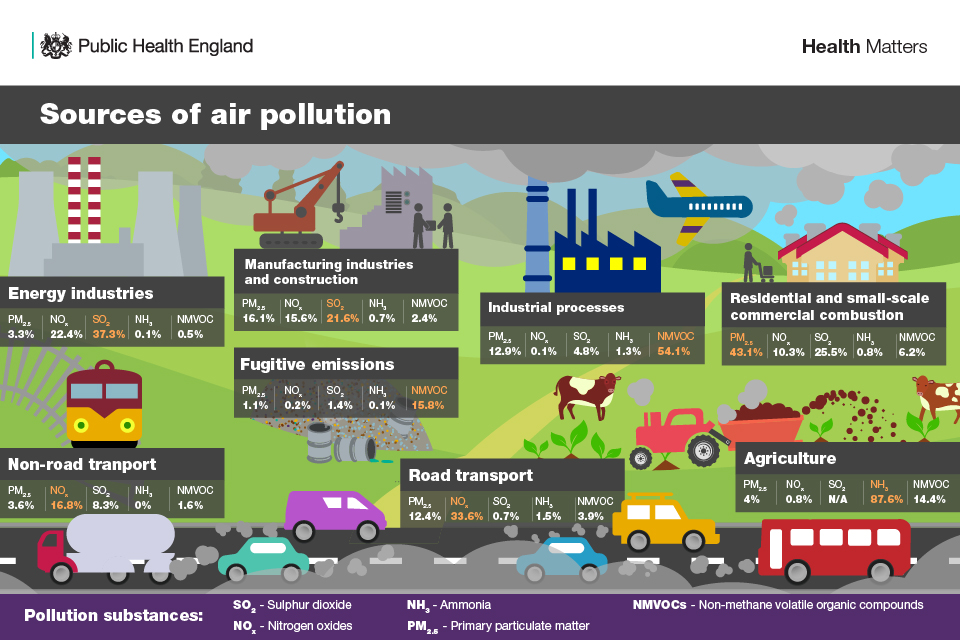
You may wish to read this study - https://www.gov.uk/government/publications/health-matters-air-pollution/health-matters-air-pollution. It has this graphic. I'm really not sure this has any convincing evidence that Mayor Khan is really dealing with the matter.


I'm all for better air quality for everyone, but surely this should be aimed at the biggest pollutors and should be done in such a way that specific sectors have proper support to transition to low pollution solutions. Generally people who have older diesel vehicles are not particularly well off and need the vehicles for work. I'd like to see such people either be given a lot more financial help to change to low pollution vehicles, or given exemptions from the rules for a period.