Music, football, Dyslexia, Cancer and all things London Borough of Barnet. Please note we have a two comments per person per blog rule.
Monday, 3 March 2025
Environment Monday - Is net zero dead?
Monday, 27 January 2025
Environment Monday - Why are British governments so addicted to mega schemes when there is so much that could be done quickly and cheaply
Monday, 1 July 2024
Environment Monday - Rishi Sunak is so scared of Reform that he won't even boast about his green successes
Saturday was an absolutely monumental day in the industrial history of the UK. In any other circumstances, the Prime Minister would be shouting about it from the rooftops, but our Prime Minister is so scared of the Reform vote and 'appearing Woke' that there are only a few mentions of this from rail enthusiasts. What am I talking about? This...
28th June 2024 and the final coal train to Ratcliffe PS(last coal train in the UK)headed by 66781(now named Ratcliffe Power Station)pulls out of Toton Yard and heads for its destination in the background @GBRailfreight @railcamlive @FreightmasterUK @Freightonrail @Clinnick1 @RAIL pic.twitter.com/He0OSs8kH3
— Darren Wetherall (@MrDeltic15) June 29, 2024
That's right. The last ever coal train has run in the UK. When Ratcliffe Power Station burns it all, the power station will shut and that will be the end of coal fired power generation in the UK. This has been a long standing policy of the UK governments, both Tory and Labour and Sunak has achieved it just before the election. If it was the Greens that Sunak felt were the threat, this would be front page news, but as he's more scared of Reform, it's been buried.
I've seen all manner of rather daft comments saying we should have maintained coal fired power stations for days when the sun isn't shining and the wind isn't blowing. The thing is that coal fired electricity is not an on demand source. You have to keep the furnaces hot at all times. For sporadic demand, gas stations are far more sensible. They can be sparked up at a second's notice. You can check where our energy is coming from in realtime today by clicking here www.energydashboard.co.uk/live
What does concern me is that nearly a quarter of our energy is imported. It doesn't say how it's generated or how green it is. If any of this is coal driven, I personally would prefer it to be UK coal from UK mines. I do not believe the UK should be dependent on imported energy, which we clearly are. If all of this was from green sources on long term contracts, I would be less bothered, but as the purple export line is fairly solid, I suspect that it is either nuclear, gas or coal. We need an energy plan that ensures we generate this in the UK and that we generate it sustainably. That is the secret to not having massive energy bills.
It is clear to me that Rishi Sunak is scared to death of his own shadow. Since 2010, the Tories have actually had a few sensible ideas and good initiatives, but they seem to have rowed back from all of them. When the last fourteen years are picked over, things such as this and the equal marriage act of 2014 will be looked back on as successful implementations of sensible policy. It will also be noted that Rishi Sunak made a name for himself peddling furiously right, only for the right to turn around and eat him. I do wonder whether if Reform win, whether the train in the tweet at the top may not actually turn out to be the last coal train in the UK.
Monday, 18 December 2023
Environment Monday - The case for investment to beat the climate crisis
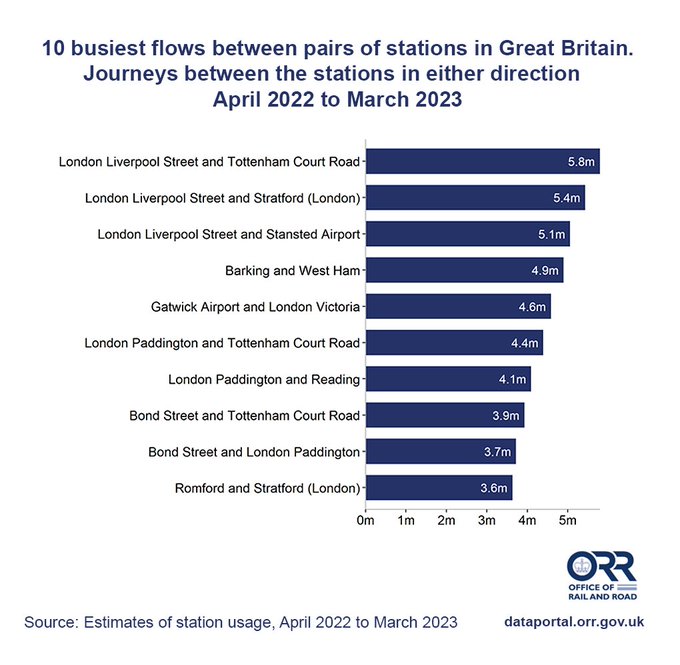
Two tweets really caught my eye this week. The first was the top ten rail stations in the UK by passenger numbers in 2022 and the second was this years figures, which see a marked change due to the opening of The Elizabeth line.
Tomorrow we'll reveal our estimates of station usage stats, showing the busiest #railway stations in Britain from April 2022 to March 2023.
— ORR (@railandroad) December 13, 2023
Share your predictions by replying below 👇
To join our Q&A tomorrow, use #AskRailStats
View last year’s data ➡️ https://t.co/XiKfeQAiEg pic.twitter.com/VhDNcO63vq
It's all change for the top 10 stations in Great Britain!
— ORR (@railandroad) December 14, 2023
Elizabeth line opening sees London Liverpool Street with most entries and exits for April 2022 to March 2023.
Paddington is 2nd and Waterloo is down to 3rd.
Got a question? #AskRailStats
➡️ https://t.co/iTSGlVG6BY pic.twitter.com/itIMrEmgfK
I was astounded to see some of the figures. A station I use all of the time, Farringdon, now has more passengers passing through it than Euston or Kings Cross. In fact, five of the top ten are now Elizabeth line Stations. It is also worth considering that Farringdon, London Bridge and St Pancras are on the Thameslink lines. The Elizabeth line and Thameslink have seen massive, multi billion investments. These figures show that investment pays off. Even more telling are the figures for the busiest passenger flows
Again, many of these aree brand new flows, created by The Elizabeth line. The Elizabeth line was a massive and very expensive project, which many queried the value of. These figures vindicate the project. The line uses electric trains, which are the most sustainable form of travel. The millions of passengers using this, not travelling in cars etc are the way forward.
I've used the Elizabeth line a few times since it opened. I don't often have need to go to East or West London, but when I do, it is an amazing addition. I use Thameslink most weeks, and the interchange with the Elizabeth line at Farringdon is one I have regularly made use of.
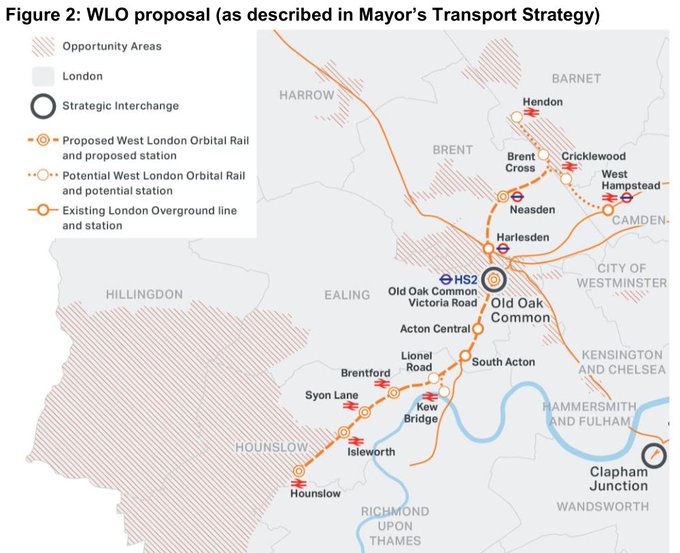
When we talk about climate change and the environment, we always talk about problems. There is not enough time and money spent developing solutions. Transport is a major contributor to CO2, so it is clear that we need better solutions and we need to invest. In the London Borough of Barnet we saw Brent Cross West station open earlier this month. For this to really justify it's investment, we need the West London Orbital Railway to open ASAP. Unlike the Elizabeth Line, all of this railway already exists. It simply needs upgrading to fascilitate regular passenger trains.
A whole swathe of West London will see massive improvements in public transport, which should mean less journeys and pollution on the North Circular. The existing rail line is a lightly used freight line, which has Victorian age signalling. I'd also like to see the line upgraded for freight, much of which moves in the early hours of the morning, removing Lorry journeys and even more pollution.
The bottom line on all of this, is that we need to spend money. London is a City that deserves world class public transport. There is no central, joined up plan to strategically improve London's transport. There are just big one off schemes, that always seem to be delivered 20 years late. The purpose of having a London Mayor was to sort this out, but sadly this simply hasn't happened. Most of London's railways were built in the Victorian era, many for freight rather than passengers. What we need to do is to work out where passengers need to travel between and build lines that go there or stations that serve them. In our Borough, we have a huge national museum at Hendon, which is next to the Thameslink line. There is no station. We have Saracen's Rugby stadium, that sees huge crowds every fortnight. It is next to an abandoned tube line to Mill Hill East, on the Northern Line that could easily be reinstated. Perhaps the strangest of all these planning cock ups, is that Brent Cross now has two stations and neither properly serves the shopping centre. Luton Airport recently had a new link from the station to the terminal, such a link between the shopping centre and the two stations seems to me to be a no brainer, but no one has even suggested it.
It would be funny if it wasn't so tragic.
Monday, 2 October 2023
Environment Monday - Time for the Borough of Barnet to take going green seriously
Did you know that the London Borough of Barnet is the most populous London Borough? Did you know that Mill Hill Broadway bus station had the worst recorded air quality of anywhere in London? Siting a bus station, where children wait every day for buses, under the M1, in a dip in the road, where buses belch out diesel fumes is a recipe for serious health issues. The Mayor of London's solution to air pollution is the ULEZ, but TFL still has a diesel bus fleet. Last year, in May, Barnet switched from a Conservative administration to a Labour one. One of the first things they did was to declare a climate emergency. I waited with bated breath for a raft of sensible plans to address the issue. Barnet put together a website https://engage.barnet.gov.uk/net-zero and put together a Barnet Citizens Climate assembly - You can see the deck here https://docs.google.com/presentation/d/1zWQGmzTmnVWcYLkh6UNCtDudGD-8_wDpbX0r8w2i7Qo/edit#slide=id.g2287152a3fb_1_0 - from the sessions in March.
As an engineer, I always look for practical solutions. Before you can fix anything, you need to understand the problem. So lets start with a look at how Barnet and its citizens assembly might actually address the climate emergency.
1. Buildings. Barnet has many old buildings that are not energy efficient. Often, the residents are on low incomes and with the cost of electricity and gas, this is adding to their poverty. Barnet should be taking action to ensure that everyone on low incomes has the most energy efficient home possible. Grants should be made available to ensure that work is undertaken. This will not only be good for the environment, but it will make a practical improvement to household budgets. As for new builds, I would like to see every new build to be as energy efficient as possible, with solar panels, heat pumps etc. Barnet should insist on a minimum energy standard for all new properties. Barnet owned properties should also have solar panels and batteries. I've been urging this for a decade. Buildings such as libraries are ideal for solar panels.
2. Roadside pollution. One of the worst causes of lung damage are particulates. Many of Barnets roads have grass verges. Simple changes such as planting certain shrubs that have sticky leaves such as cotoneasta franchetii have been proven to lower pollution by up to 20% (Read what the RHS has to say) It is beyond my comprehension as to why Barnet are not doing this.
3. Public Transportation. When you look at Barnets transport links, we have some wonderful routes into Central London. I cannot fault the Thameslink service (when it works and is not on strike). The Northern line is also pretty good. But to my mind, it is crazy that the last new railway station in the Borough was built in the 1920's. We will soon see a new one open at Brent Cross, but given the problems we are having, what we really need are new lines. Croydon, that has less people, has tramlink. It is high time that Barnet had a similar network. Getting from East to West in Barnet is difficult and time consuming and for many people, journeys to important sites in the Borough such as Barnet Hospital and Brent Cross are only practical by car. One thing that I simply cannot understand is why the Northern Line is not being extended to Copthall, where Saracens are based. There is a disused railway line that could terminate at the stadium, which is also an important college site now. That would make journeys to Barnet far easier for residents of Mill Hill. I'd like to see a tram network linking Brent Cross, Edgware, Mill Hill, Barnet and Finchley. Some of this could exploit disused rail lines and some would, like the Croydon system, run on roads. I'm not an expert, but electric trams, running to fast and reliable timetables would massively cut the number of car journeys in London. As a Manchester City FC fan, I've seen first hand the benefit of such a system in Manchester. These systems are not cheap, but they make a huge difference and the investment gets payback for decades, if not centuries.
4. Cycling and walking. Cycling on many of Barnets roads is a nightmare. I'd like to see far more dedicated cycle paths and better schemes to encourage cycling to schools. You only have to see the traffic around schools to know we are getting it wrong. I would like to see proximity to a school being the primary selection criteria for local schools and parents urged to sign up to cycle to school schemes. Schools should have safe and secure bike parking. Schools should be given financial incentives and penalties to encourage cycling and walking. I also believe that actions should be taken to have cycle provision on all major traffic lights. That will make cycling far safer.
5. 15 minute cities. For some reason the alt right get hot under the collar about this. The concept is that you have everything you need within a 15 minute walk or bike ride. Technically, I'd say I already live in one. My house on Millway is 15 minutes from my work, doctor, shops, pharmacy and there are schools as well. The only real issue is that the nearest hospital is in Barnet. It is 1 hour 27 minutes walk and at least 40 minutes by bus. Hubs like hospitals really do need proper public transport links. I like the idea of 15 minute cities and having local ameneties should be part of the planning process. Barnet needs to make a proper commitment to this in its planning criteria.
Monday, 22 May 2023
The housing crisis, the planning system, the environment and the NIMBY enablers - Environment Monday
Over the weekend, I fell foul on Twitter of the YIMBY movement (something I'd not heard of previously), who have decided, rather amusingly that I'm a NIMBY and that I was a little flower who could be crushed by brute force! Given that I've got the M1 and the Midland Mainline railway in my back yard, I'd say that the charge of NIMBYism is not an easy one to make stick (for a sane, rational person).
Am I NIMBY or a YIMBY?
— Roger Tichborne/Rog T (@Barneteye) May 22, 2023
Well in my back yard I’ve got the M1 Motorway and the Thameslink Mainline railway. This is what it sounds like. The #OrientExpress was passing pic.twitter.com/4HvqBDAWzI
It soon became clear to me that the leader of the YIMBY pile in was not really a YIMBY, more a IAARAHDYDWM ("I am always right, how dare you disagree with me" character). I am rather grateful to him, as he inspired me to put together a blog I've been pondering for a while on the subject of planning. I end with why such people are in fact a hindrance to the more reasonable people who may agree with them.
So where to start.
15 minute cities.
I like Mill Hill for several reasons, but the biggest is the excellent public transport links. I can get a Thameslink train to central London and be there in 18 minutes, and pick up an Elizabeth line train there to Heathrow. I can also get a direct train to Luton airport and Gatwick is an easy change away, as is the seaside at Brighton. I can take a 384 bus to the nearest hospital in Barnet (and Hadley FC who I support), I can take a 114/251/302 bus to Burnt Oak if I need the Northern Line. There are ample shops, cafe's and restaurants at the bottom of the road, parks and open spaces where I can walk my dog. There's even a fantastic music rehearsal and recording studio within walking distance, where I work and where I can indulge my hobbies. In short, I live in a 15 minute neighbourhood and love it. The only time I've driven my car in the last week is to deliver a PA system for a gig I was doing sound for.
To my mind, any new city based developments should deliver exactly what I mentioned above. If stuff is on the doorstep and there are good transport links, it means less cars and less pollution.
There is a caveat though. It's not enough to just be near all of those services. They need to be fit for purpose. The Hospitals must not be overloaded to breaking point, the Bus and train services should not be so busy that they are unusable. Shops need to provide goods at reasonable prices, not the premium price that many local convenience stores seem to charge. There needs to be ample open spaces and good air quality. Where these issues are not addressed, putting people in huge tower blocks is, to my mind inhuman.
The Housing Crisis.
Which brings us on to the housing crisis. Lets start with the beneficiaries.The only people who are really happy are people who have a house and see the price rising, often by thousands of pounds a month and may be seeking to downsize. Many voters in this position are staunch Conservatives and for them, the system works (until their children want to join them on the property ladder, when many find that the equity in their property is soon gobbled up). But I firmly believe that the huge profits many Conservative voters are making are a root cause of the inaction of the Government in resolving the crisis. Anything that cools the housing market, will make a big dent in the value of their core voters property assets. If you want to understand why anything is a mess, follow the money.
The way the UK build houses is a complete mess. Social housing waiting lists are so long that they are simply not an option for many. My parents, who were not badly off, lived in council housing from 1946-1960, when they were in a position to buy, My brother was given a council house in Burnt Oak when he married and had a child in 1972. Today, anyone in their position would have no chance at all.
My daughter is a teaching assistant, a key worker, who worked during the pandemic. She is in expensive private rented accomodation and for her, the only chance of owning her own home is if I fall under a bus. Her generation has been failed. She has a bedroom in a shared house. In the last decade, we've seen huge numbers of flats built in the Borough of Barnet, but none of these has impacted the availability of council housing for young families. Estate agent windows are full of what are called "Luxury" flats. In my opinion, Luxury simply means 'overpriced' and none of the building locally has addressed the issues of housing poverty in Barnet. We have imported a lot of rather well to do people from other parts of the country, but for the young, working population of Barnet, we've done nothing.
Of course, we've seen a huge influx of refugee's in the last few years, drawn to the UK by wars and we have to address their needs. I have no problem at all with the concept that the people with most genuine need go to the front of the queue. I am not always sure that the assessment of what is genuine need is correct, and can be very subjective, but we need a huge number of new homes in the UK and we need them as soon as possible. But we cannot simply build properties without the infrastructure around them that delivers a decent living environment. Which brings us to.....
The Planning System.
The bottom line with all of this is that the whole planning system is dysfunctional. It is broken. It does not do what it is supposed to do, which is ensure that there is ample housing, a decent environment and it is affordable. In London, local councils have responsibility for planning, but can in various circumstances be overridden by the planning inspectorate, the Mayor and the Secretary of State. The council has no control over transport, which is run by TFL and healthcare, which is run by the NHS and the government. So when a large scale development is planned, it is almost impossible for a council to ensure that the infrastructure needed to support it is delivered.
I've had dealings with the system in Barnet. Back in 2000, I needed more space for my family. I had a choice, I could move or put an extra room in my loft. I chose the latter. It is wholly appropriate for local councils to adjudicate in such cases. The approval process was quite time consuming and a relatively minor change had two iterations before approval. It made me realise the frustration of many. I had no local objections and my plans impacted no one, but I was still refused initially.
Small changes, such as extensions, loft conversions, etc deliver extra living space in a time when there is pressure on housing, should be given a fair wind, unless there is an adverse impact on the locality. As it is, there are many arcane rules, drawn up in a different era. They are not fit for purpose today.
As for larger changes. When we are talking schemes that deliver hundreds, if not thousands of homes, such as the proposed scheme for Edgware, having a process where the local council manages the process does not work. Developers know that in the event of a rejection, the Mayor will probably approve on nod. All that happens is a year is added to the process and local concerns are ridden roughshod over. In Edgware, 5,000 new residents will add a large number of passengers to the Northern Line. It will add a new strain on already overcrowded A&E units at Edgware Hospital and Northwick Park. If it was the only development in Barnet, this might be manageable, but there are several huge schemes, including Brent Cross and Colindale. Barnet has seen approximately 50,000 new residents since 2011, with almost no improvements in transport infrastructure or hospital provision.
A local planning system that is designed to deal with new sheds and a few houses being built on fields, is simply not fit for purpose when it is faced with the challenge of a site like Brent Cross, where there will be a new station, a new shopping centre and 29,000 new homes. Such sites should be holistically looked at as part of a London wide solution to the housing crisis. The Edgware development is on the border of the Borough with Harrow. Again, there will be iomplications for the Northern Line as well as Northwick Park A&E which is in Harrow.
Any scheme that has cross borough and cross London impacts on healthcare, transport, school provision, the natural enviroment etc, needs a planning authority that is fit for purpose and one which can influence all of these. Although the Mayor of London may not be overly popular in Barnet right now, his office should assume responsibility for such large schemes. The government should be able to frame the rules in such a way that there is still accountability, but developments are properly planned. The system we have delivers huge profits for developers and huge hassle for affected residents. We need a system that redresses the balance, so that it is the local community that sees the benefits as well as the big developers. London needs new transport infrastructure, more hospital provision, fairer allocation of places in schools and utility networks such as water, sewers, electricty and gas networks that can cope. This needs to be designed in at the planning stage and if developers are making huge profits, some of this should be ploughed back into the schemes. Section 106 money seems simply to act as a sop to councils, rather than delivering much of use. In hard times, it helps the council coffers.
One other aspect that, as a nation, we should be addressing is regional inequality. Although it may not be fashionable in some circles to say it, the huge numbers of migrants that are driving the housing crisis in the UK do offer us scope to address this. Any policy that seeks to provide housing for refugees, should also try and ensure that the areas where they are housed are ones which have labour shortages and where an influx of people would benefit the local community. I really do not like the idea of simply building huge tower blocks as storage facilities for refugees until we figure out what to do with them. I'd rather see people living where there is an oppportunity for them to work and contribute to the economy.
I am not against huge towers and skyscrapers. They have a place in solving the problem. As with any scheme, we should ensure that they are the most appropriate solution. In the case of the Edgware development, for me the problem is not high buildings. The problem is that the number of people would completetely overload the local infrastructure. In 2018, my wife broke her shoulder and had to wait 8 hours for treatment at Barnet General. She was in agony. Anything that makes such things worse, is to me dangerous. The situation has got worse, not better. The Conservative government needs to accept it has failed the NHS and do something.
I have no expectation that the Conservatives have the appetite for this. Hopefully, when Keir Starmer takes over, this will be top of his in tray.
The Environment.
As far as I am concerned, the biggest challenge in fixing the housing crisis, is to not devastate the local environment as we do it. There is a huge movement to concrete over the green belt. I can see the attraction for developers. For them, this is an easy win. Most of those who propose this, have no interest in the natural environment, biodiversity and the plants, fish and animals affected. If there were genuinely not other solutions, then this would be something to possibly consider. However, in London we have approx 700,000 empty properties. On top of that, property developers have been banking land for years, to force up prices and enhance their profits. After the war, the then Labour government recognised the competing pressures and the Atlee govt took appropriate action such as the New Towns Act 1946 & the Town & Country Planning Act 1947. The results were not perfect, but they delivered new homes and protected the natural environment. A balance was achieved. What we need is a proper national audit of land, with a view to identifying brown field sites and areas of minimal impact. We need action where land has been banked. I believe that if those developers who have sat on land were faced with financial losses, then we'd see the crisis resolved far more quickly, without tearing up our green spaces.
The NIMBY enablers.
What I've seen over the last few days was quite shocking. Local residents alarmed by aspects of the Edgware redevelopment scheme have started a petition to get aspects of the scheme changed.
I've just signed this petition. Will you add your name and share too?
— Roger Tichborne/Rog T (@Barneteye) May 19, 2023
https://t.co/l27xE0WXpa via @38degrees
The petition does not call for the abandonment of the scheme, it calls for a scaling back. I don't think even the most optimistic of signatories will expect there suggestions to be fully implemented. I signed as I agree with the general idea that a scheme on this scale simply cannot be supported by the local infrastructure. I am also more than familiar with how developers operate. They come up with schemes that sound superficially appealing. They put the benefits to the local residents at the end of the development. These usually cost most and deliver the least profits. They then claim that they are "no longer economical" and things have changed. They are quietly dropped. This happened with the proposed doctors surgery in MillBrook Park. The petition notes that the shops, cinema, etc are scheduled to be delivered in the latter part of the scheme. To me, this does not pass the sniff test.
No one is saying leave the site as it is. The backers of the petition just want to ensure that the scheme is properly thought through and does not cause issues where none existed before, or even worse, make existing problems impossible. Until 1998, the Borough of Barnet had two A&E departments. One in Barnet and one in Edgware. One of the first acts of the Blair Government was to rubber stamp the closure of Edgware. Since that day, Barnet General and Northwick Park have seen a massive increase in waiting times. When people start bandying around the term NIMBY at people who have sat for hours on end in A&E departments, all they do is make people more determined to stand their ground. For me, what was shocking, was that a member of the Polar and Limehouse Labour party started questioning my knowledge of Barnet, calling me names, insinuating that I was in the pay of the Campaign for Rural England or some other body. I've been writing a blog for fifteen years and that is the first time I've ever had such a charge levelled. I genuinely think that no one in Barnet, even my arch nemesis Brian Coleman ever suggested that!
Are you local? Are you aware of the cheems mindset? Do you understand the concept of the chicken and the egg? Are you a NIMBY? Are you a member of the CPRE? Who funds you? pic.twitter.com/AfbnlLBLa3
— Chris 🥑🌹 (@yimbychris) May 20, 2023
This particular individual is a classic example of a bully. I'm used to it and I can give as good as I get, but such people use such behaviour as their modus oiperandi, hoping that people will be scared by such abuse and shut up. In fact, all they do is get blocked and make those that they call names operate out of their sight. The people they label NIMBY's don't go away, they just don't share their plans with such obnoxious people. Ultimately this makes the campaigns more effective. Twitter is by and large an echo chamber. You are followed by people who agree with you. When your world collides with a world you don't like you block. You are no longer party to what they are doing and what arguments they've raised.
I daresay I am now on all sorts of rather inaccurate lists, labelling me as "The Enemy". Why? Because I want the schemes that these self labelled "YIMBY"'s are keen on, to deliver decent housing, a good living environment, good transport and good services for the residents. There is no harm at all in having an intelligent debate, raising potential issues. My brother worked on the construction of the Grahame Park Estate in the 1970's. This won awards at the time. Much of it has been demolished since, as the accomodation was sub standard. It took decades to get a decent bus service to Mill Hill station, something that should have been part of the scheme from day one. Grahame Park was a scheme built by the GLC and is an example of what happens when you don't listen to communities and you go for shiny scheme's that are not well thought through.
There is an old maxim in business that your most difficult customers are your biggest friends. They tell you the truth. That is the only way you up your game. Those who seek to stifle debate, call names and intimidate are in fact their own worst enemies. I'm well known in Barnet and when people saw that tweet, even those that don't like me would have realised it was ridiculous. Who did that help?
I've spent decades arguing with local Tories. All of the sensible ones, over the years, from Ex Mayor Hugh Rayner to current Mill Hill Councillors Elliot Simberg and Laithe Jajeh privately and candidly discuss local matter with me. They don't always agree, but they appreciate sensible feedback. The leader of Labour's Barnet administration, another sensible councillor Barry Rawlings spoke to me shortly after Labour took the council last year and asked me to continue to scrutinise them, as it makes for better decision making. By shouting at people with your fingers in your ear, you learn nothing and achive nothing. You end up enabling those you seek to stifle. You may think you are clever and when you get blocked, that you've won a victory. You've done nothing of the sort. You've just confirmed other people's prejudices and prevented a sensible dialogue.
It seems a shame that the chair of Poplar and Limehouse Labour does not take the same sensible approach as his colleagues in Barnet (some of who privately told me they know him and none too impressed). All I can say is that I am glad I am not a member of group with such a chair.
Monday, 10 April 2023
Water privatisation has failed the UK - Our rivers are full of $h1t!
When the Conservatives privatised water back in the 1980's, the argument was that this was necessary to generate the investment needed to bring the quality of the network up to a suitable standard for the 21st century. Various governments, both Tory and Labour had cut investment and it was true that the UK's water system was in a dilapidated state. The argument was that private companies access to capital and innovation would lead to a rapid upgrade of our water supplies and sewage networks.
Here we are, nearly 40 years later and the system is in a worse state than ever. In 2022 there were more than 300,000 sewage spills into UK rivers and coastal areas. The argument that the water companies use is that this happens when there is exceptionally heavy rainfall. It cannot possibly be argued that if it is happening 300,000 times a year, it is due to upredictable or unusually heavy rain. The way this is prevented is well known. It also happens to be expensive. The sewage runs off because there is a lack of storage capacity for it. As soon as there is any heavy rain, plants are inundated and the sluice gates are opened. To prevent this, water companies need to invest serious money in sewage storage systems, that can hold the sewage, until it can be treated. This is a huge amount of sewage to be temporarily stored and the investment needed is massive. Companies make far more money, simply pumping the sewage into the natural water environment.
There are also many issues with home owners doing bodged work that direct sewage into waterways, to cut the cost of proper drainage being installed. The water companies are meant to police this, but again are failing.
In both cases, the remedy is simple. The answer is to properly regulate and fine companies that are failing to protect waterways and habitats. Privatisation has produced huge cash generating monoliths that do not serve the UK or its population and are failing to meet their mission on every measurable goal. I suspect that one of the reasons that these companies are not properly regulated is because they would no longer generate the cash for their shareholders if they were. Rather like private rail companies, when they are forced to do the job properly, they don't make the cash and hand back the keys.
The UK need to decide whether our interests are best served by lining the pockets of shareholders or by having a clean, safe natural environment. I know which one I would want.
Tuesday, 14 March 2023
Happy to swim in raw sewage - Matthew Offord MP replies to our concerns about water quality in local streams
On the 9th January 2023, I sent an open letter to Matthew Offord MP, concerning water quality, following highly worrying reports in the media about water quality in Barnet.
I am pleased to report that Dr Offord has finally responded. Here is his repsonse. I really suggest you read it. It is, perhaps, the most interesting reply I've ever had from an MP (click on the image for a more readable version).
So lets see what he has to say for himself. Dr Offord swims in the Thames, sails on the Welsh Harp and Scuba dives off the South Coast. The problems with dumping of sewage are a passion of his. Dr Offord admits that one outlet is discharging into the Welsh Harp a nature reserve, where he sails. When Dr Offord says that he has a passion for dealing with the problems, I can only conclude that his idea of being passionate and mine are rather different. My version of passion is to get up and put every ounce of energy I have into what I am passionate about, until the deed is done and done properly. I suspect that Dr Offords idea of being passionate is to lie in bed thinking about it, vigorously. I do respect the fact that at one stage he voted against the government, but he acquisced and voted to allow the disgusting practice to continue.
Some things should be immediately changed, or at the very least as quickly as possible. A situation where swimmers, divers and sailors are put at risk, simply because they want to indulge in healthy outdoor pursuits is completely unacceptable.
The net result of Mr Offord and his Conservative colleagues voting for the government measure is that he will be swimming, diving and sailing sewage for the next fifteen years, he may be happy with that, but I am not.
Mr Offord is one of 292 Tory MP's who think that is OK.
Last night, 292 Conservative MPs voted to allow sewage dumping by water companies in our rivers and coasts for at least 15 more years.
— Liberal Democrats (@LibDems) January 26, 2023
Can you spot your MP on the list? pic.twitter.com/VXXafEGXjZ
Here is my original email to Dr Offord.
Dear Dr Offord
I am writing to you to ask your views on the high level of sewage in local waterways and what action you will be taking to address this. Like yourself, I am a dog lover and a dog owner and I have become increasingly concerned about the levels of sewage, bacteria and other contaminents in the local waterways. There have been several reports of dogs becoming ill following exposure to water contamination in local streams. A local stream in the Borough of Barnet was featured on the BBC News last week. I have seen first hand sewage contamination in folly brook in Mill Hill and there have also been concerns about discharges into the Silk Stream and other streams feeding into the Welsh Harp. Many of these pass through areas where both dogs and children exercise.
My personal view is that the way to resolve this is to have far steeper penalties for water companies discharging sewage into local waterways, which act as a punitive deterrent. There should also be strong powers to deal with misconnections. Home owners employing cowboy building firms deliberately misconnecting to save costs should be liable for punitive fines to facilitate the costs of cleanup as a deterrent. I would personally like to see a clean water bill brought forward, with households given a six month amnesty to resolve issues and then heavy fines. I would recommend that a proper inspectorate of water quality are set up, who have enforcement powers and statuatory targets to deliver. The current system simply isn't working.
I would be interested to know your views on this matter
Regards
Roger Tichborne
Tuesday, 31 January 2023
How can we be building the Edmonton incinerator whilst imposing a ULEZ zone
There has been an ongoing campaign against the proposed new Edmonton waste incinerator for several years now. The incinerator is being commissioned by the North West London Waste Authority. It seems to me to be absurd that we can be even considering an incinerator in an urban area, given the known harm that pollution causes to our lungs. The Mayor of London recognises this with his imposition of the ULEZ zone, but for some reason seems strangely reticent to support the campaign against the incinertaor. In May, GLA member Emma Best asked Khan about his support for the campaign. The Mayors response was lukewarm to say the least. It seems that Mayor Khan is happy for the incinerator to be built and for the govt to take the blame.
Latest Edmonton (new) incinerator plume plot, 15:50 31/01/23 #HaleEnd #WoodfordGreen #Woodford https://t.co/ue2w4O0AUu pic.twitter.com/3FKp3BzuDz
— Plume Plotter (@plumeplotter) January 31, 2023
The rights and wrongs of this scheme are quite clear. We should not be building incinerators in urban areas. London needs a strategy to remove the amount of packaging that we produce. Sadly one of the biggest side effects of shift to online shopping is a massive increase in packaging. When we buy stuff from shops, most of us now take our own bags. When stuff comes via delivery services, we see huge amounts of cardboard and plastic added to the packaging. Much of this will end up being burned or buried. Barnet Council had a successful food recycling scheme, but this was ended to save money. It cannot be right that it is cheaper to burn such waste rather than composting it.
🎥 Our interview with Rembrandt Koppelaar from XR Zero Waste about new technological alternatives to building waste incinerator plants.
— Real Media (@RealMediaGB) January 16, 2022
@DeliaMatiss@georgiaes@StopTheRebuild@EndBlackBags@nlicts
#StopEdmontonIncinerator#BlackLivesMatter #StopTheBurn pic.twitter.com/1DbNguCo08
London needs a strategy to massively reduce packaging and to have proper recycling. With this, incinerators and landdfill would no longer be needed. Mayor Khan has invested huge political capital in the ULEZ, but he seems to have a blind spot on waste. My preferred resolution would be to make retailers liable for disposal of non recyclable waste that their businesses generate. It used to be that you'd get a few pennies back from the sweet shop for glass bottles. I'd like to see that brought back, with legal penalties for non compliance, for all packaging. Supermarkets would soon cut back, if they had to deal with the rubbish they generate.
Such a scheme needs leadership. Sadly, Sadiq Khan doesn't really seem interested in this.
And if you are wondering why all the noisy Tories moaning about the ULEZ haven't pointed this out, look no furtherMRW
— Simone Lamb (@prorubbish1) January 26, 2023
Gove refuses to block incinerator project
Challenge to North London Waste Authority's Edmonton EfW plant fails as Local Government Association to undertake peer review
Gove refuses to block incinerator project
Mark Smulian
#News https://t.co/vcrPv47Lbp
Monday, 16 January 2023
How the government and the Mayor are discrediting environmental measures with greedy, moneygrabbing policies
I've spent all of my adult life campaigning for green issues and trying my hardest to argue the case for sustainability, clean energy and sensible environmental measures. Over the last 25 years, I believe I've been proven right by science and by events. You may think that I'd be celebrating but the truth is that I believe that the Government and The Mayor of London are seriously undermining support for sensible environmental measures by seemingly using eco friendly measures as a way to drum up cash. I've always believed that energy efficiency, good public transport and sensible long term policies are the way forward. What do we have? We have 'green taxes', ULEZ and Congestion charges, scrapping of feed in tariffs that incentivise solar energy, Low Traffic Neighbourhood schemes that alienate local residentsand cavalier and pompous statements that alienate all but the staunchest eoc warriors.
Lets look at a few issues.
1. CO2 emissions. To combate these, we need a global effort, centrered on new technologies and new ways of doing things. If the UK had passed stringent laws on insulation and set a target of ensuring every home, factory and business was properly insulated, when we had the first COP summit, we'd have lower energy bills now and would be insulated from the effects global incidents such as the Ukraine war. We have long needed a coherent policy to renewable power sources. Instead, we have had to reopen coal fired power stations this year. Carbon levies are giving the concept of environmentalism a bad name in some quarters. It seems that it is all cash generating sticks, with no carrots at all.
2. Car emissions. The big schemes in London to deal with car emissions are the ULEZ zone and LTN's (although LTNS have other benefits for residents). For many small businesses, the ULEZ zone will have a massive negative financial impact, with it's implementation coming at a time when many businesses are just starting to recover from the pandemic. Musicians, who need vans to transport equipment and are not flush with money are especially hard hit. The Mayor simply hasn't listened. There has been no reasonable trade in scheme to encourage small businesses to move away from Diesel. It is worth remembering that in the first few years of the century, the government were encouraging people to buy diesel vehicles. Clearly we shouldn't have highly polluting vehicles belching out fumes as kids leave school, but many suspect that the ULEZ and the congestion charge are more about money making than really cleaning up London's air. The main cause of pollution on London's streets is congestion, with cars, vans and lorries stuck in traffic, stopping and starting, belching out fumes. LTN's do nothing to address this. Some residents have to do long detours, just to get home. The best way to reduce this is better, cheaper and more reliable public transport. London's transport prices are ridiculously high and the network is ever more unreliable. Last night (Sunday), I went to a gig at The 100 club. It finished at 11am, but the last Westbound train on the Elizabeth line from Tottenham Court Road was 10.47pm. That is no way to run a transport system in a 24 hour global city.
3. LTN's. In theory, I'd support these, but whenthey cause congestion and long detours, it cannot be argued that they are sensible. They have simply united many residents against them, which makes the case harder to argue. My view is that consultations with residents should be legally binding and subject to local referendums. If locals vote for a scheme there can be no arguments if the scheme is passed.
4. Reopening of closed rail lines. In the 1960's the UK took the axe to it's rail network. All manner of lines that would provide decent public transport were chopped. In the Borough of Barnet, a link between the two branches of the Northern Line, which would provide an interchange with Thameslink at Mill Hill was closed. Had this been retained and developed, Journeys from east to west across the borough on public transport would be far easier, quicker and cheaper. In places like Croydon, Manchester and Sheffield, efficient Tram networks have been installed, many on disused and lightly usesd rail lines. Trams are powered by electricity and have dedicated track beds, so are far quicker and greener than buses. People generally take the form of transport that is most convenient. If the Old Mill Hill East to Edgware line was converted to form the core of a NW London tram network, extending from Edgware to Finsbury Park along the old track bed and sharing track with The Northern Line between FInchley Central and East Finchley, this would give NW London a step change and remove many cars from crowded roads around the A1, Bunns Lane etc. When we hear arguments about costs, we should think in terms of decades, if not centuries, to recover costs. The Thameslink line in Mill Hill was opened in 1867. If the costs were annualised over 50 years, they'd be miniscule. I'd personally like to see the line reopened using hydrogen powered tram technology, with trams running on roads for the built over sections. As a business owner, I recognise the benefits of borrowing for investments, which produce a return. Such schemes generate economic activity, lower pollution and improve the quality of life of all concerned. It is a win/win.
Monday, 12 December 2022
West London Wildlife book launch - Sat 10th Dec 2022 at Books on the Rise, Richmond
The launch event was at the rather wonderful Books on the Rise bookshop, well worth a visit. I bagged myself a copy of the recently published Patrick MacGoohan biography, which was an added bonus.
If you are in Richmond, check out @BooksontheRise where you can purchase a copy of West London Wildlife, an amazing book about some of London’s most interesting wildlife habitats published by @AuroraMetro pic.twitter.com/dbh35aM3iD
— Roger Tichborne/Rog T (@Barneteye) December 12, 2022
There were two panels consisting of four and then three of the authors. The event was sold out which was most heartening.
Thanks to everyone who joined us today for the launch of West London Wildlife! We were thrilled to be joined by an amazing panel, from nature writers to conservationists🌳🌊🦇 @WWTLondon @FRPTweets @Ethnobotanica @Barneteye @FriendsRivCrane @ThamesEstPart @_BCT_ @WWTLondon pic.twitter.com/7UFBONQTKe
— Aurora Metro Books (@AuroraMetro) December 10, 2022
Lisa Woodward is the General Manager for London Wetland Centre, looking after the visitors and wildlife, ably supported by an incredible team and over 200 volunteers. Lisa’s background is in charity and visitor attractions, having worked for iconic names such as Kew Gardens and Battersea Dogs & Cats Home. Her expertise is in commercial operations, but wildlife has a special place in her heart, and running London Wetland Centre is her dream job.
Wanda Bodnar is a marine geospatial data scientist. She currently works at the Thames Estuary Partnership where she applies spatial data in the context of aquatic habitat conservation, restoration and climate resilience within the Greater Thames Estuary. She also leads stand up paddleboarding (SUP) sessions at a Kew based paddleboarding club called Active360 on the upper Thames Estuary.
Philip Briggs has lived in the borough of Richmond-upon-Thames all his life and developed a love of wildlife from an early age. He has volunteered at the WWT London Wetland Centre since 1998, leading wildlife walks and assisting with wildlife monitoring, particularly bats. Since 2003 he has worked for the Bat Conservation Trust where he manages the National Bat Monitoring Programme, a long-running citizen science project.
Panel 2
Susanne Masters is a botanist specializing in edible plants and their trade around the world. She works with distilleries on ingredient selection and sourcing. Susanne has run workshops and spoken about plants in beverages for organisations including the Boutique Bar Show, Royal Horticultural Society, and Chelsea Physic Garden, Author of Wild Waters and contributor to Kew's Teas, Tonics, and Tipples', she has written features for publications including the New York Times, Guardian. Her academic research on wild species in trade is listed on https://orcid.org
Ian Alexander has been in love with nature all his life, having at various times been fascinated by lichens, birdwatching, fossils, and dragonflies. He enjoys practical conservation work, gardening, and photographing nature. He lives in Chiswick, blogs about nature, and volunteers at his local nature reserve, Gunnersbury Triangle.
Roger Tichborne - Me.
The first panel discussion was fascinating. Such events, with experts are always worth a listen. I learned of the problems of wet wipes in the environment and how they are devastatating wetland habitats. On one spot on the river Thames, there is a 1 metre deep build up. Both Lisa and Wanda were keen for us all to simply stop using them and use a more sustainable form of wipe instead. Gary contributed a fascinating passage about the River Crane, which I'd not even heard of previously. He explained how the space had been opened up and the dumped fridges removed. Phillip spoke about his work with bats. I was interested in this, as I once had a job making bat detectors for Queen Mary's College global bat survey in 1982.
I was on the second panel. Susanne gave an interesting talk, explaining how she'd discovered how you could make money writing about subjects you are interested in. Something that had't previously occurred to her. Ian spoke about his work and his previous book. I finished up. Given that everyone was an expert of sorts, whereas I was a blogger with an interest in a local nature reserve, I spoke more about how blogging and social media can be used to bring campaigns together, something I am far more an expert in. I made sure to credit Samuel Levy , who did much of the heavy lifting for my section of the book.
I also got to chat after to a couple of the photographers who contributed, including the rather wonderful Amanda Boardman. There are some wonderful pictures in the book.
Lovely to meet the contributors to the West London Wildlife book, I am thrilled that 3 of my photos are included 😀@WWTLondon @AuroraMetro @Ethnobotanica @Barneteye @FRPTweets @FriendsRivCrane @ThamesEstPart @_BCT_ @BooksontheRise #photography #photographylovers #richmondpark pic.twitter.com/OluDvDrZBt
— Amanda Boardman (@Mandsby) December 10, 2022
The habitats covered in the book include Richmond Park, Ruislip Woods, a Bushy Park, London Wetland Centre, Kew Gardens, Gunnersbury Triangle, Crane Park, Chiswick House and of course Darlands. I realised that these are areas of London that deserve some proper exploration and I will be covering them in my London Symphonies series at some point over the coming year, exploring the area and giving my own take on them. When you think about London you think of buildings and people, but as Wanda pointed out, the River Thames is the largest open space in London.
When Allen Ashley was in the False Dots, we recorded a song about The River Thames called "Be The River", but the event and the book made me realise that there is far more to the river. If you are interested in our environment, I'd strongly recommend buying the book, for three reasons (CLICK HERE TO BUY THE BOOK)
1. It's a damn fine book, with some very interesting content.
2. The photo's are beautiful
3. We should support independent publishers such as Aurora Metro.
For me personally, it was interesting writing for the book. When I blog, it is very much a stream of consciousness. For the book, I had to do the job properly, do my research, correct my grammar and spelling (thanks to my Daughter Lizzie who proof read it) and write with discipline, which is something I am not normally inclined to do, but if people have faith in me, I try and do things properly. I thank Aurora Metro for asking me. It was an honour and a privildge.
This blog runs a series called Environment Monday, where we highlight environmental issues. Contributing a chapter, attending the event and speaking to the panel has only reinforced why we must keep these issues in the public eye. And please chip in a donation for Darlands Lake conservation.
darlandsconservationtrust.org.uk/darlander.html#signup
Monday, 18 July 2022
Environment Monday - Should the UK stick to its net carbon zero target
![]() |
| We need carbon neutral, clean developments |
Did you see the Conservative Leadership debate last night, where the candidates were asked whether they would stick to their net carbon zero target. You would think that being asked this the day before the UK had it's hottest day on record may have lead to a degree of caution. Strangely it seemed to inspire them to even more stupid responses. Apparently we can afford tax cuts, but we can't afford to try and save the planet. There was a time when Conservatives were supposed to be sensible and cautious. That seems to be a thing of history. The problem with the UK is that if a costly policy can be postponed it will be, if there is the slightest politcally expedient reason to do it.
The truth is, one which the gutless fools refused to acknowledge, is that the reason our energy costs are going through the roof is because the UK has chosen to have no long term plan for energy security. If we'd started to decarbonise in an orderly fashion 40 years ago, when it was clear that there was a problem, we'd not be in the position we find ourselves in. If we'd changed planning laws to make new homes energy efficient and well insulated, with solar panels, then we wouldn't be sitting in our homes boiling. If we'd had a sensible strategy to move away from petrol and diesel cars, we'd have less exposure to hikes in oil prices. If we'd moved new homes to heat pump technology, we'd not be caught up in the mess of spiralling oil prices.
What Truss, Sunak, Moradaunt and the other two forgot to say is that all of this will only get worse. By dropping our targets, we are exposing ourselves to the ever wilder fluctuations in prices. For a nation to be truly independent, we simply cannot afford to be at the long term whim of other nations. We should not only be investing in new green technologies, we should have a plan that means we know where our supplies will come from and what the costs will be. The country needs massive investment in energy storage, so the excess electricity produced by solar arrays today can be used when the sun isn't shining. We should be looking at hydrogen cell technology, which produces clean energy.
The problem we have is that the schemes we have introduced are ones which penalise people who are least able to afford it. I installed solar panels when there were incentives to do so. I could do this as I am reasonably well off. Now I am paying nothing for my electricity when the sun shines. With the ever rising cost of electricity, I am doing OK out of this deal. If the government made it a planning condition that all new homes were well insulated and had solar panels, then those in new social housing would get some benefits. As it is it is only those who could afford to who have benefitted.
What was shocking to me was that none of the candidates had anything positive to say about any sort of energy security plan, let alone a green one. The way to secure familes futures against spiralling enrgy costs is to ensure our supplies are reliable and the costs are fixed long term.
Sadly we all know that there will climate change commentators claiming that there has always been hot weather. How many temperature records do we have to break before they admit there may be a problem. You can be sure that ion January when it is -5, they will say "Look there is no such thing as climate change". It will not be temperature records that ultimately force us to grasp the nettle. It will be the fact we need a reliable energy supply at a predictable cost, to allow businesses to plan. You'd think that Conservatives would get that?
Monday, 6 June 2022
Environment Monday - Event this Sunday at Mill Hill East Church - Guest blog by Dr Anna Hands
By Dr Anna Hands,
Below is some info about a screening in Mill Hill of 'Legacy' - The best event I went to when I attended COP26 last year was an exclusive screening of 'Legacy' by Yann Arthus-Bertrand (feat. Sting) about the relationship between humanity and nature through history.An exciting opportunity has arisen for a Portfolio Lead (Sustainability) to join our growing Sustainability Team. This newly established role will be responsible for building on, expanding and amplifying the work already taking place across the Council to deliver against our ambitious Net Zero commitments (as a Council by 2030 and as a place no later than 2042). You will be responsible for developing an aspirational and rigorous strategy and associated Climate Engagement Plan, engaging with residents, partners and communities, to establish Sustainability at the heart of everything we do.
About you
You will be an enthusiastic individual who is keen to drive change through our ambitious programme of delivery. As such you will have significant experience of managing complex multi-disciplinary teams within a local government context at a management level and excellent knowledge of best practice in programme management (a good understanding of Climate Change will be desirable).
As a driver for change you will have strong communication skills and be able to influence at all levels of the organisation and its partners. You will be responsible for developing and managing a team to support the organisation in delivering it commitments to becoming Net Zero. You will be comfortable collaborating across the organisation and have strong leadership skills; with a proven experience of getting things done!
Monday, 18 April 2022
Environment Monday - Mill Hill's Parks and Green Spaces are under threat
Barnet Council have recently posted a licencing application
(https://admin.barnet.gov.uk/sites/default/files/Licencingapplication04042022.pdf) on some lamp posts near and in Mill Hill Park.
The application states:
![]() |
| Sign in Mill Hill Park |
“A new application seeking to allow: For all the activities below the hours are as follows; Monday – Sunday 10:00 -20:00 Plays Both Indoors and outdoors) Films Both Indoors and outdoors) Live music ( Both Indoors and outdoors ) Recorded music (Both Indoors and outdoors) Performances of dance Both Indoors and outdoors) Anything of a similar description to that falling within (e), (f) or (g) Anything of a similar description to that falling within (e), (f) or (g) “This application is to ensure that the park is correctly licenced for any future ad-hoc events ”
This application has very serious implications for residents like you who live near Mill Hill Park. At present if anyone wishes to run an event in the park, they must apply for a temporary events licence. Only a maximum of 15 events per year with a capacity of 499 – including staff – can be currently run at the park.
If this licence is approved events can run all year at the park and a premises licence allows a maximum capacity of 4999. Imagine the parking chaos and noise!
We are hearing that the fun fair at Brent Cross is looking for a new venue. Mill Hill Park could be that venue under this licence.
We must stop this from happening. It is vital that YOU put in a representation email to Barnet Council licencing to oppose this, but time is running short. You have until May 2nd – before the elections – to submit a representation at licensingadmin@barnet.gov.uk
Barnet Council state the following:
• Representations must relate to one of more of the four licensing objectives, the prevention of crime and disorder, public safety, the prevention of public nuisance and the protection of children from harm.
Copthall Green Space under threat.
As if this wasn't bad enough, they are also planning to turn Copthall playing fields into a huge music venue this summer, with 10,000 people attending a large festival on green belt fields. The proposed license for the festival will have music until 10pm and will see thousands of revelllers descending on Mill Hill's train station when the music finishes. It will take at least two hours for such a crowd to disperse. The festival organisers are moving to Barnet after huge problems at it's previous home in Enfield, leading to Enfield Council banning the festival. Read this report in the Enfield press.
All of this is happening because the local Conservative Council have messed up the finances and are desperate to rent out the parks to bring in some cash to the empty coffers.
The Mill Hill Lib Dem team is committed to opposing these threats to our green spaces. We are available to discuss any issues you think should be dealt with. Please contact us by email at millhill@barnetlibdems.org.uk
Please help us to protect Mill Hill's green spaces by giving us your support in the forthcoming local election in Mill Hill Ward. You can follow our campaign on our digital newsletter site here