Showing posts with label Network Rail. Show all posts

Monday, 24 June 2024

In Cricklewood to pay homage to the UK's last great engineering design masterpiece

 I was mulling over the day my life changed forever at the weekend. I don't recall the day. I was four years old and it was just after Easter in 1967. It was the day I started at St Vincents Primary School and it was the day my education started. What was I taught? Well back then, we believed that the UK was the best country in the world. We had the best bands, the Beatles and the Rolling Stones. We had the best Underground system. The big buzz then was about the Victoria Line, which was opening the following year. In Mill Hill, there was a lot of excitement and disruption as the M1 was being constructed. Huge concrete laying machines slowly made their way from Watford to Fiveways corner. The UK had it''s own Space program, with the Black Arrow and Blue Streak rockets. We were working with the French to develop Concorde, the supersonic airliner that would 'change the way we fly'.

Then there was our railways. These propelled the UK to lead the industrial revolution. Having the Midland Mainline Railway at the bottom of my garden, I witnessed the replacement of 'old fashioned' steam engines with more modern diesel ones. My Dad, being an engineer, was not at all sentimental and considered steam engines to be slow, old rustbuckets and loved the shiny new diesel ones. Dad ran a crash repair business called MacMetals and was a proper petrol head. Every time a fancy new motor, such as an E Type Jag, Aston Martin DB6 etc came in, he'd take me for a spin in it up to Watford, ingnoring all speed limits and often hurtling past police cars. I don't condone such behaviour, but it was real fun!

Within ten years, by the time I was ready to leave school, it had all gone wrong for Britain! Blue Streak and Black Arrow were cancelled. The Motor industry was mired in disputes and almost bankrupt. My Dad's high hopes that the M1 and other motorways would make the UK a pleasure to drive around disappeared and they all became car parks. Concorde only changed travel for a very rich few on a few select routes. It felt like the country was falling apart and that we'd given up. Britains railways summed up the malaise. The Japanese had high speed rail for nearly 20 years, on specially built lines. Here British Rail was struggling to keep the network running, with clapped out engines and Victorian infrastructure. Back then, British Rail did more than just 'run trains'. They ran ferries under the Sealink brand, they made their own sandwiches and had their own brand of Cafe called Travellers Fayre. Unlike modern station franchises, they were cheap and cheerful. They also designed and built their own trains under the British Rail Engineering label. This division was stuffed with some of Britains finest engineers. Starved of funds in the 1970's, they were tasked with modernising the Inter City network with no money. They had two solutions to try and bring us up to speed. The first was the strategic solution, known as the Advanced Passenger Train. It used the latest technology, tilting carriages, that meant trains could travel at high speed on existing tracks, it ran on electrified railways. The other was a stop gap. Originally called The High Speed Train (HST), it was a diesel engine, that used more conventional technology, but was leading edge. It was styled to look modern and it offered a quick route to faster journeys. As most of the network was not electrified, it was introduced on long distance mainline services, which were not electrified. Originally these were the East Coast Main Line between King Cross and Edinburgh and The Great Western Line between London and Bristol and Cardiff. The new trains knocked an hour off the time of a journey between Kings Cross and Edinburgh, with a maximum speed of 125 MPH.

A huge advertising campaign, rather unfortunately with Jimmy Savile at it's helm. The service was branded as Inter City 125 and was a great success. The modern styling and the shorter journey times were proved popular. British Rail sold the design to the Australians, who even had their own version. British Rail had plans to electrify the Intercity Network over the next 25 years, which was the expected life of the these new trains. By 1989, the East Coast line had been electrified and the trains were moved to the shorter Midland Mainline between London, Derby, Nottingham and Sheffield. Sadly, due to lack of investment, initially, they were limited to a maximum of 100mph on this route, although sections were upgraded for faster running over the years.

These workhorses ruled the roost on the line until lockdown. For a long time, it looked like their days would be numbered as the government planned to electrify the line. Work was started and reached Kettering and Corby, before austerity derailed it. The then Minister of Transport decided that it wasn't value for money. This gave the HST's another lease of life, but eventually time caught up with them. The final scheduled service ran on 16th May 2021. The Barnet Eye was lucky enough to be invited to Cricklewood, by Robin Morel, the local Network Rail manager. We recorded this for posterity. It seemed like the days of the HST were numbered, apart from a few destined for museums.

However you can't keep a good design down. Some bright sparks came up with the idea of buying a few of the units to run charters. Others were procured to run services in Scotland, delivering quicker journeys to parts of the network that were in dire need of better services. Recently some have been exported to places such as Mexico and Nigeria. What was seen as a 'stop gap' is still stopping gaps in places that the BREL designers of the 1970's never dreamed of. I find such things fascinating. 

A couple of weeks ago, Robin told me that an HST unit would be back at Cricklewood Rail Depot for a visit. It was running a charter on Saturday from St Pancras to Skegness and so would be being refuelled and stabled overnight in Cricklewood carriage sidings. Robin invited me down for a nose around, whilst it was being refuelled. As I have a bit of a fascination for industrial sites, it was an opportunity not to be missed. Seeing one of these amazing trains at close had was also a pleasure. It also gave me the chance to find out about other planned improvements on the Thameslink line. I asked about the West London Orbital Scheme (still in planning phase), the new freight superhub at Radlett (the line is being closed for nine days at Xmas to build a bridge for the new freight line) and the slowly progressing electrification in the north (new trains arriving soon for testing). 

Since my last visit, the new station at Brent Cross West had been built. Robin seemed amused that the new station has twice the number of trains, for almost no passengers currently than Cricklewood, which is packed to bursting in the morning rush hour. 

We all donned Hi Vis jackets and had a good old look at the things you never normally see. 


Anyway, here are my pictures from the visit

This is the visitor. Painted in what I find to be a rather odd colour scheme, that looks as if it's been photoshopped into black and white!

It is great to see these grand old ladies of the British Rail network looking all nice and shiny with fresh paint. 


Here is a more close up view from the front. As I mentioned above, I am not sure of the colours. It reminds me, and this will date me, of the old Airfix kits. Robin explained that this particular version of the HST has proper buffers. This means it can be used for other duties, such as delivering other trains etc, which apparently is a nice little sideline for Rail Adventures, who own them.
Another view of the train. In the distance you can see the crew that came down with the train. They started their journey in Butterley in Derbyshire. There is a heritage rail centre, where the coaches are kept when not working trips. 
There are inspection points at the depot, to allow cleaners, etc access to the trains. 
A nice view inside the cab.I wonder how many millions of miles has been observed from this view.


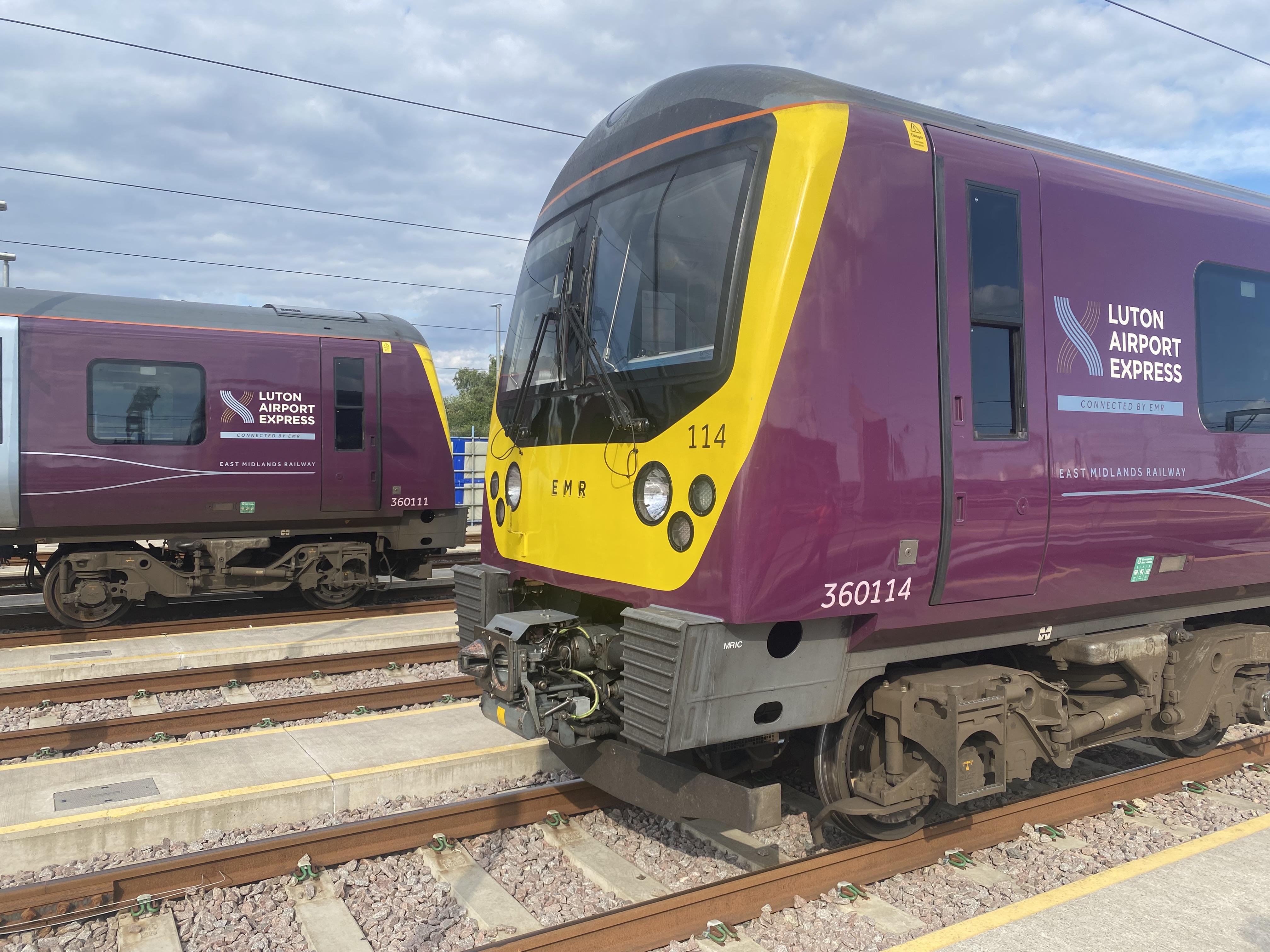
We also had a looka round the rest of the facility. The Luton Express service in the background is a broken down unit that is waiting a part from Germany. When this arrives, it has to be dragged to another depot, where they actually have ramps etc and a lift, to repair it. There are no such facilities in Cricklewood anymore. 


"Fill her up Jacko!". Robin Morel of Network Rail explains the refulling process for the diesel locomotives etc at the depot.


After my previous visit, I wrote a tune for The False Dots about some of my experiences on our railways over the years and with some commentary on how it's all gone a bit Pete Tong with privatisation. I used some of my footage from my previous visit, as well as other clips I've taken over the years.


Thursday, 12 September 2019

Why Thameslink's new trains can't cope with a power outage

Like many people in Mill Hill, I regularly use the the Thameslink service. Like many, I was massively impacted by the power supply problems on 9th August.  My wife even had to be evacuated from a train north of Kentish Town and walked along the railway lines. I am endebted to Robin Morel of Network Rail for sharing the report.  nationalgrideso.com/document/15235


Older trains were unaffected - Pic Copy Barneteye
The reason for the problem is that a 'Safety feature' of the new Thameslink 700 class trains means that if the power supply drops below 49Hz, the train will do a protective closedown. The drivers can do a manual reboot that takes ten minutes, but for 30 of the trains this didn't work, so technicians had to be sent out with a Laptop to restart the trains.

The section on planned mitigations is fascinating. It seems that Siemens, who manufacture the trains are now working on software to allow the train to restart itself automatically when the power returns to 49Hz. None of the older trains on the network were affected. One has to ask how they could not have considered that a power outage might occur and that needing an engineer with a laptop to access the train was not an acceptable or safe solution.

I am not an expert, but this is not only dangerous, but shows an almost criminal level of negligence in design by Siemens. Just suppose that my wife had been in a wheel chair or suffered from claustrophobia, as the power and air conditioning had shut down. Luckily her train was not too far from the station, but had it been in the middle of the mile long Belsize new tunnel, then that would have been terrifying.

Electric trains should be resilient and a driver should be trained to restart them. We need to know how long these changes will take to be implemented. We also need a robust recovery plan for such issues from GTR and Network Rail, in the event of such problems. Engineers need to live in the real world. It is all very well designing massively complicated trains, but if they are not resilient and predictable problems, that clearly can easily be resolved, cause the whole network to pack up, then it is clear that the whole design process is flawed. When the emergency cutoff was designed, someone should have said "what would happen if this train was packed and in a tunnel?".

Since the new class 700 trains were introduced, we've had air conditioning problems, ironing board seats and now we find out that if there is momentary power blip, half of them pack up completely. To me this is a sign of a very badly managed railway. Siemens should compensate commuters for the aggravation their bad design has caused. Maybe this would focus their minds when they come to designing their next generation of trains. The thing that irritates me beyond belief is that these issues always end up in a blame game. Obvious problems are excused as the contractors all start blaming each other, the government and the regulator. British Rail had its faults, but at least we all knew where the buck stopped.

Here is the full report.

Appendix F – Govia Thameslink Railway (GTR) technical report 
This Appendix contains the independent technical report provided to the ESO by GTR into the impact of the frequency disturbance on their trains on 09 August as part of the detailed investigation into the incident. Title Power Surge Disruption on 9th August 2019: Technical Review.

Date 3rd September 2019

Event Summary

1. From information supplied by the National Grid at 1653 on Friday the 9th of August the frequency of the OLE AC voltage supply dropped below 49Hz for 16 seconds. It dropped below 48.89Hz to a minimum of 48.8 Hz for milliseconds.
2. There was no identified OLE AC Voltage supply interruption.
3. All Desiro City class 700 and 717 units operating on AC Voltage suffered a Protective Shutdown where the converter, known as the 4QC (4 Quadrant Controller) shut down. None of the other AC trains in the GTR fleet suffered any power related issues from this event e.g. Class 387, Class 365, Class 313.
4. In Passenger Service this involved circa 60 units, consisting of Class 700 FLU/RLUs and Class 717, suffering a 4QC lock out.
5. The effect of the 4QC shutting down on the train is that the train switches to battery power which causes a loss of HVAC (fan only fresh air supply), stand by reduced lighting (emergency lighting is activated when battery voltage drops), no at seat power, no PIS displays (audio only from the cab), and no traction power. The GSM-R radio remains active.
6. Following failed attempts to repower the trains, the established first response for a train failing with these symptoms is for the Driver to perform a reboot of the train known as a Battery Reset. This takes approximately 10 minutes.
7. Fleet Control diagnosed the issue quickly and a global GSM-R call was broadcast to instruct drivers to carry out the Battery Reset process.
8. After this 27 of the affected units were recovered.
9. The remaining circa 30 units required the Protective Shutdown to be unlocked by the intervention of a Technician with a laptop attending each unit.
10. There were 17 Technicians available at the time of the event. These 17 were immediately sent to stranded units with laptops and a further 24 technicians were mobilized within the next hour. The trains affected were widely spread geographically and some were not easily accessible.
11.Therefore, this process took some time and resulted in 23 train evacuations and severe levels of service disruption.

Cause

1. The Desiro City from Siemens Mobility is the latest generation software enabled commuter train, so requiring protection against power supply frequency excursions for safety reasons and to protect low power electronics.
2. Siemens Technical Specification for the train states that the train will continue to operate with supply frequency drops down to 48.5Hz for short periods of time.
3. The NR Electrification System Compatibility document, NR/GN/ELP/27010(“Guidance for compatibility between electric trains and electrification systems”), a Manufacturing and Supply Agreement compliance requirement, identifies that the supply frequency can fall to 48.5Hz in extreme conditions.
4. A review of the Class 700 NoBo design submission (Siemens document A6Z00036309602 item 4.2.8.2.2) shows that compliance with both NR/GN/ELP 27010 and EN 50163 (“Railway Applications – Supply Voltages of Traction Systems”) would be demonstrated.
5. Following investigations, Siemens advised that the supply frequency response of the train was designed to comply with the EN 50163 Clause 4.2 Note 2. This note permits train drives to disconnected at 49Hz. Use of this supply frequency value in the train design led to the train protectively shutting down its drives when the supply frequency response fell below 49Hz.
6. Importantly Siemens have also clarified that there should not have been a Permanent Lockout on the train following a protective shutdown caused by a supply voltage frequency drop. All trains should have been recoverable via Battery Reset whereas 30 trains were not recoverable. This was not the intended behaviour of the train.
7. Therefore, the affected Class 700 and 717 sets did not react according to their design intent in these circumstances. The risk of this happening was not known prior to the power event on Friday 9 August.
8. Separately as a part of the new TCMS (Train Control Management System) software version 3.27, the ability for the driver to recover from a Permanent Lockout by using the Battery Reset process was removed.
9. On the 9th of August all the units which required a Technician to recover power were at software level 3.27 or above. The 28 units recovered by the driver performing a Battery Reset were at the previous TCMS software level of 3.25 or below.

Conclusion

1. All the Class 700 and Class 717 trains operating on AC suffered a Protective Shutdown of the 4QC controller because of a drop in the supply frequency below 49Hz for 16 seconds.
2. This was not how the train system had been specified to operate. This event should not have caused a Permanent Lockout fault on the trains.
3. The effects of this were exacerbated as the fleet was undergoing a software change, contained in this was a change in functionality removing the Battery Reset remedy for Permanent Lockout events. 4. This meant that the driver could not recover failed trains which were operating on the new software, instead a Technician was required to attend.

Planned Mitigation

1. Siemens are developing a software patch to allow units which protectively shutdown below 49Hz supply frequency to recover themselves without the need of a reboot or laptop when the frequency rises above 49.5Hz.
2. It is not proposed by Siemens or GTR to revert units to previous software versions as there are concerns this could severely impact unit availability. Based on discussions with the National Grid Head of Networks, the risk of frequency excursion dropping below 49Hz before the patch is fully introduced are considered extremely unlikely.
3. In addition to this Siemens will investigate how the train could be made to operate for a short time with supply frequency falling to 48.5Hz.