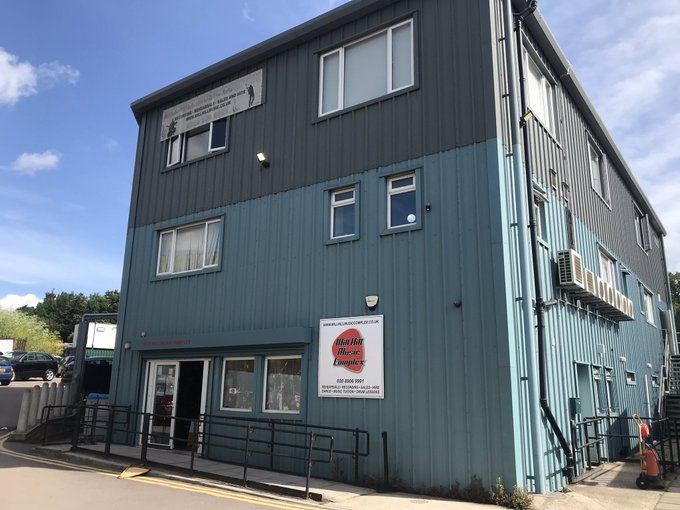
I've been running my studios now for 43 years. In that time, I've had a lot of ups and downs. We are now London's oldest independent music rehearsal studios, to the best of my knowledge., if anyone else has been doing it longer, please let me know and I'll big you up, as I know how hard it really is.
I've never seen other studios as competition. I see them as a sign that the industry is healthy and I see their innovations as a challenge for us to improve. Why have we survived when so many have fallen by the wayside? Well one answer is that I started the business when I was 16, all of the other studio owners were older at the time, so most have retired. Another reason is luck, my family own the freehold of the site and support me. Many sucessful studios have been on leases, which the owners have cashed in for development and thrown out the studios.
Perhaps the biggest reason is that I've put together a team that has managed the business and the finances properly. I've always believed that with the right team around them, the village idiot could run a successful business, so long as they listened to the team. Sadly, we get a lot of village idiots pontificating on how to run businesses, who don't have teams and don't listen to anyone. Such people simply don't understand what you need to do to run a business. So here are a few tips.
1. If there are no customers, there is no business. There is a huge difference between having a great idea and transforming it into a business. For small businesses, you need to be sure that you actually have a market. When I started the studios, I didn't understand this principle. We didn't open as a business, we opened as a collective, to provide rehearsal space for our own music. We soon became inundated with other bands, who had nowhere to rehearse. Initially, we didn't advertise and have only advertised since when we needed to grow, such as when we opened our new studio block in 2012. Make sure that there is a core business that is on your doorstep.
2.The best advertising is free advertising. There is not a week goes by without half a dozen people contacting me to offer services advertising our business. These range from local guides, internet SEO marketers, leafletting services and trade publications. Currently the only paid advertising we have is in the local post office. We've done all of the above, but we do it when we need it, not when we are offered a great deal. We have a 'business development budget' and we try and think creatively. If we have £5,000 to spend, what will bring most business in? Some new equipment? An advert? Toilet refurbishment? Artwork on the walls? During lockdown, we employed a local artist to paint some murals on our studio walls. These have been a hit. Our customers are doing our advertising for us for free! Here's an example.
We'd suggest that anyone considering advertising in an on line guide or other such service do your homework. Check out their Twitter, Instagram and Facebook feeds. We know of one such service that sells advertising, but also uses their business Twitter feed to propogate anti semitism, Islamaphobia and anti vax conspiracy theories. Do you really want to be associated with such things? We've found such on line services to be very uneconomical. Advertising in local churches, shuls, mosques, school fete's programmes is a far more cost effective way of doing local advertising and you help good causes.
Our most important form of advertising is free. It's word of mouth from satisfied customers, so keep them happy. If you are on a high st, make sure you've got good signage and your shop front is attractive. That will bring more people in than just about anything else.
3. Only borrow money when you have to, and only on investment to increase your turnover. I'm lucky, I come from a family steeped in running small businesses. I was raised learning how to read a spreadsheet and how to understand a profit and loss account. My chosen business is a very investment intensive operation. We probably have around £150,000 worth of equipment and the new studio complex cost over a million pounds to put up. Much as I'd love to have that as spare cash in my pocket, I haven't. What I did have was a rock solid business case and a proven customer base. When you borrow large sums, you end up with a charge on the business, so you have to be certain that the cash will increase the business. There have recently been some nasty comments from a local twitter troll about a local business that has "charges on their business". The troll had clearly spent hours searching for mud to fling, from the companies house website.
This betrays a complete lack of understanding of how business works. The company being attacked is a limited liability company, therefore the charge is on the assetts of the company. Generally large cash loans are taken as charges on individual directors assets for small businesses.
When a company supplies expensive equipment on finance, it is quite normal to put a charge on the company. It means that if there is an issue, the supplier or finance company can get their equipment or money back. We took a charge on our company when we borrowed money to erect the new building. We did this in the knowledge that the building is worth far more than the charge and it has easily generated enough to repay the mortgage and generate a profit. My businesses now have no charges on them.
I would never normally borrow money to subsidise poor cash flow in a failing business to stay afloat. By all means attract investors, who bring cash and expertise, but simply going into debt to prop up a failing business is suicidal. Of course the lockdown blew a lot of these rules out of the water and many took "bounce back loans" to stay afloat. We were lucky enough to have cash to ride out the crisis, but may well have broken my own rule, as it was an extreme situation.
4. Follow your competitors on social media and see what they are up to. I follow as many studios and other music businesses on social media as I possibly can. I like to see what they are doing. Sometimes, it is as simple as they buy a new amp or mixing desk and think it's great and we can check it out. Sometimes they have great innovations. During lockdown, we saw a few in distress and we offered advice to our competitors on getting government support. You may think "Why does he want to help the opposition? What is the benefit?". The truth is that we have more customers than we can service in good times and if there is not a healthy supply of studios this will damage the London music scene. It also means that we have goodwill and friends if we ever need them. This was exemplified when Survival Studios in Acton closed. They gave us over £10,000 worth of equipment for free, as they would have had to pay to dispose of it and didn't want to pay for storage. We offered to pay and they simply said "you can have it for free". If people think you are OK, they will do such things. A follow on social media is the best way to start a dialog.
5. Make sure you are properly insured. This is a basic. Our studio was burgled twice in the 1980's. Without proper insurance, we'd have died. After the first burglary, we learned a bitter lesson. We got a payout that got us back on our feet, but it was nowhere near what we needed. The second time, we got an independent loss adjuster, who ensured that we got what we were entitled to. Even with his fee, we got a much better deal. As the insurance company knew they were dealing with a professional who understood the industry, we were not screwed as we had been. He pointed out all manner of basics, such as that we could claim for loss of earnings and a new door and a repair to the alarm system. Make sure you are clear what you are paying for.
6. Listen to your customers. The best feedback you can possibly get is from your customers. If someone complains, they are not being awkward, they are doing you a favour, telling you what 20 other people who just don't come back didn't tell you. One rather dodgy local advertising company has conducted a war against a former customer of theirs for over 2 years in Mill Hill, which happens to be a well loved restaurant. Rather than simply return the money for a badly performed service, they've continually bad mouthed the business. As a result, no sane business would not touch their services as they know if there is a dispute they will get a public vendetta. Sadly the individual who runs this advertising company is to dim to realise that the only thing he's damaged is his own business. Take it on the chin and learn.
7. Take early settlement discounts from suppliers. We buy and sell musical instruments. Some of our suppliers offer discounts for early settlement. This is usually between 2-5%. Not all do. Whilst £2 - £5 on a £100 bill may not seem a huge amount, if you spend £100,000 a year that's £2-5,000. We have a rule that if a company gives an early settlement discount, we take it. If they don't we pay within the date, but not as quickly.
8. Understand your business costs. When you set your prices, you need to factor everything in and pass this on to your customers. Note every single expense. Add this up and then add up your total sales. Work out how much you are making, then review the items you are selling, be it services or items. When we started planning our new studio block, our initial plan was to have a couple of large, presitigious studios. I then did some number crunching and found that the smaller the space and the cheaper, the more money we made from it. We ended up putting seven studios in the space we'd originally planned to put two. We may not get the big touring bands we orignally hoped to attracted, but we have dozens of customers and the space is getting ever more popular.
9. Be prepared to work hard. Between 1979 and 2017, for most of the time I had two or three jobs, to keep the business afloat. I worked as a freelance IT consultant for much of the time, as well as doing some building work and property development. This allowed me to have nice holidays, invest in the studio and build financial resilience. At many points, I tried to step back from the non studio business interests. With the IT work, I simply kept getting offers I couldn't refuse and I have a great team at the studio who do most of the work, so I only needed to nip in for an hour or two every few days. In 2017, I finally stood back, so we could take our studio up to the next level, something that needed me full time. We had a plan for a new studio block and finance in place. Sadly the pandemic scuppered this. The good thing was that the hard work I'd put in had given us a cushon. There is a business in our estate that has just opened. They do car crash repairs. In the evening, the owner is a Pizza Delivery driver. This keeps the family cash going and he gets cheap pizzas for the family. If you want to put your feet up and be lazy, don't start a business. Always have a plan B.
10. Build a great team and keep them happy. Almost byy default, I have built a great team. Many small business owners do not appreciate good staff until they leave, when it is too late. It is also worth saying that bad staff can destroy your business, so be very careful who you employ.
11. Build resilience into your business. One of my last IT jobs was on a large resilience project for Lloyds Bank's payments team. I had overall responsibility for technical delivery of the project. I was involved in the banks resilienbce committee. It was a real eye opener. It taught me many things that were applicable to small businesses, but that many owners simply don't think of. The expertise served me very well during lockdown. For our new development, we'd seriously looked at building new income streams. Some of these were vital as we bounced back. A good example was hosting Rock School Exams. We'd become a venue in 2018, as we looked to build our presence in the music education market. When the strictest conditions of lockdown were lifted, we could host exams, that gave us some vital cash flow when we most needed it. The question should always be "Is there any way we can diversify our business and generate cash from areas we've not considered or find savings and economies which we've missed. It is also worth making a plan of all of the vital things you need to keep your business running. Ask questions like "How do we manage if we lose my phones/Internet/Electricity/Gas/card payments", "How will local road closures etc affect us", "what do I do if we lose key staff", "what do we do if we lose our key customer or customers" and "Are we ready for another lockdown?".
Business resilience means having plans in place or developing alternative ways of doing things. For many of these things, there is little you can do in the short term, but if you regularly review what you do, there are options. The guys who provide our solar panels told me that many large organisations are supplying work from home staff withsolar panels and battery back up systems, so key staff can work at home if there are power cuts. These are the type of creative solutions that we can all think about. It may be that the solar panels and batteries would save you money as well.
In our business, we have mailing lists, social media and a website that we have extensively used to communicate with customers when we have problems, such as road closures. This doesn't solve the problems, but it does mitigate it.