Showing posts with label Thameslink. Show all posts

Monday, 28 September 2026

Labour Nationalises Thameslink and cuts services to Mill Hill Broadway

There are times in my life when I wonder why I bother? Last week, our Labour MP David Pinto-Duschinsky posted this on Facebook "I’ve just met with Govia Thameslink (GTR) at Mill Hill Broadway Station to raise constituents’ concerns about the timetable changes they are bringing in. The new timetable will see the frequency of off peak trains reduced. GTR say it will improve service reliability but I’m not happy with the changes, nor with the fact the residents were not consulted before they were made. I pushed them pretty hard in the meeting. It’s not clear I can get them amended, but I’ll continue to push for residents’ voices to be listened to" 

I have taken a keen interest in the running of Thameslink for most of my adult life. I commuted on the line every day for 37 years. When I started, they were still running a diesel service. That became the BedPan line. Then Thameslink opened up and trains started running south of the river. John Major privatised the railways, which proved to be a disaster. Under British Rail, Mill Hill had eight trains an hour at peak times. A succession of private operators never achieved this. Labour quite rightly pointed to the shambolic way many private operators run the railway, and came up with a cunning scheme to renationalise the network. GTR, the company that ran the service was recently taken back into public ownership. I had assumed that this would see more investment and better services as profits which were going to private shareholders were reinvested back into the network. It seems that I was wrong. The new owners, answerable to the Labour government, have taken no time to start cost cutting, trimming services. 

This is absolutely ridiculous. London needs better, not worse public transport. Thameslink should operate a regular, frequent service that passengers can rely on. The claim that cutting services increases reliability is utter nonsense. You improve reliability by maintaing and investing in the infrastructure, employing enough staff, particularly drivers, to run the service and by having systems that correctly inform passengers when things go wrong. If there are less trains, it just means that you wait even longer for another one, when they cancel one. 

Renationalisation of rail was a key pledge of Sir Keir Starmer's Labour party. They didn't say that this would lead to a worse service. It almost feels like they are deliberately annoying people so that there is no clamour for more widespread nationalisation of other failing industries such as water. I can see no other sensible reason for service cuts. 

Now Mr Pinto-Duschisky has been MP since Labour won in 2024. He has a majority of seven votes, I believe Hendon is the most marginal seat in the country. I have some sage career advice for him. You may know that you have no power and the usefulness to your constituents of a chocolate teapot, but spelling it out on Facebook is not a good move. He should be banging on the door of the transport secretary and standing up for his constituents, not sitting around being fobbed off by a few members of Thameslinks middle management. 

Monday, 18 December 2023

Environment Monday - The case for investment to beat the climate crisis

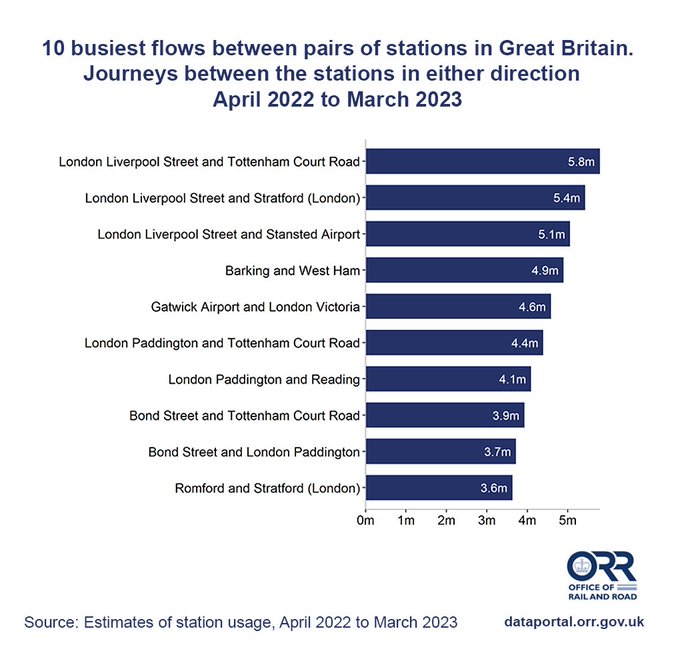
 Two tweets really caught my eye this week. The first was the top ten rail stations in the UK by passenger numbers in 2022 and the second was this years figures, which see a marked change due to the opening of The Elizabeth line.


I was astounded to see some of the figures. A station I use all of the time, Farringdon, now has more passengers passing through it than Euston or Kings Cross. In fact, five of the top ten are now Elizabeth line Stations. It is also worth considering that Farringdon, London Bridge and St Pancras are on the Thameslink lines. The Elizabeth line and Thameslink have seen massive, multi billion investments. These figures show that investment pays off. Even more telling are the figures for the busiest passenger flows


Again, many of these aree brand new flows, created by The Elizabeth line. The Elizabeth line was a massive and very expensive project, which many queried the value of. These figures vindicate the project. The line uses electric trains, which are the most sustainable form of travel. The millions of passengers using this, not travelling in cars etc are the way forward. 

I've used the Elizabeth line a few times since it opened. I don't often have need to go to East or West London, but when I do, it is an amazing addition. I use Thameslink most weeks, and the interchange with the Elizabeth line at Farringdon is one I have regularly made use of. 

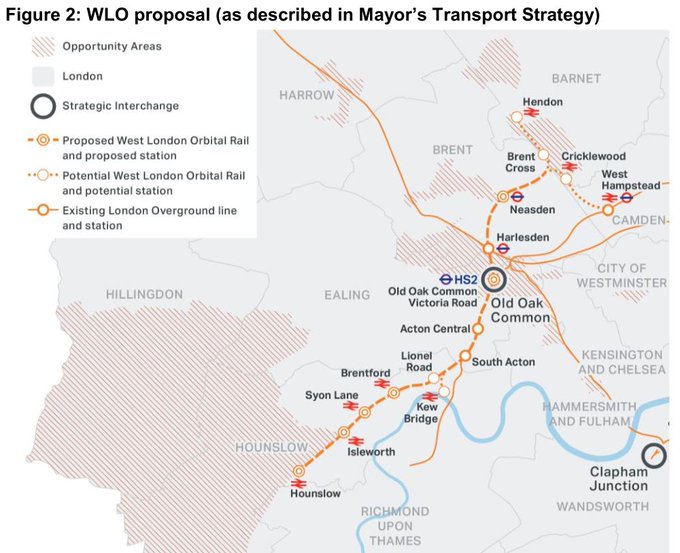
When we talk about climate change and the environment, we always talk about problems. There is not enough time and money spent developing solutions. Transport is a major contributor to CO2, so it is clear that we need better solutions and we need to invest. In the London Borough of Barnet we saw Brent Cross West station open earlier this month. For this to really justify it's investment, we need the West London Orbital Railway to open ASAP. Unlike the Elizabeth Line, all of this railway already exists. It simply needs upgrading to fascilitate regular passenger trains. 


A whole swathe of West London will see massive improvements in public transport, which should mean less journeys and pollution on the North Circular. The existing rail line is a lightly used freight line, which has Victorian age signalling. I'd also like to see the line upgraded for freight, much of which moves in the early hours of the morning, removing Lorry journeys and even more pollution. 

The bottom line on all of this, is that we need to spend money. London is a City that deserves world class public transport. There is no central, joined up plan to strategically improve London's transport. There are just big one off schemes, that always seem to be delivered 20 years late. The purpose of having a London Mayor was to sort this out, but sadly this simply hasn't happened. Most of London's railways were built in the Victorian era, many for freight rather than passengers. What we need to do is to work out where passengers need to travel between and build lines that go there or stations that serve them. In our Borough, we have a huge national museum at Hendon, which is next to the Thameslink line. There is no station. We have Saracen's Rugby stadium, that sees huge crowds every fortnight. It is next to an abandoned tube line to Mill Hill East, on the Northern Line that could easily be reinstated. Perhaps the strangest of all these planning cock ups, is that Brent Cross now has two stations and neither properly serves the shopping centre. Luton Airport recently had a new link from the station to the terminal, such a link between the shopping centre and the two stations seems to me to be a no brainer, but no one has even suggested it. 

It would be funny if it wasn't so tragic.

Tuesday, 24 May 2022

Why Thameslink is far better than Crossrail

 Today sees the opening of Crossrail, or the Elizabeth line as it's now known. As a Mill Hill resident, I have to say I'm totally underwhelmed by the whole Crosswail thing. The powers that be are making out it's a new concept and something wonderful.  It's not, Thameslink has been crossing London since 1988, with no fanfair. It has a proper name, more destinations, better trains. Whilst it will make getting to Heathrow and Docklands (and who want's to go there) by train a bit better. This got me thinking, if you were to have a face off between Crossrail and Thameslink, which line is more impressive?  

I'd go for Thameslink every time. Of course it's great that Thameslink is finally open, but here's a few facts that prove Thameslink is far better.

Thameslink


Crossrail


Major London Rail Terminus served

Thameslink                                               Crossrail

Kings Cross                                               Paddington

St Pancras                                                  Liverpool St

Blackfriars

London Bridge


End of Line Destinations

Thameslink                                               Crossrail

Brighton                                                    Shenfield 

Cambridge                                                Abbey Wood

Bedford                                                     Reading

Orpington

Sevenoaks

Rainham

Peterborough

Bedford

League Football Grounds Served

Thameslink                                               Crossrail

Brighton & Hove Albion                            Reading

Cambridge Utd                                           West Ham

Peterborough

Wimbledon

Sutton

Gillingham

Luton Town


Airports Served

Thameslink                                               Crossrail

Gatwick                                                      Heathrow

Luton

Train Capacity

Thameslink                                               Crossrail

  • 700/1: 666 seats                                  450 seated, 4 wheelchair, 1,500 people total
  • plus 1088 standees
  • 1754 TOTAL

Toilets on Trains

Thameslink                                               Crossrail

Yes                                                              No

And best of all, you get this view on Thameslink's heart in Blackfriars.


I rest my case!

Tuesday, 29 March 2022

Thameslink Special - Why is the government letting GTR (Govia) trains carry on mismanaging our railway?


I've used the Thameslink service since it was inaugurated. I was working for BT at the time in Blackfriars and travelling from Mill Hill. I was rather fond of the service, as it took me from door to door in just under half an hour on a good day. There were eight trains an hour in the rush hour, four of which were fast from Mill Hill to St Pancras. Prior to the line opening, I'd have to walk from Farringdon and it cut 15 minutes each way from my journey. The service opened in May 1988. 

When British Rail was privatised, Govia took over. It took them a couple of years to work out how to run the network properly. The early years were a nightmare of cancellations and delays, but it eventually settled down. In 2006 (to my disgust as I thought it should have been renationalised), it was handed over to First Capital Connect. Another period of two years of chaos and debacle as they worked out how to run the network resulted. They also cut the number of trains an hour to four slow ones, which as a result were always packed in rush hour. There was a mini rebellion and eventually they were restored to six an hour in rush hour, with couple of semi fast services.

In 2015 Govia returned in the form of GTR, once again there was a period of chaos as the new operator worked out how to manage the network. In 2018 a chaotic new timetable was introduced, which caused chaos. It ended with the managing director of Govia resigning. The service had just about recovered when the pandemic hit. Over the course of the pandemic, it emerged that Go-Ahead trains, the majority owner of GTR had performed £25 million fraud on the taxpayer and were stripped of the Southern Railways franchise.

As the railway system recovevered from the pandemic and numbers started to return, GTR have imposed an emergency timetable on commuters. This has resulted in a return to four slow trains in the morning rush hour, with a long gap between trains

08:23 from Mill Hill Broadway(MIL) arriving at London St Pancras(STP) at 08:47. This service takes 24 minutes, is Direct. and is currently On time. click for more info


This has created a situation where there is overcrowding and at a time when there is a pandemic, additional risks to commuters of infection. Many are voting with their feet and shunning train travel, just at a time when we should be trying to reduce our usage of fossil fuels such as petrol and diesel.


As the service is supported by the taxpayer, we need a service that serves taxpayers properly, not dodgy train companies that have a very shady record of dealing with public money. Why is the government allowing this mess to continue? If we are serious about sorting out our emissions, we need a reliable transport service. The sorry tale of the Thameslink franchise is anything but that. It should be brought under public control ASAP. 


Thursday, 12 September 2019

Why Thameslink's new trains can't cope with a power outage

Like many people in Mill Hill, I regularly use the the Thameslink service. Like many, I was massively impacted by the power supply problems on 9th August.  My wife even had to be evacuated from a train north of Kentish Town and walked along the railway lines. I am endebted to Robin Morel of Network Rail for sharing the report.  nationalgrideso.com/document/15235


Older trains were unaffected - Pic Copy Barneteye
The reason for the problem is that a 'Safety feature' of the new Thameslink 700 class trains means that if the power supply drops below 49Hz, the train will do a protective closedown. The drivers can do a manual reboot that takes ten minutes, but for 30 of the trains this didn't work, so technicians had to be sent out with a Laptop to restart the trains.

The section on planned mitigations is fascinating. It seems that Siemens, who manufacture the trains are now working on software to allow the train to restart itself automatically when the power returns to 49Hz. None of the older trains on the network were affected. One has to ask how they could not have considered that a power outage might occur and that needing an engineer with a laptop to access the train was not an acceptable or safe solution.

I am not an expert, but this is not only dangerous, but shows an almost criminal level of negligence in design by Siemens. Just suppose that my wife had been in a wheel chair or suffered from claustrophobia, as the power and air conditioning had shut down. Luckily her train was not too far from the station, but had it been in the middle of the mile long Belsize new tunnel, then that would have been terrifying.

Electric trains should be resilient and a driver should be trained to restart them. We need to know how long these changes will take to be implemented. We also need a robust recovery plan for such issues from GTR and Network Rail, in the event of such problems. Engineers need to live in the real world. It is all very well designing massively complicated trains, but if they are not resilient and predictable problems, that clearly can easily be resolved, cause the whole network to pack up, then it is clear that the whole design process is flawed. When the emergency cutoff was designed, someone should have said "what would happen if this train was packed and in a tunnel?".

Since the new class 700 trains were introduced, we've had air conditioning problems, ironing board seats and now we find out that if there is momentary power blip, half of them pack up completely. To me this is a sign of a very badly managed railway. Siemens should compensate commuters for the aggravation their bad design has caused. Maybe this would focus their minds when they come to designing their next generation of trains. The thing that irritates me beyond belief is that these issues always end up in a blame game. Obvious problems are excused as the contractors all start blaming each other, the government and the regulator. British Rail had its faults, but at least we all knew where the buck stopped.

Here is the full report.

Appendix F – Govia Thameslink Railway (GTR) technical report 
This Appendix contains the independent technical report provided to the ESO by GTR into the impact of the frequency disturbance on their trains on 09 August as part of the detailed investigation into the incident. Title Power Surge Disruption on 9th August 2019: Technical Review.

Date 3rd September 2019

Event Summary

1. From information supplied by the National Grid at 1653 on Friday the 9th of August the frequency of the OLE AC voltage supply dropped below 49Hz for 16 seconds. It dropped below 48.89Hz to a minimum of 48.8 Hz for milliseconds.
2. There was no identified OLE AC Voltage supply interruption.
3. All Desiro City class 700 and 717 units operating on AC Voltage suffered a Protective Shutdown where the converter, known as the 4QC (4 Quadrant Controller) shut down. None of the other AC trains in the GTR fleet suffered any power related issues from this event e.g. Class 387, Class 365, Class 313.
4. In Passenger Service this involved circa 60 units, consisting of Class 700 FLU/RLUs and Class 717, suffering a 4QC lock out.
5. The effect of the 4QC shutting down on the train is that the train switches to battery power which causes a loss of HVAC (fan only fresh air supply), stand by reduced lighting (emergency lighting is activated when battery voltage drops), no at seat power, no PIS displays (audio only from the cab), and no traction power. The GSM-R radio remains active.
6. Following failed attempts to repower the trains, the established first response for a train failing with these symptoms is for the Driver to perform a reboot of the train known as a Battery Reset. This takes approximately 10 minutes.
7. Fleet Control diagnosed the issue quickly and a global GSM-R call was broadcast to instruct drivers to carry out the Battery Reset process.
8. After this 27 of the affected units were recovered.
9. The remaining circa 30 units required the Protective Shutdown to be unlocked by the intervention of a Technician with a laptop attending each unit.
10. There were 17 Technicians available at the time of the event. These 17 were immediately sent to stranded units with laptops and a further 24 technicians were mobilized within the next hour. The trains affected were widely spread geographically and some were not easily accessible.
11.Therefore, this process took some time and resulted in 23 train evacuations and severe levels of service disruption.

Cause

1. The Desiro City from Siemens Mobility is the latest generation software enabled commuter train, so requiring protection against power supply frequency excursions for safety reasons and to protect low power electronics.
2. Siemens Technical Specification for the train states that the train will continue to operate with supply frequency drops down to 48.5Hz for short periods of time.
3. The NR Electrification System Compatibility document, NR/GN/ELP/27010(“Guidance for compatibility between electric trains and electrification systems”), a Manufacturing and Supply Agreement compliance requirement, identifies that the supply frequency can fall to 48.5Hz in extreme conditions.
4. A review of the Class 700 NoBo design submission (Siemens document A6Z00036309602 item 4.2.8.2.2) shows that compliance with both NR/GN/ELP 27010 and EN 50163 (“Railway Applications – Supply Voltages of Traction Systems”) would be demonstrated.
5. Following investigations, Siemens advised that the supply frequency response of the train was designed to comply with the EN 50163 Clause 4.2 Note 2. This note permits train drives to disconnected at 49Hz. Use of this supply frequency value in the train design led to the train protectively shutting down its drives when the supply frequency response fell below 49Hz.
6. Importantly Siemens have also clarified that there should not have been a Permanent Lockout on the train following a protective shutdown caused by a supply voltage frequency drop. All trains should have been recoverable via Battery Reset whereas 30 trains were not recoverable. This was not the intended behaviour of the train.
7. Therefore, the affected Class 700 and 717 sets did not react according to their design intent in these circumstances. The risk of this happening was not known prior to the power event on Friday 9 August.
8. Separately as a part of the new TCMS (Train Control Management System) software version 3.27, the ability for the driver to recover from a Permanent Lockout by using the Battery Reset process was removed.
9. On the 9th of August all the units which required a Technician to recover power were at software level 3.27 or above. The 28 units recovered by the driver performing a Battery Reset were at the previous TCMS software level of 3.25 or below.

Conclusion

1. All the Class 700 and Class 717 trains operating on AC suffered a Protective Shutdown of the 4QC controller because of a drop in the supply frequency below 49Hz for 16 seconds.
2. This was not how the train system had been specified to operate. This event should not have caused a Permanent Lockout fault on the trains.
3. The effects of this were exacerbated as the fleet was undergoing a software change, contained in this was a change in functionality removing the Battery Reset remedy for Permanent Lockout events. 4. This meant that the driver could not recover failed trains which were operating on the new software, instead a Technician was required to attend.

Planned Mitigation

1. Siemens are developing a software patch to allow units which protectively shutdown below 49Hz supply frequency to recover themselves without the need of a reboot or laptop when the frequency rises above 49.5Hz.
2. It is not proposed by Siemens or GTR to revert units to previous software versions as there are concerns this could severely impact unit availability. Based on discussions with the National Grid Head of Networks, the risk of frequency excursion dropping below 49Hz before the patch is fully introduced are considered extremely unlikely.
3. In addition to this Siemens will investigate how the train could be made to operate for a short time with supply frequency falling to 48.5Hz.

Monday, 17 September 2018

Thameslink Chaos - Time for Matthew Offord to review his cunning plan?

Thameslink Chaos Explained (courtesy London Reconnections)
Like many people who live in Mr Matthew Offord MP's constituency of Hendon, I regularly use the Thameslink service from Mill Hill into the city. Over the past few years, the service has been absolutely chaotic. This blog has regularly chronicled the failures, and the privations suffered by commuters. If you are interested in the sheer scale of the abject failure of the service in May when the new timetable was introduced and the reasons for it, there is a comprehensive analysis on the London Reconnections website.  The problems are summed up by this excellent flowchart. The article explains that the whole thing was a disaster from start to finish and  unbelieveably no one seems to have noticed. The article makes it pretty clear that the problems are not only the fault Govia (the train operator), but Network rail and the government.

In years gone by, the Transport secretary, Chris Grayling would have been swiftly sacked for such a cock up, but these days ministers simply do not take responsibility, so the country just ends up with a no blame culture of shoddy delivery from top to bottom. Let me just state that I am not saying this because of Graylings party allegiances. Competence is not a party political issue. I am equally critical of how the Labour Mayor of London is managing the Crossrail project.

The effects of this mismanagement on ridership of Thameslink since Govia have taken over is demonstrated by a huge drop in ridership at Mill Hill.

National Rail annual entry and exit
2012–13Increase 2.040 million[1]
2013–14Increase 2.482 million[1]
2014–15Increase 2.675 million[1]
2015–16Decrease 1.949 million[1]
2016–17Decrease 1.884 million[1]

This was before the new Timetable, so we can only speculate the loss to the economy. Given that the average Londoner earns £22.32 an hour, every day that Thameslink disruption causes an hours lateness to Mill Hill commuters, this costs the economy over £115,000. If we speculate that Mill Hill commuters have lost an hour 44 times this year as a result of the disruption, that is over £5 million pounds of economic impact. That is without considering the sheer hassle that this causes. The cancellation of meetings, the disruption to family plans, the cancelled wedding anniversary meals and birthday celebrations etc, as people wait for trains that never come or too busy to board. As the figures indicate that over 5,000 people a day use Mill Hill Broadway, this is a huge number of locals who are inconvenienced.

What disappoints me more than anything is that our local MP is the chair of the Thameslink group in the House of Commons (according to his website). I would expect such an insider to be tirelessly battling for us and campaigning on our behalf. I had a quick look through his recent Parliamentary activities. The last mention of Thameslink that I could find was on the 4th June, over three months ago. Mr Offord asked the following question and got the listed reply from Grayling

Photo of Matthew OffordMatthew Offord Conservative, HendonThis really is an appalling situation and one that we should have seen coming down the line given the history of the train operating companies. I have emails from my constituents that complain about lack of communication from Govia Thameslink. They say that the refund procedures are lengthy and difficult to navigate and that the timetable implementation has simply not worked. Will the Secretary of State give serious consideration to introducing a short deadline to ensure that GTR in particular brings the service up to an acceptable standard, or finding another train provider that will do so?


Chris Grayling The Secretary of State for TransportI am very clear that I expect GTR to deliver an improvement to the current situation as a matter of real urgency. If it does not do so, it will lack the credibility to continue as operator.

This is a pretty poor show. On Mr Offords website, he has a TAB that lists his plan. Item number 2 is one to get a "better deal for rail users". Sadly, as plans go, Mr Offords is far from cunning.  Below is the entire text of his plan

As a Hendon resident I am a regular user of the Northern Line and understand how important it is that hard working commuters and other Tube and train users have a smooth and comfortable journey.
I will continue to campaign for improvements to the Northern Line and Thameslink and am Chairman of the All-Party Parliamentary Group to improve the Thameslink line.
It is no surprise to me that we are seeing such appalling service when our MP has so little interest and puts so little effort into representing his constituents interests. Whilst I have no wish to become the MP for Hendon, if I was, I would, like Mr Offord, have a plan for Rail users. Here is my plan.

1. Hold fortnightly meetings with the management of Govia and Network Rail, to update on progress to resolve the issues facing commuters, until such time as the timetabling issues were fully resolved. I would then hold monthly meetings. I would provide a full update on my website of these meetings.

2. I would hold monthly meetings with TFL to ensure that commuters issues are fully understood by TFL and the Mayor of London.

3. Hold monthly meetings with regular users of both the Northern Line and the Thameslink route, to ensure that I could properly represent my constituents.

4. I would draw up a list of transport improvements that would improve the lives of my constituents, and lobby tirelessly to make them happen. Amongst the proposals that I would champion are the following
 - Step Free Access for Mill Hill Broadway and Hendon Thameslink Stations
 - Step free access for Northern Line stations
 - Full support for the West London Orbital route, with provision for an extension of the plans to RAF museum in Hendon and Mill Hill Broadway.
- Work to secure the route of the disused railway between Mill Hill East and Edgware, initially as a dedicated cycle path, with a view to reviewing options for light rail or full reopening if possible.
- Ensure better integration of the rail, tube and bus networks and seek introduction of better cycling provision to rail hubs.
- work with residents groups, commuter associations and the industry to deliver these objectives.

Provide regular update on all of these via my website.

It may well be that Mr Offord doesn't think any of these ideas are a worthwhile use of his time representing the Constituency of Hendon. He has asked plenty of questions in Parliament since it resumed sitting earlier this month. I will leave you to decide whether these issues are more important to the average Hendon voter.

Photo of Matthew Offord

Matthew Offord Conservative, Hendon

To ask the Secretary of State for Environment, Food and Rural Affairs, whether he has made an assessment of the potential productivity of the livestock industry over the next six months.

Photo of Matthew OffordMatthew Offord Conservative, Hendon

To ask the Secretary of State for Environment, Food and Rural Affairs, whether he has made an assessment of the potential productivity of the arable industry over the next six months.

Photo of Matthew OffordMatthew Offord Conservative, Hendon

To ask the Secretary of State for Environment, Food and Rural Affairs, how many parking penalty charge notices were issued under the Forestry Commission Byelaws 1982 for (a) non-payment and (b) insufficient payment in 2017.


Photo of Matthew OffordMatthew Offord Conservative, Hendon

To ask the Secretary of State for Transport, if he will seek a change through the International Maritime Organisation to ban ships from using heavy fuel oil when travelling in the Arctic and Antarctic regions.


Finally let me finish with my favourite of the lot. We have previously noted Mr Offords interest in Cheese shops. Now it seems that he's taken up the cudgels for our local potato farmers. I hadn't realised that these were more important to the local economy than the thousands who commute into the City, but as we all love a nice bag of chips, it shows he's got his finger on the pulse.

Photo of Matthew OffordMatthew Offord Conservative, Hendon

To ask the Secretary of State for Environment, Food and Rural Affairs, what estimate he has made of the potato crop for England and Wales in 2018.
The answer is also quite fascinating (if you find counting potatoes fascinating).

Photo of George EusticeGeorge EusticeThe Minister of State, Department for Environment, Food and Rural Affairs

With the cold, wet spring followed by the prolonged dry spell over June and July, some yield and quality issues are expected for the potato crop this year. The Agriculture and Horticulture Development Board (AHDB) estimate that there is a 3% reduction in the planted area in Great Britain. The harvest is on-going and estimates of yield and production will be published in Agriculture in the UK next spring.

If it wasn't for the fact that thousands of commuters every day have been subjected to complete mayhem on Thameslink, you would be forgiven for thinking that maybe Mr Offord hasn't got much to do with himself.

Tuesday, 11 September 2018

Thameslink Brent Cross South Station - The risks to Barnet Taxpayers mount

 
Next Monday, we see the Barnet Council Assets, Regeneration and Growth Committee meet to discuss the proposal to build a new Thameslink Station at Brent Cross South. As Hammersons (The developer of the shopping centre scheme) has put the shopping centre on hold, this has created a massive funding black hole as described in Section 1.2 of the Council report. It says
1.2 - It also outlines the work being undertaken by the Council following Hammerson’s
announcement to defer start on site on the Brent Cross Shopping Centre as set out in paragraph 1.4 of this report. Whilst the preferred station funding strategy set out in the Full Business Case approved by Policy & Resources Committee and HM Government is based on the ringfencing of business rates growth from the shopping centre development to date, the FBC also addresses the risk of delay by Hammerson and identifies possible mitigations. The public sector partners have agreed to work together to find an alternative funding solution by end of October 2018 to secure delivery of the station and BXS. The public sector partners agreed to continue to commit MHCLG grant to maintain momentum and in the expectation that a solution will be found as set out in paragraph 1.41 of this report. 
To summarise, it appears from the papers that the public sector are now pulling together a funding package. Later in the report the following statement is made

Impact of Hammerson deferral on the Thameslink Station
1.41 The Committee will recall that the Council’s investment in the station is dependent on the BXL Partners commencing the shopping centre development (which secures the business rates growth that will support the borrowing costs). Following Hammerson’s announcement to defer Brent Cross as set out in paragraph 1.4 of this report, this funding is not expected to be confirmed by December 2018, when the Council needs to enter into contract with Network Rail to maintain May 2022 opening date. Thus, an alternative funding solution needs to be agreed with HM Government and the GLA for the station. This scenario was identified as a risk in the Full Business Case approved by Policy and Resources Committee and HM Government in 2016. On 1 August 2018, the Government Assurance Board, comprising the Council, MHCLG, HM Treasury and GLA:
1. Reaffirmed public sector commitment to delivery of BX South and Thameslink
2. Confirmed commitment to finding a solution to the funding challenge
3. Confirmed that LBB can continue to commit MHCLG grant, to maintain momentum and in the expectation that a solution will be found.
Whilst I am a big fan of rail infrastructure projects, this one is starting to ring alarm bells. What particularly concerns me is that for the project to proceed, funding will have to be secured by December. Once this is done and dusted, what is to stop Hammersons coming back and building the shopping centre with no financial commitments at all. As the station will hugely improve the scheme, they will in effect have secured a massive win.

The big question for me is where will the extra dosh come from. Barnet Council can't put up council tax any higher without a public referendum, as the Tory administration is already committed to the maximum permitted rise without funding Brent Cross. So where else can the council find the dosh? One would have rather hoped that if there were grants and subsidies available, these would have already been tapped up to ensure the project proceeded without the risk of the rates guarantee. The other possible source that comes to mind is stealth taxes. Typically we are talking about parking charges. Barnet Council has fallen foul of the law on this before, but presumably the station can be sold as a transport enhancement.

I have asked two questions of the committee. I await the responses with interest

1. Please can the council explain how the funding for the new station at BXS will be achieved. In particular I am concerned that it appears that alternative funding is being sought, wheras the original business case envisaged a ring fencing of Business Rates from the Brent Cross expansion. Once this funding has been identified, is there a realistic prospect that the developers will be able to reactivate their plans and dodge their previously rig fenced commitments.

2. In light of the current problems facing retailers, there has been talk of a complete review of the system of business rates (a proposal I fully support). What plans are in place to ensure that such a change to legislation would prevent the Barnet Taxpayer having to pick up the bill if Business rates are abolished and another method of business taxation used? I note that this is not mentioned in the risk register.


I will keep you updated with what happens. Just to give some idea of the scale of this scheme the papers state

5.1.9 The current total approved Capital Budget for Thameslink is £70.516m Current spend to date (including expenditure committed but not yet paid) is £30.7m.
What is encouraging in the papers is that there is a firm commitment to improve the West London Orbital Railway Scheme and improve access between the station and the Thameslink Station. Sadly like many schemes, this one seems to have become one where the public sector takes all the risk and the private sector reaps all the rewards.
.

Monday, 23 July 2018

Thameslink - This is not a service, it is a complete joke - Barneteye comment

This morning I had a very lucky result. I was due to have a business meeting in Farringdon at 9.15. When the alarm clock went off at 7am, I did a quick check on the service from Mill Hill Broadway into town. I've not been commuting regularly since November, so I've missed the worst of the disruption, but what I saw shocked me. I first started regularly using the service back in 1981, when it was run by British Rail and operated by clapped out diesel railcars. The line was known as the Bedpan (Bedford to St Pancras) line. Shortly after, new trains were introduced when the line was electrified. In the mid 1980's, it was further improved with the introduction of the cross London Thameslink service. At the time, there were eight trains an hour in rush hour, from Mill Hill to Central London. In 2004, First Capital Connect had taken over and brought in the first of many "timetable improvements" Mill Hill has seen. The frequency was slashed from eight to four trains an hour. All of the fast trains were abolished. The result was overcrowding and chaos.

After much lobbying, some fast trains were re-introduced over a period of years, with 5-6 trains an hour. The line has had huge disruption, first with the construction of the International terminal at St Pancras, which resulted in a six month blocade of the central London service. For this period, the "Bedpan" service was reintroduced, with a very regular stopping shuttle between Bedford and St Pancras. Then all manner of disruption as the line was overhauled for the Thameslink program. We were promised that when the work was finished, we'd get an amazing new timetable with a metro frequency timetable.  In May, the new timetable was introduced. It collapsed. There were more cancellations than trains running. A new emergency timetable was hastily drawn up.

This new timetable was introduced last week. So what sort of service are we now getting at Mill Hill. As I mentioned, I saw the effects first hand today. I was shocked. 
There are now only three trains at the height of the rush hour between 8am and 9am. This is the worst service I've ever seen for a morning rush hour. Worse than when British Rail ran a diesel service, worse than the dark days of the First Capital Connect mismanagement.

This is not a joke. People have to get to work. People have appointments. This chaos is not down to accidents, war, plague or famine. It is completely down to a failed system of privatised management. The only people I know who support the current arrangements are either ideologically obsessed Conservative MP's, who never use the service. The transport secretary, Chris Grayling is completely out of his depth. After years of sticking up for Govia, even our local MP Matthew Offord has been forced to mildly criticise Thameslink. He asked the Transport secretary to give Govia a deadline to sort the service out and sack them if they didn't meet it. The response sums up just how completely out of his depth the transport secretary is
I am very clear that I expect GTR to deliver an improvement to the current situation as a matter of real urgency. If it does not do so, it will lack the credibility to continue as operator.
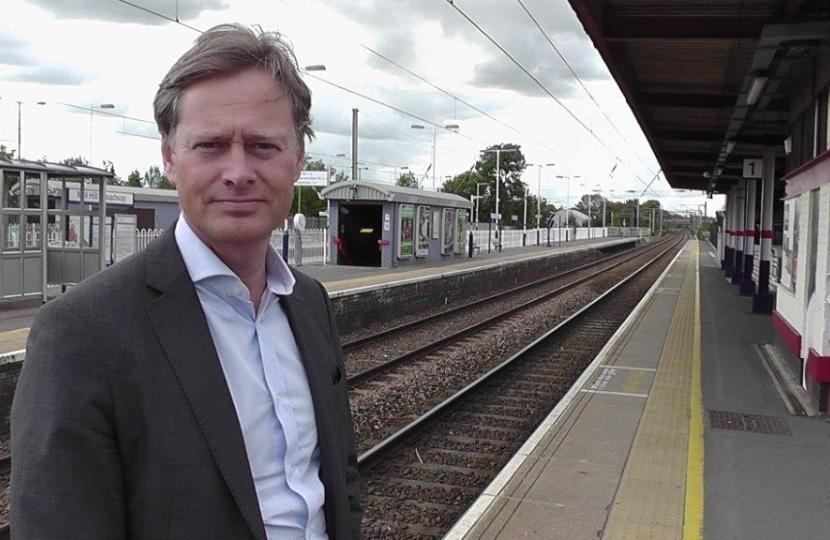
Matthew at Mill Hill Broadway Station
Mr Matthew Offord at Mill Hill Broadway Station
That will have them quaking in their boots. Sadly Mr Offord really doesn't seem to have a grip on the situation. I suggest you read the full text of his latest blog post. I am really rather disappointed that he had nothing to say about the abysmal response from the secretary of state. Mr Offord seems to think that bunging commuters a few quid in exchange for the misery they've suffered is something to brag about. Most people I know can't be bothered to waste the time claiming, they just want a good service. If you look carefully, you will see Mr Offord has a picture on the blog of himself at Mill Hill Broadway (see right). He seems to have achieved the almost impossible feat of going to the station when there were no disgruntled passengers waiting for non existent trains. I'd rather like to see Mr Offord visit the station between 8am and 9am to see what real users, the daily commuters have to say to him.

Anyone who has had to suffer the service in all its incarnations since British Rail will know that none of the operators have improved the offering. Railways need joined up management. Mr Offord admits as much in his blog where he says
I appreciate that some issues such as signalling are the responsibility of Network Rail and I have raised - and continue to do so - the high number of signal failures.
The answer is obvious, bring back a unified operation. I am under no illusions that BR was perfect, but as with many things in life, I'd settle for the least worst option. There is no way that we'd have had a cock up like this under BR. I took a Thameslink train on it's first day of operation and regularly used it ever since. I remember the BR excuses and the strikes. It was the original Thameslink 319 trains that failed with the excuse "the wrong type of snow". We'd have periods of bad service, but not for months on end. What is worse is that it shows no signs of actually improving. It is nearly two months since the original "new timetable" was introduced, yet here we are down to three trains in rush hour.

The time has come for Govia to Go! Bring back a unified operator and bring some sanity back to public transport.


Thursday, 31 May 2018

Why the new Thameslink Timetable is in meltdown

For many living in the London Borough of Barnet, the Thameslink services, run by Govia, is the main transport network used on the daily commute. Trains are run on both the Mildand main line (Mill Hill, Hendon, Cricklewood) and the East Coast Main Line (Hadleigh Wood, New Barnet, Oakleigh Park) to stations in the Borough and residents rely on the service to get to work. For many of these commuters, their employers operate a system of appraisals to determine bonuses and pay rises. Therefore a poor train service can have a highly detrimental effect not only on the quality of life of Barnet residents, but their paypackets.

Last week, Thameslink introduced a new timetable. This included a radical shakeup of times, new destinations (such as Rainham in Kent) and full introduction of a through London service from the East Coast Mainline destinations. For commuters from Mill Hill, a massive increase in train frequency throughout the day was promised. 

Sadly what has actually happened has been complete chaos. So much so that on Sunday, train companies sent a private email to their staff (you will note that they didn't bother notifying media or passengers), informing them that they should check any journeys before setting out as a meltdown was expected. This memo was leaked by the Association of British Commuters in a tweet.

Further research and digging revealed that Govia were misleading passengers about the cause of cancellations. The operators have full access to a system which shows why trains are cancelled. There is a code "PG" which means a planned cancellation by an operator, which means the train was never going to run. This tweet gives one such example and the trail shows how the operator actively mislead a passenger, until such time as another commuter stepped up to put the record straight.


Sadly the train operators do not share this information with passengers, resulting in disrupted journeys and inability to plan. There is nothing more frustrating than to check to see if a train is running on the company website, only to find that it has been cancelled when you get to the station. The fact that these are scheduled cancellations is quit appalling.

The question that has been asked is why, when the timetable has been being planned for months, can they have a shortage of drivers. Surely, they know how many drivers they need and how many trains they have? A question many are asking is that given that there is not a major rabies epidemic amongst drivers, it should not be hard to run the service.

The answer is that the company has an adequate number of drivers and an adequate number of trains to meet the timetable. Where the problem lies is that before a driver can take a train load of passengers out, they need to be trained on both the route and the train. A certain number of hours operating the train and journeys over the specific pathway are required. As the Thameslink service has new routes and new trains, there are not the drivers available who are certified to actually operate the required number of trains over the routes. One example was given to me a service from Hitchin to East Croydon, which required five different drivers to complete the journey. The first driver took the train from Hitchen to Finsbury Park, this journey was on the classic East Coast Main Line service. The driver then changed, as the section between Finsbury Park and St Pancras is through a new tunnel and there are limited numbers of drivers certified to run this section. At St Pancras, a third driver boarded and took the train to Blackfriars, where a fourth driver was then embarked for the journey to London Bridge, over another new bit of track, which there are still limited numbers trained up for. At London Bridge, the fifth Driver took the train to East Croydon. Each of these changes adds time to the departure and if any driver is unavailable or late, it soon cascades, with dozens of trains running through central London every hour. The timetable does not cater for multiple driver changes and even small increases in waiting times at stations, soon has a knock on effect.

The Thameslink website now has a cursory apology on it
We apologise to passengers for the continued disruption linked to the introduction of the new timetable. We are working on a recovery plan with rail industry partners. Meanwhile, as late notice changes continue to be made, we ask passengers to check train times on the day of travel using our service updates page. We expect disruption to ease over the coming month. 
As drivers learn the route, clearly there will be an improvement. Thameslink have also introduced an amended timetable, to more adequately reflect the services they can actually run. Sadly I can't seem to find it, but maybe I've just not looked hard enough.


Given that many of his constituents are affected, we were shocked to see that our MP, Mr Matthew Offord has no word on his website about the chaos. We should expect our MP to be taking up the cudgels on behalf of taxpayers, who both elect him and pay his wages. even worse is the response of the Transport secretary Chris Grayling, who has adopted a "not my problem guv'nor" approach.


Voters should not wear this nonsense. It is totally Mr Graylings fault. He is the transport minister, and if transport fails due to incompetence and bad planning, he is the person who should take responsibility. He should have been spending the last three months asking "will the timetables work?". He should have informed Govia that if they couldn't deliver on commitments, then they would face harsh penalties or even be stripped of the franchise. He won't do this, because his ideology states that outsourcing and privatisation are the way to go. I have used the Thameslink service since its inception. I have seen four different operators, BR, Govia (Mk 1), First Capital Connect and Govia (Mk2). All have had their problems, but Govia (Mk2) are the worst (closely followed by First). I actually thought that when the franchise was returned to Govia, it would improve, but quite the opposite has happened.

There can only be one conclusion to be drawn. When Govia (Mk 1) were operating the Franchise, there was a Labour government (albiet a very right wing one), which was quite happy to renationalise failing rail franchises. As a result, Govia by and large behaved for the term of its Franchise. Even so, the Department of Transport still booted them out as they weren't exactly amazing. First Capital Connect got away with many things, but their tenure coincided with a major redevelopment of St Pancras etc. Eventually though, they were booted out, much to the relief of many commuters. It strikes me that we are now seeing how Govia operate in an environment where the Government has an ideological addiction to outsourcing and cannot admit that it doesn't work for national infrastructure. In short, why would any service provider go the extra mile for customers, when there is no pressure on them. Chris Grayling has actually had the brass neck to blame Network Rail for the failings of the operators to train up drivers and provide a coherent timetable. 

It is no wonder that the whole system is in meltdown, with such a useless incompetent minister running the show.