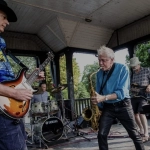
Having run a studio and played in a band for 47 years, as well as running several music festival over the years, and promoting our own gigs, I thought it might be good to pass on some of the things I've learned over the years on the subject of gig promoters. This post is primarily aimed at relatively inexperienced bands playing original material, looking to build a profile.
The first thing to consider is "why do we want to do a gig". This may sound like a silly question, but there are many reasons a band may want to do gigs and you should consider what you are trying to achieve before you leap headlong into the world of gigging. If you've never gigged before, it really is a good idea, if you can, to do a couple of low profile gigs to try out material and see how the band gels, before you launch out on the wonderful world of gigging. My band, The False Dots, started gigging in 1980. We were still at school. Our first two gigs were self promoted shows in the local church hall, the third was at our school. The wisdom of this became apparent when our lead singer didn't show up for the first gig. Just imagine if we'd been playing for a good promoter. Our fourth gig was supporting a band called Way of The West, who had a Radio 1 single of the week! It meant we were used to playing live and were able to do ourselves justice. I really think it is important to know the band works before engaging with professional promoters. We also played a couple of parties for mates, that we didn't consider 'proper gigs' at the time, but actually enabled us to build a following.
When you feel you are ready to start stepping up, there are three things to consider. The first is whether the promoter is right for you. Often, the best promoters specialise in a specific genre of music and work to put on a bill where bands complement each other. If you play Metal, then look for someone who promotes Metal, if you play Reggae, look for a Reggae promoter, etc. They will understand that you are a new band, and should be sympathetic. Some venues use different promoters on different nights, so it is important to ensure that you get the right one. I would always advise going to the venue and checking out the setup, when you are starting out. Speak to the bands, the door people, the sound person if you can. See if the venue has posters up. Check the socials to see what effort the promoter has gone to. If the promoter has done nothing, then they will most likely do nothing for you.
Promoters will ask you how many people you will bring. They will also expect you to bring them. This is not them being arsey, they are running it as a business. If you bring no one, then they won't rebook you, unless there is a very good reason (tube strikes etc). If you can persuade your fans to buy advance tickets, this makes a good impression, but don't be bullied by promoters demanding pre-sales. If the promoter has a "cancellation clause", where they can pull the gig and not refund your fans their ticket, then do not take the gig under any circumstances. They should confirm the timings well in advance.
Often bands pull a far bigger crowd for their first couple of proper gigs. Mates will come a couple of times, but to grow your fan base, you need a lot of hard work. Make sure you tag the promoter into your socials. If they do not repost your socials, then they are not doing what they should. If you post 100 times a day, then they won't but they should post some of your postings. Also tag in the other bands on the bill. Make your postings appealing to fans of all on the bill. That way, you may get a few fans of the headliners coming early. The promoters should support this activity.
With regards to money, the promoter should be clear and transparent as to what you will receive. This is usually a share of the door, often for people who sign in for you. Promoters have to cover their costs first, so it is not unusual for a minimum door take to be required before you are paid.
To sum up. A good promoter will
* Make all terms and conditions of performance clear up front.
* Put effort into making the line up work for all bands.
* Put effort into getting fans along via posters/leaflets/socials
* Pay you as agreed
* Communicate properly
A bad promoter will
* Mess you around on timings.
* Threaten to cancel the gig if you don't sell advance tickets.
* Make no effort to make line ups work.
* Not be interested in your actual music.
* Hassle you on the phone and change arrangements at short notice with no reason.
The False Dots have mostly played for good promoters, who support us and are reasonable. The bad ones we've played for have been a nightmare. We have fulfilled the gigs, as I consider it unprofessional to cancel them, but we have told them to jog on, when approached again. It is also worth saying that we've done gigs for good promoters that didn't work out. This was usually because the venues were at places we couldn't pull a crowd (notably one at the Tunnel Club in Greenwich on a Tuesday night, where two people came). You lean from such things. They waste everyones time. Now we tend to play in Camden, Islington and around Barnet as we can pull a crowd and do festivals etc, where there is an audience that we can reach. Make sure that wherever you play, it fits into a plan to grow the band.
And lastly good luck. The False Dots are part of the Band Up network of Independent bands. This was us performing at Fabwick in Hackney. Check it out as it is the best resource for new unsigned bands looking for gigs etc.
When I started this blog, one of the absolute first principles I vowed to abide by was that I would not stand by and say nothing when I saw people spreading dangerous untruths, either through ignorance or malice. I have come to realise that with the rise of X.com and the Elon Musk era, where people get verified and rewarded for clicks, ignorance is far more dangerous than malice, as ignorance is harder to rebut and refute. People who spout ignorance are generally far harded to argue with. However if we stand by and say nothing, then their uninformed views become accepted and entrenched.
So what sparked this. Yesterday, this tweet popped onto my timeline.
I don't follow this character and I'd not previously heard of him, but as he has an MBE and over 80,000 followers, I felt that some people may feel his tweet was an informed and intelligent view and that ADHD does not exist. He is totally incorrect. How do I know? My nephew who is now in his 40's has ADHD. He was born and raised in Florida. His father, now retired was one of the USA's most acclaimed ER doctors. During Tim's long career (he's 80 now) he told me he probably saved 10,000 lives. He was an executive for the corporation that had the contract for hospital services to the US Congress. Of all the people I know, Tim's expertise on medicine I would trust more than anyone on the planet. In short, he is a pre-eminent expert in the field of medicine, and as an ER doctor, working mainly in Miami, saw more different medical situations than almost anyone on the planet.
My nephew was chronically under performing at school. He was diagnosed with ADHD, by one of the pre-eminent pediatric consultants in the USA. My brother in law, theough his business connections, had access to the best medical practitioners in the USA, which has the most advanced medical system in the world. My nephew was prescribed with Ritalin. His grades improved and he eventually graduated with a degree in architecture.
So when I read Mr Buckley's tweet, I asked myself several questions. Firstly does he have a better knowledge of medicine than my brother in law, or his colleague who provided the diagnosis? I will donate £100 to the charity of his choice if he can prove he is, however from his profile there is no evidence at all. Secondly, does he believe that a man like my brother in law, who spent his life saving people's lives, would allow his own son to be prescribed a dangerous sunbstance, for no reason at all? Well maybe Nick Buckley thinks that, but to me the proposition is ridiculous. Which brings me to the third question. Is Nick Buckley being malign or simply ignorant by posting such a statement?
I have no idea at all. I am guessing that he has no experience of the condition. The article he commented on was that the Daily Mail stated that there was an over diagnosis. I am more than prepared to accept this. However when someone who has simply got an uninformed opinion on such a matter posts such a tweet, it cannot go unchallenged. I am sure I have many views that are incorrect, ill informed, stupid, etc. I am more than happy to listen to people who know what they are talking about and issue corrections when I am wrong.
Sadly, we live in a society where people get financially incentivised to post such things. The bottom line is people read such things, see his MBE and assume that he knows what he's talking about. When they then encounter someone with ADHD, they will mistakenly believe that they do not have a medically recognised condition. This can lead to bullying and discrimination etc. I don't understand why any decent person would post something like this. Do you?
Oh yeah, two other things. Firstly, in my family, I think that the person I am most proud of, who is still alive is my brother in law Tim. Imagine having 10,000 people being alive because you were good at your job. And I am proud of my nephew, who through bloody hard work and being lucky enough to have intelligent parents who wanted the best for him got a fantastic degree. That should tell you all you need to know.
I have a pretty set Sunday ritual, but that all went out of the window today. My daughter & her boyfriend bought me a pair of tickets for Man City vs Sunderland at the Etihad stadium for today. Rather annoyingly, when I went to book train tickets, we learned that Euston Station was closed. A 2 ish hour journey became a 4 hour journey, via Marylebone and Birmingham. I had to get up at 6.30 and the trains were stuffed to the brim. In short it was really unpleasant. As I’d had a late night and a good drink, you can imagine the joy of standing for an hour on a packed train, before getting a seat. At Birmingham the train split in half and it was so busy some people couldn’t board.
By the time we were in Manchester, we were pretty frazzled. But it’s a pleasant walk along the canal and it was one of the most enjoyable games of football I’ve seen. City won 5-3. Afterwards we had a curry and I’m writing this on the train back, Euston has reopened so it should be plain sailing.
It brought home to me the fact that often the best things in life come with a cost. Although the outbound journey was awful, I saw an extraordinary match and thoroughly enjoyed my day. I guess I’ll remember the journey for ever, one of the worst. But that is a price worth paying
If you'd just met me, byt didn't know me, you may well be surprised at what a sickly, unhealthy soul I am. On a visit to the Doctor a couple of years ago, I had a minor argument with her. I had been feeling unwell and I was concerned that it may be something serious. She did a quick examination, proscribed anti biotics and told me she'd write me a sick note so I could have a couple of weeks off work. I replied that I didn't want a sicknote, I work for myself and skiving costs me money. I wanted to make sure that it wasn't something more serious and asked her to have a quick browse through my medical history.
After she pondered it for a couple of minutes she said "Oh". SHe then explained that most people who come in and are my age are alzy hypochondriacs who simply want permission to skive and its cheaper to give them some pills and a sicknote. A whole range of tests were commissioned and a load of new conditions to add to the existing list were added. Fortunately none are at the stage where they are serious, so long as I am sensible. The problem is that I am not sensible sometimes. Each condition has its own different list of things that need to be done to keep them in check.
So for your entertaiment and to remind me, here is my list of non medical remedies that seem to work.
1. Hiatus Hernia. I was diagnosed with this in 1984. I was prescribed Tagamet until they found it caused cancer. I am now prescribed Omnaprazol. But if I follow a few rules, I do not get acid reflux at all. So what are the rules. Drink a litre of water before I eat in the morning. Then have porridge, nothing greasy. Don't eat after 6pm, don't eat greasy food. Don't drink acidic drinks like orange juice. Don't overdo the alcohol.
2. Gallstones. This was a recent discovery. When I was first told I had them, I didn't recognise any of the headline symptoms, but after eating a very greasy burger at a music festival the penny dropped and I realised this has been a massive problem for years. The remedy is simple, don't eat more than 40 grams of fat a day. It can be a bit boring. I can have a bit more on occasions, but I've had my last greasy burger. Just as important is to also eat more fibre. And one other thing, which was causing all manner of problems, I have stopped fasting. This is very bad for gallstones.
3. Prostate Cancer. Well I had my prostate out, but I completely changed my diet when I was diagnosed in 2011 and it has made me feel far better, so I persist, even though, in theory, it is unnecessary. I avoid dairy and I add Pomegranite juice to tea.
4. Vitamin B Complex deficiency. I didn't eat meat for 16 years. In 2001, I started to get all manner of odd symptoms. I was even given an HIV test (I am not in a risk group). Then I mentioned to my Dr about the not eating meat. He advised me to go and have a big dinner of liver and bacon. He said "come back in a week". I did and all of the symptoms had gone, almost magically. He said "You had a vitamin deficiency caused by being stupid, eat liver at least every three months". I have done. No more boils on the bum.
5. Severe joint pain. I have played a lot of football over the years. I've broken many bones. I've been run over. There are more bits that hurt than don't. I can't take anti inflammatories since I had a stomach bleed in 1984. However, I have found out that if I take turmeric, I can get by. It eases the inflammation and I am still here.
6. Ankle and knee issues. This has been ongoing for several years. It was getting too much, but I saw great physio, who recommended instep supports for my shoes. These massively helped. I can walk around 10,000 steps per day without pain. Sadly if I do more, it swells up and hurts and I have to rest for a few days and elevate it. It was suggested that maybe a new knee may help, but actually the ankle is far worse, where will it end?
7. Spider bite. I was bitten on my ankle in Australia by a spider in 1987. It has never properly healed. I still get really bad itchy eczma at the point. However an Aussie mate told me to wash my hair with Head and Shoulders and then put some on the eczma and it will improve. It did. So long as I do it, there is little itching.
8. Tinnitus. This is in some ways the least of my issues and at times the worst. It can literally drive you mad. For me it started after an operation to remove an infected polyp from my ear in 1984. The only thing that works when it is really bad is alcohol, which ain't great for some of the other conditions. However, if I get overtired, it gets worse, so it is a balancing act.
9. Anxiety. When I was 13, I was diagnosed with anxiety issues and given medication that my parents zombified me. I actually thought it was depression until a friend who was a GP explained that the medication was for anxiety. It made more sense. After I had my stomach issues in 1984, I took up Yoga and meditation. I still periodically suffer with anxiety, but so long as I realised that is what is happening, I can control it by using relaxation techniques.
10. Chronic back pain. When I was run over in 1988, I suffered a stress fracture in my L2 vertibrae. This has caused me significant pain ever since. In 2007, I saw a specialist and had an MRI. I was offered surgery, but there was a 20% chance of paralysis.I asked if there was another option. I had 26 sessions of physiotherapy. I now have a series of exercises and stretches that keep it at a just about manageable level. I also have massages and have had acupuncture. It is kept in check.
I played football until I was 60, I still play in a gigging band. I almost never take sick days, apart from medical procedures. I've never claimed benefits because I couldn't work. I've got the MRI's and X-Rays to prove all of these. I am a believer in the mind being able to drive you through anything. There are things I'd love to do Run a marathon, do the Camino. They are not possible, but I will go down fighting, We are all different. I have great sympathy for everyone who has any of the above conditions. They are all horrible in their own way. I don't judge other people, however for me. the first question I always ask is "What can I do to help myself?". My Doctor advised me that I appear to have an extremely high p[ain threshold. I suggested that this was a good thing. She said "not really, most people get their issues sorted out rather than enduring them". I asked which ones could be mitigates with minimal side effects or risks. She had another look and said "Er, Nothing".
In truth, so long as I remember all of these rules, I am fine. It's when I don't that it all goes wrong.
Have a great Saturday. Here's a song I wrote about living with all of my ailments.
Many years ago, I used to work in IT support for a card processing company. I wroked in London, but the people we supported were based in Gateshead up north. I use dtos peak to the supervisor most days. Although she lived in Tyneside, Jackie was originally a Cockney and had moved up North when she married. I think she was a bit older than me, but we had a great rapport and a lot of banter. At the time, the terrible Soham murders occurred. I had a 7 year old daughter at the time. I watched the coverage on TV and I commented to Jackie "That was awful to watch as a father" and commented about the distraught reaction of the caretaker, Ian Huntley. Jackie said "He did it, you wait". I was quite shocked when she said it. It is a terrible accusation to make. A few days later, Huntley was arrested. I was absolutely shocked, but I remember Jackie's comment. so I asked her how she knew. She explained that before she had kids she'd been in the Police. She said that she could instinctively spot the culprit and explained how many of the things the Police do are to trap people they suspect, getting them to reveal details only the killer could know. Even so, to spot it from a two minute TV interview surprised me. Over the next couple of years, every time there was a high profile murder, she'd tell me the murderer before the arrest. I asked her whether it was all down to understanding police techniques, or was it something else. She replied "My superpower is that I can always spot someone lying, if there is a murder, why would someone lie, unless they were involved?". I said "But there are people who confess to everything, what about them, they are lying". She replied "Yes but they are attention seekers lying to draw attention to themselves, you can spot them a mile off".
I thought it was a real shame that Jackie wasn't still in the police, because she was very good at it. She explained a few dead giveaways on how to spot someone lying. Her technique was totally flawless. I am not in her league though. I was thinking about Jackie and her superpower yesterday, for no particular reason. It got me thinking of other people I knew who had superpowers. My Dad always claimed he could make weather and strange as it may seem, we believed him. One of my Dad's customers was a fairly major gangster. I can remember my Dad chatting to him over a cup of tea, when he collected his car. They were having a bit of a laugh over his nefarious activities. I'll never forget him saying "You know, there is no such thing as innocent and guilt, there is just getting away with it or getting caught". Dad said "So what is the secret of getting away with it?". He replied "I can spot a copper a mile off and I get a feeling when they are on their way and scarper". They both laughed. He went on "They sent one to spy on me, I twigged straight away and got him to get rid of the opposition instead".
Another friend of mine sent me a message about ten years ago. She said "Be really careful in London, something terrible is going to happen". She had never said such a thing before, but I took heed. The next morning, I awoke to the news that Grenfell Tower was on fire. She messaged to say that this was the disaster. That is not a power I'd like, to be able to know bad things are coming, but do nothing about it.
Sadly,not everyone's superpower is used for good. I have known one or two who an unfortuate talent for making people do things they don't want or shouldn't do. They almost seem able to cast a hypnotic spell over their victims. It always ends the same and the victims can never really understand how they fell for it. The US government and the Soviets spent billions on programmes designed to use and develop psychic powers for military gain. Depending on who you believe, this was either a stunning success or a terrible flop. I would advise anyone with any sort of telepathic powers to never tell a soul and only use them when no one is around. I suspect that if you don't you end up in a government lab, in most unfortunate circumstances
When I was a kid, I wanted the powers of Superman, but I realised that it is actually a terrible gig. I do have a rather strange superpower. I am very lucky. Not in raffles, lotteries, etc, but in life. The right people come into my life at just the time I need them. It is not a glamorous superpower, but I suspect it is the best one of all.
What is your special power? Do you use it for good or evil? Has it made you money or just caused you grief? I'd be intrigued to know.
I bumped into David Grant yesterday. BBC Radio London presenter and frontman of Lynx. During of the course of our chat, I asked whether he had any plans for gigs. He said that he was planning a tour with Lynx next year. He said he'd recently done a show at the Union chapel and he'd 'got the bug back'. It was funny to hear that. I lost the bug in 1990 and didn't perform again until 2002. When we put a line up together and played at the Red Lion in Colindale, it was amazing. The odd thing was our last gig before that in 1990 was something of a tour de force. We played really well, but I'd become jaded.
It is now 24 years since we started gigging again. We've had a oouple of shows which weren't as good as I'd like, but even then they were fun. Since Tom Hammond joined the band, I think they've all been pretty amazing. We play 10-15 gigs a year, not enough to become jaded but more than enough to feel like a proper gigging band. We put a huge amount of effort into the shows. For some, Tom makes special T-Shirts. For others, we plan special songs, or interval statements etc. We always give 100% to try and get people involved. When Tom first joined, I think he thought he'd be standing at the back playing amazing trumpet lines. Now he leaps into the crowd to incite them to join in on the chorus sections. The band is very interactive. We actively encourage audience participation. On Saturday night, we played at The Mill Hill Services Club, for cub members. A very different sort of gig to the last two. The previous one was a massive street festival, which was amazing. Before that, it was London's most iconic grassroots venue, the Dublin Castle. Each was different in its own way, all were brilliant. We played 2 sets for the Services club, which is great as it meant that we played two sets, meaning the songs we don't play that often got an airing. It keeps it fresh. We probably have 15 really strong songs that suit the current set/line up and around 10 more which are more than good enough to play and I enjoy playing, which we don't play enough. Most of the time, we get to play 8-12 songs in a set. Before Tom joined on trumpet, we wrote some cracking songs, which do not really suit a trumpet though. It is great to give them a play through as well.
The band has massively evolved over the last two years. Tom sings a few songs now and we are getting Fil to sing more. This really helps, especially with two set gigs, as it means I can give my vocal chords (and everyone's ears) a rest. Both Tom and Fil have far more versatile voices than me. It makes the set more interesting and I think they bboth do huge justice to the songs. Derek Treadwell has also joined on percussion and backing vocals. Again it adds another layer to the sound, which makes us different. That is something I really appreciate.
I put a huge amount of effort into my stage performance and expend a huge amount of energy. Now I sing, this is even more the case. When we finish, I am usually in that strange place that performers find themselves, where they are totally exhausted, but also buzzing with adrenalin. When I was a kid, my Dad, who was a WW2 bomber pilot told me that whatever the time, when they returned from missions, crews went to the mess bar. They were totally exhausted, but also completely wired and adrenaline from the sheer stress of the situation. It was only when I started performing that I understood the feeling.
So what happens is you do the set, then have a drink/celebrate/party. You eventually go home, hit the sack and wake up the next day completely worn out. Now I am 64, I feel knackered for several days. It takes longer to catch up. It is now Thursday and as I've had a really busy week, with no scope to chill, I am running on fumes. I couldn't get out of bed this morning. I like to go to the gym every day, but it is a struggle. The strange thing is that if I had another gig, or a rehearsal, the tiuredness would instantly disappear. The human body and adrenaline is a wonderful thing.
If you look at major bands, like the Rolling Stones, they have been doing this for decades and make me look like a spring chicken. They are lucky though, they have an army to do everything. They just have to play. But even so, performing at the level the likes of Mick Jagger would is phenominal at any age, let alone as an octagnerian. It is almost impossible to explain just how much energy you expend just expanding and contracting your diaphragm to sing. Let alone do a 2 hour dance routine as well.
If you consider that Mick Jagger is three years older than Donald Trump and the same age as Joe Biden, you realise just what a feat it is. I have been doing the main lead vocals role since 2022. I also play guitar. I love doing both, however, I have increasingly found playing the guitar to be constraining. I have considered even stepping back from playing guitar, but the band has a great dynamic and I am loathe to spoil it. But I do feel I could perform better as a vocalist if I could give it 100% concentration.
I suspect if I did, I'd use more, not less energy, as playing guitar and singing into a static mic is a big constraint, and I can't move around and wave my arms around as I might like to. If ever the band starts getting paid more money, I will! Sadly it won't be in place until long after our next gig!
So today was a bit of a special day. Not quite as special as it should have been, but pretty special. BBC Radio London midday show host, Eddie Nestor had invited me to the "BBC Make a Diference Awards Ceremony". I was slightly shocked but also honoured. I have jousted with Eddie for years on the radio, mostly playfully, but I had no idea that he actually liked me enough to want to see me in the flesh. As most readers know, I am a big supporter of the BBC and think it is one of the UK's greatest institutions and well worth fighting for. It was a real honour for one of my favourite hosts to invite me to one of the biggest events in their calendar. When I arrived I was reminded of just what a legacy the BBC has, when I was greeted by a Dalek in reception! No broadcaster on the planet has the rich legacy of the BBC.
We had a pre awards snack and a glass of bubbly on the tax payer in the cafe before. Most pleasant, whilst they prepared the stage. We were able to watch this on a large telly in the media cafe.
We saw the various nominees and hosts arrive and many had their picture taken. Most were just very ordinary people, who were being recognised for doing good in the community. The Barnet Eye used to do a similar thing with our community awards ceremony until covid stopped it. It wasn't until people started to tell me how great it was to get some appreciation that I realised the true worth of what I was doing. It also lead to several of our awards winners getting natiional awards, as people saw that they were doing great stuff. So I get it and understand why it is important.
One of the nice things was to meet a few of the BBC presenters. They all seem like lovely people. I'd not met them in person before, but I had a quick chat with Jim Davis, who is as lovely as he sounds on air. They were mingling and chatting. Jim came to where we were sitting to say hello to the doggies. Jim, like me, has a soft spot for dogs. We had an all too brief chat, but it was great to put a face to the voice. Riz Lateef was also greeting people and seemed lovely. All of the presenters were helping out ushering people.We made our way to the seats. We had the best seat in the house, next to this lovely chap, who was up for an award. He really was the most gorgeous dog, far better behaved than ours! He was up for a prize, sadly he didn't win, but took it in his stride. All around us were nominees. Wonderful people who had done great things, for the love of community. Next to me was Mary, who was 95 and ran a project at St Marys Paddington, the hospital where my sisters were born. Such people really put me to shame. She was there with her crew! If ever I went to war, they are the sort of people I'd want on my side, the sort of people who make the UK great. There is a view that Superheroes kill people, wear capes and fly. They don't. They just do good things because they are beautiful people. They don't want rewards or accolda
Sonna Rele performing
There was a big surprise for me. One of the guest artists was the amazing Sonna Rele. I've known Sonna for years. She is an amazing artist, but has had serious health issues, which prevented her from performing. She has used the studios for a very long time, but I was worried that she had to hang her boots up. When she took to the stage, it was a real joy. Even better is that she announced that she is on the new series of The Voice. After the show we caught up. She is a really special soul. She explained that she had managed to heal her health issues holistically without medicine and was using her platform to promote a new therapy for the condition. I have always believed that artists should use their platform for good and it is no surprise that Sonna buys into that ethos as well.
David and Carrie Grant
Another treat was being able to watch Carrie and David Grant perform a short set. David is a wonderful performer. After the show, I caught up with them oustide and had a chat. David is going on tour next year, having got the bug for live performance again following a recent show at the Union Chapel. I am a fan of Britfunk and Lynx were an excellent band. They are a really inspirational couple and have done so much behind the scenes mentoring of artist in the UK, work which goes totally unmentioned most of the time. Our own vocal coach at the studios Joshua Alamu, is among those mentored by David and Carrie over the years. They also do a hell of a lot of other great work in the community. To me they were very fitting performers for the show.
The Winners
At the end, all of the winners gathered on the stage for a group shot. It is funny to think that this picture contains 12 people who have touched thousands of lives in a really positive way, not for accolades, money or gongs. Just because it is the right thing to do. It so is easy to be cynical in this day and age. The people in this picture are the perfect antidote to that. A group of people who didn't seek acclaim and some who genuinely seemed embarrassed by it.
The first year we did the Barnet Eye awards, various community groups showed up. We gave them a printed citation and I put a blog up saying why they deserved the citation. All showed up with family, friends and people associated with their group. When I saw a full pub for the awards, I felt really embarrassed. I hadn't organised a buffet, got them a free drink. I'd simply printed a piece of paper and I read out the award. At the end I apologised to a few of them and said I felt bad I hadn't done more. The response was the same from all "It is just nice to know a few people appreciate what we've done". In fact a couple said that they didn't even realise they were doing something special until they got the award. It's just what they do. I saw exactly the same ethos from these wonderful people.
Me in the bar after
After the show, I went for a very quick drink (at my own expense) in the bar with Clare. We saw the various winners and nominee's chatting with some of the presenters and hosts. They seemed chuffed. It made me think that there are currently calls in some quarters, mainly on the right, to "defund the BBC". The same people applaud when crypto billionaires pump tens of millions of pounds into UK political parties. Do they not realise that these people are not on their side. One of the truly great things about the UK is that we have braodcasting that is not controlled by billionaires. Billionaires don't like that, but sane, rational, ordinary people should. The BBC doesn't always get it right. I have called them out here,but the alternative to having a BBC is simply to have the mega rich completely in control of what content we consume. People say "Well on X.COM it is comepletely democratic and anyone can post anything" Whilst anyone can post anything, they control who sees what is posted. That is why you may have thousands of followers, but your posts get no views and no engagement. My main X.COM account has been suspended. I have no idea why, they won't tell me. Was it because I was mildly critical of Elon Musk? I have no idea. Can you imaging any other walk of life, where you simply cease to exist and they refuse to tell you why? It completely focused my mind on the potential for misuse of power by the rich and powerful and why the BBC is so important, but enough of me ranting and back to the matter in hand.
For all its faults, the BBC is ours. It has the backs of people who build communitee, such as the people in the picture. It is not in hock to advertisers or people chasing ratings. Like all public bodies, it makes mistakes, gets it wrong, screws up. But it gets it right 99% of the time and it is ours. I genuiney think that if the UK sells out the BBC it sells out its soul.
Have you ever listened to LAMF by The Heartbreakers? If you haven't then you should. In my opinion, it is the greatest album ever recorded. It is on my Xmas day playlist. I always listen to all of my favourite albums whilst I prepare Xmas dinner. If the rest of the family don't like the playlist, they can either go hungry, or take the dog for a walk. Over the years many albums have made the cut, but only LAMF makes it every year. I was feeling particularly down today. Not for any particularly rational reason, other than I have lots of things to attend to that don't fill me with glee and I simply don't feel like doing any of it. My studio manager has been off, so I had to work a full shift and cancel a meet with a couple mates in town for an early evening drink. When I feel down and I am working, I always play my favourite albums on the shop system. This usually perks me up, but I always save LAMF for the days when nothing else works. When I put it on, I was reminded why. There is literally no one who plays guitar like Johnny Thunders. Unlike Thunders I am not a junkie, but his songs really connect with me. His voice is the absolute perfect mix of aggression, swagger and vulnerability. People often ask who I think is the greatest ever Rock vocalist. When I say Johnny Thunders, they usually say something ridiculous like "You cannot seriously say he's better than Freddie Mercury" or soe such character. Yes I can. I will concede that Mercury is technically better as a singer. However, his singing is far too controlled for me. There is no vulnerability at all in his performance. If Rock and Roll was Opera, then Mercury would win hands down. However, when Thunders sings the line "Baby I love you" not only does he sound like he means it. He sounds like he wants to be loved and doesn't think he is. Mercury just delivers the line. As to his guitar playing? I will confess that there are people like Hendrix who have the same brilliance. At his best Hendrix is the man. The tragedy of the Heartbreakers is that they only released LAMF, they were like a shooting star that burned brilliantly and disappeared. All the members of the classic line up are dead. The odd thing is that the older I get, the better the album gets and it was pretty amazing the first time I played it. Of all the people I have ever met, only the False Dots very first drummer, when we were getting the band together, a certain Mr Dave Edwards, agreed with me. There are many brilliant albums, but only LAMF takes me back to the day I bought it, in the same way. It was in the window of the record shop in Mill Hill and I had some cash. I'd not really heard of the Heartbreakers. I'd only just got into the music and only had one album, as there had not been too many released. I bought it, rushed home, played it continually until my folks got home. I thought life would always be this good..................
Over the course of my career, I've mentored dozens if not hundreds of people. This was both in my music career and in my IT career. Some of it has been formally, some of it hasn't. But there is one thing I learned very early on. No one achieves their goals if they approach them in the wrong frame of mind. If you want to achieve anything, you have to believe that you can do it. If you let yourself think that something is beyond your capabilities, then it is. When I have a goal I wish to achieve, no matter how ridiculous, I always ask myself three questions.
The first is whether there is anyt physical reason why I can't do it. If I can't then I look at what aspect of the aspiration I could do and I adjust my goal to be the best thing I can do which might tick the personal boxes I had. I would have loved to play football for England, but to be honest, I just enjoyed playing. So I found a team with people I liked and I put my heart into it. When I couldn't play 11 a side, I switched to 5-a-side and played until I was 61. It was a massive part of my life. It scratched the itch for me.
The second question is this. If I can physically do what I aspire to, what is preventing me from doing it. Since I was fourteen I wanted to be in a band which did gigs and made records. What was stopping me when I started wanting to do this? I'd been told I couldn't sing, I couldn't play an instrument and I didn't have an instrument. Then I saw Ian Dury and thought, I can do that. I will never be an Opera singer, but I can write songs that suit my voice. I saved up, bought a guitar, taught myself to play and then put a band together. Strange as it may seem, when we had our first rehearsal, I thought we'd cracked it just by having our first rehearsal. I was in a band. That was what I wanted. It took two years to get it together, but it was worth it.
The third question is this. Will this satisfy my financial objectives, is it a hobby or is it a vocation? If I can do what I want and nothing is preventing me, then am I doing it for fun or am I doing it to make money. Some things are vocational. I have volunteered with several charities. This was neither for money or fun. But it gave me a lot and I recommend it. If, like my football career, it is just a hobby for fun, that doesn't mean you can't take it seriously, but you should set your goals and plans around such things realistically. If you are looking to fulfill a financial aspiration, then you need to plan and make sure that you do the right things to achieve it.
Bear in mind that a financial objective may not necessarily be a new job. It may be a holiday in Australia, or a new car. But whatever it is, you need to plan. If you want a better job, my first advice is always to try and ensure that it is an improvement on the old one. This could be more money, it might be more interesting, it may just be to escape a toxic workspace. Th first thing to do is to ensure that what you are chasing is actually what you want, not just a sideways move that will improve nothing. If you have a job, work out what it is that make you aspire to another job, make a wish list of things that you want the new job to do for you personally. Move for the right reasons.
So we are now at the point where you have satisfied yourself that you can physically do it, there is nothing stopping you and it will satisfy your aspirations, comes the part that is so hard for some people to do. You go for it. The reason I always tell people to ask the three questions is because you then repeat the mantra to yourself "I can do this, there is nothing stopping me and it will deliver my aspirations". I other words, there is nothing to stop you. All you have to do now, is to do your homework and make sure that you have given yourself every possible chance to get it. Do your homework. Be as well informed as you can possibly be about what you are going for. If it is a job, read up on the company, look at the profile of possible colleagues on Linkedin, etc. Look at the technology they use. Anticipate their questions, try and work out the best answers, work out all of the reasons why you are the best person to do the job. If the aspiration is to go to Australia on holiday, work out what sights you want to see, what is the best way to get there and get back, how will you minimise Jetlag, so you get the best value. See what offers there are, as the less you spend on travelling, the more you can spend on fun (unless cash is no object). If you want a new car, so your research there. There are always good deals and bad ones. I always check five or six different options, including whether its cheaper in Birmingham etc.
But to do all of these things, first you need to make sure that your mindset is one that gives you the permission to succeed in life. Whenever I mentor people, I ask "What is stopping you doing this?". The real answer is almost always "Nothing", but there are excuses. People set out the reasons why they will fail, then they don't try. There is an old mantra that if you fight, you may lose, but if you don't fight you always lose. So beieve you can win and do everything in your power to win. You may still lose, but take on board why you lost, learn the lessons and go again.
As a final word, I was talking with a young person recently, who was just setting out on the hunt for a job. They said "It's impossible, AI screens everything, so you don't even get to sit before a real person". I said "Have you looked at how and why AI might be screening you CV etc out and how you can make your CV the one it will say is the best". So I asked AI and we looked at their CV. This is what AI said
AI screening tools and Applicant Tracking Systems (ATS) look for specific gaps, mismatches, and formatting issues to rank or filter out CVs. [1, 2, 3]
Key Factors AI Looks For to Reject CVs
Missing Keywords and Hard Skills: Systems scan for exact matches on required skills, certifications, and technical terms listed in the job description. Lacking these core terms lowers your relevance score.
Unconventional Formatting: Graphics, columns, tables, headers, footers, or non-standard file types confuse the parser. If the AI cannot read the text, it misses your core experience.
Hard Requirement Gaps: Failing to meet baseline criteria—such as minimum years of experience, specific education levels, or required licensing—triggers an automatic low score or disqualification.
Generic AI Buzzwords: Overused, AI-generated filler phrases (like "results-driven" or "proven track record") lack specific context and are increasingly flagged or down-scored for lacking authentic proof of impact.
Poor Work History Relevance: If your most recent role does not clearly demonstrate a direct connection to the target position within the first few lines, the system or stressed human screener moves on.
What was interesting was that in all of these, there was massive scope for improvements. People often do not realise that vocational activities, etc can help. But if you are going for a specific role, make it relevant and make it hit home. If you don't have the basic requirements for a sought after job, then it is unlikely that you will get it, so make sure you are applying for things at the right level.
Have you ever watched The Producers by Mel Brooks? If you haven't, you should. Mostly because it is a brilliant and hilarious film (I mean the 1967 version, not the awful, turgid remake). The central character is a Spiv like chancer called Max Bialystock, who is a highly unsuccessful chancer, who funds his terrible productions by seducing rich elderly ladies and getting them to fund his terrible productions. His life is transformed when he meets earnest accountant Leo Bloom. Bloom realised that Max has invented the perfect scam by accident. All you need to do is get a bunch of naive people to funnel a shedload of money into a show. Promise them the earth in rewards when it is a hit. You them make a production so awful that it closes on the first night, to terrible reviews. Because the show fails, no one will ask for their money back and you keep the lot. All you need is the worst script, the worst director, the worst actors and the worst director. You hype it up to the maximum, offer small bungs to unbribable critics, knowing they will be disgusted and pan the show, Simple, isn't it? The only real problem will happen if the show is actually a success, despite doing everything wrong.
Today I awoke to the news that Nigel Farage and Reform had received the biggest ever bung for a political party from a crypto-billionaire. I simply couldn't help but be reminded of the Mel Brooks classic. For many years, when Nigel Farage ran UKIP, he had the best job in politics. He was a Euro MP. You get paid a fortune, you have almost unlimited expenses and you don't have to do any work. It is a matter of public record that Farage never thought Leave would win the Referendum. When they did, he realised the gravy train was over and UKIP fell apart. I don't know who the Leo Bloom character was who persuaded him to get involved in the Reform project, but clearly something happened. The scam is different. The carrot isn't a juicy job in the EU Parliament, it is a much bigger pot of cash, as we seem to be continually finding more and more. Unlike Max, it is not rich old ladies who are seduced for cash (although strangely rich old ladies are the core of the Reform support base). For Nigel, it is crypto billionaires, etc that are to be seduced. The carrot is simple, give us a pot of cash and we will deregulate the UK economy, so you can make even more cash. As we have seen, the cash rolls in. I don't know too much about the world of crypto, but what I do know is that it attracts gamblers, who love a punt and when they win convince themselves that it is because they are very clever. Just the type of character that a chancer like Farage sees as ripe for financial seduction and rinsing.
I first started having my suspicions when I saw the team he has built. The Tories got absolutely mullered at the last election. The one thing that was clear was that the public hated them. So what would be the most logical thing to do if you were doing a Producers style scam? You'd recruit the most bonkers Tories that you could find, the ones that people either turn off the telly because they are so horrible, or keep it on, because they enjoy watching a car crash. People who were absolutely associated with the failure of the last Tory government. Farage recruited former Home Secretary Suella Braverman. It is the job of the Home Secretary to keep the country safe, so Farage picked someone who had completely failed to do so, and who has no self awareness at all. He recruited Nadine Dorries, who was most famous as culture secretary for giving interviews when completely plastered. He recruited Robert Jenryck, a fomer Justice Secretary who again had a record of total failure. Other key figures are rather strange. Zia Yusuf is the Home Affairs spokesman. Despite being a practising Muslim, he is best known for criticising other Muslims. He has seemingly fallen out with many of his colleagues and also has aspirations to be leader. I speak to many Reform supporters and when I ask them who else in Reform, other than Farage, would they trust with the top job, I am invariably met with silence, or the name of someone I've never heard of. Most are deeply uncomfortable with the dodgy Tories that have been recruited.
Then we move on to the script. Max chose a script called "Springtime for Hitler" written by an unreformed Nazi, on the basis that it was the absolute worst one he could find. I won't mention what might be seen as another parallel here. Just that the script was chosen because it was awful. Whcih brings us to Reform policies. Reform are riding high in the polls, but this is not based on actual policies, but on the basis that they are anti immigration and a belief that they will 'do something'. Whenever Reform actually make a policy announcement, it invariably is pulled apart within a couple of days and is never mentioned again. A great example is Nigel Farage's commitment to deploy the Royal Navy in the channel to "stop the boats". There were three major problems with this, The biggest is that we simply don't have the capacity to do this. The very Tories who Farage is so keen to recruit shrank the Navy to a point where it can barely perform its basic defence functions. The second problem is that when you board refugees onto a naval ship, they become our problem. British warships are simply not allowed to sail into French ports and dock without permission. The third problem is that the global situation as it stands at the moment, means that the Royal Navy is not set up for this sort of work, large, relatively slow warships are not designed to intercept small boats and decant people in the middle of the sea from them. We would need a whole fleet of new, fast boats that are purposely designed for the task and we'd need to properly train and fund the whole thing. I know that many Reform supporters would love this, but it is not a trivial undertaking.
As for Farage's economic policies, this is what he is proposing
Public Spending Reductions: Proposes roughly £80 billion to £150 billion in spending reductions across public services, government waste, and administration.
Welfare Reform: Aims to slash welfare spending by targeting disability benefits, including removing Personal Independence Payments (PIP) for mild or non-major anxiety, requiring in-person third-party reassessments, and restricting welfare access primarily to British citizens.
Net Zero Scrapping: Plans to abandon net-zero carbon emission targets and subsidies to save billions, though critics argue this creates economic risks and lost revenues.
As you can see, there is virtually nothing that is properly thought out and costed. How many times have we heard Labour and Tories state that they will "cut waste and administration". If it was that easy, it would have been done years ago. When they say they will cut public services, is this librarys, bin collections, street lighting?
As for Welfare Reform, whilst targetting disability benefits may sound attractive and we are bombarded with stories of people who are on the take, with no real disability, such broad brush strokes usually end uop hitting decent, honest people who tell the truth and missing those who know how to play the system. I believe that if it would work, the Tories (lead by the likes of Boris, Braverman and Jenryck) would have done it.
Scrapping Net Zero targets sounds attractive to many. I would agree with many that the whole implementation of the Net Zero agenda has been botched. Given that we have coal and gas reserves, I think it is insanity to import these, when we still have a requirement for them for the country to work. Shipping coal from abroad usually in large, diesel powered ships adds more carbon to the atmosphere. We should have a proper policy to phase these out, but using our own supplies. We should be doing things like updating planning laws to require all new homes to be energy efficient, have solar panels, batteries etc. We should have sane and sensible transport policies, with long term improvements to public transport and infrastructure. But this isn't what Reform are proposing. They are proposing a sudden jibe in government policy that will throw everything into chaos in planning and infratstructure spending,
What does all of this actualluy mean? Well you have a bunch of undeliverable policies, presented by a bunch of largely discredited clowns. What could possibly go right? Well the punch line of The Producers was "We picked the wrong play, the wrong actors, the wrong director, how did it all go right?". Springtime for Hitler was a massive hit, so they blew up the Theatre and all went to jail.
And therein lies the conundrum. Millions in the UK are totally disillusioned with the mainstream UK political parties. Many feel that they are not being listened to. Many feel that the people who live in the UK are treated badly by our own government, whilst the red carpet is rolled out to immigrants. Simply addressing these fears by saying "All of this is just dog whistle politics stirring up a bunch of racists" is not the way that you win arguments. What has actually happened in the last 10 years is people have become bolder about saying things that had become socially unacceptable. I actually agree that millions of people in the UK, mostly those at the bottom of the pile, get an absolutely raw deal. The estates where the Union Jacks went up, where the is no jobs and little prosperity, have been let down for decades. Everyone knows this and no one is interested, the perception is that there are no votes in it. This is the bedrock of the Reform support. If one good thing comes out of the rise of Reform is that maybe politicians will be forced to address this. If they don't we may yet have the nightmare scenario, that I beleive Farage dreads, where he becomes PM. I think he has seen the film and knows the ending.
The election will not be decided in wealthy areas such as Camden and Hampstead. It will be decided across the country in places like Derbyshire, former red wall seats. There was a council by-election this week and it is quite sobering. I don't know the area, but clearly the Andy Burnham bounce has passed them by
Eckington South & Renishaw (North East Derbyshire) Council By-Election Result:
My view is that Farage wants to do well enough to keep the cash rolling in, whilst making sure that this is not enough to actually win. The crypto bosses must be kept believing and pouring the cash in, it must be credible. It is pretty clear to me that the donation came because Reform are plunging in the polls. Farage clearly said "We need this now or we are f**k*d" and it worked. Whilst £36 million sounds a lot, consider this. It costs 91p for a second class letter. This won't even cover a second class mailout to the 48 million registered UK voters. Parties like Labour and The Tories have a well organised team of local activists to deliver these for free. Where Reform have been found wanting is in on the ground organisation. I genuinely don't think donations from crypto billionaires deals with this. What it does do though, is make sure that Nigel Farage won't be short of beer, fags and expensive plonk for a very long time.
The big tragedy of this is that there are millions of very disenchanted people in the UK who have been taken in by all this. They have hopes and aspirations. They think that these very rich, career politicans care for them. I believe that nothing could be further from the truth. The bottom line is that Reform is not properly run. This is not just my view, right wing super pundit Tim Montgomerie said the same thing earlier this week, after resigning from Reform.
I want @Nigel_Farage to be the next Prime Minister, @RobertJenrick to be the next Chancellor and for Reform to implement its exciting First 100 Days programme but none of that will happen until it rejects all imitations of Restore and the far right; it professionalises its HQ…
Come and start your weekend with the best sounds in Rockabilly, Rock 'n' Roll, Rhythm 'n' Blues and Hillbilly. This friendly club ran for 11 years on a Sunday and has now moved to a Friday night by...
We’re back this Friday 11th September at our home at the Southgate Club with a blistering start to the autumn term. Kaspar ‘berry’ Rapkin has been making considerable waves on the blues scene...
Jamie is a singer/guitarist who specialises in accoustic interpretations of classic (and occasionally obscure) songs, predominantly from the 60's, 70's and 80's. Featuring the likes of The Beatles,...
The Longest-Running Jam Night in HIGH BARNET.. Every Sunday, from 8:30pm. Electric based rock/blues jam night - we encourage all performers to jam with other musicians. Full backline, but amps...