Showing posts with label Local History. Show all posts

Tuesday, 22 April 2025

The history of Fanning Builders in Mill Hill. A guest blog by Chris The Millhillian

Fanning Builders were founded by brothers George and Jimmy Fanning in Mill Hill after being demobbed  from the army after World War two. They found plenty of building work in Mill Hill, undertaking many bomb damage repair jobs and other projects. Their first yard was located in the old Bunns Farm buildings (now known as Bunns Lane Works) situated at the junction of Flower Lane and Bunns Lane next to the old railway sidings and coal depot with the entrance opposite Mill Hill Park. The firm eventually moved out of there in the early fifties and their buildings were taken over by Laurie Tichborne who co founded Macmetals, a car crash and metal work repair shop. There were other business owners in that yard including Lynn Products making kitchens for local councils, Smiths Coffee roasters (now based in Hemel Hempstead), Higginsons Joinery, Daleys fire places and Blake engineering. It was an industrious workplace with a strong smell of freshly ground coffee and cellulose paint wafting across the park land.

The move was to occupy larger premises on the sloping railway sidings of Mill Hill Station fronting Bunns Lane. Most of the buildings were old wooden site huts and the office building was constructed at street level to designs submitted to Hendon Council by George. They operated there until the yard was taken over by the council for use as a car park and the old Station Masters House, Garden, sidings and station yard and buildings were all demolished and built over in 1973. There were no toilet facilities at the yard so staff would use the toilets at the station which were also basic. The joiners shed was heated with off cuts of wood in an old iron burner and the hot water was fed to iron radiators rescued from jobs.

 The yard man Joe, who was the uncle of George and Jimmy,  a Lancastrian. Joe would chop up all the old scrap wood and sell it at the gate for firewood for about 6 pence a bag. This paid for his beer at the service men’s club in Hartley Avenue.

At Christmas the men knocked off early and went to the yard for a Christmas booze up and ham sandwiches from a barrel supplied by the Brothers. There was a Christmas club, so each week the staff contributed to a fund and the firm matched the funding which was put into Premium bonds and shared out at Christmas including any prize money. Joe would create a crib in the shop window with a light which was always fascinating for the children to look at. Each summer was a firms coach outing to Southend which was a boozy and jovial affair.
 
There was quite an industrial set up in Mill Hill situated all along the railway sidings where several businesses thrived. There were builders merchants such as C. J. Hunts just by the bridge, the roof tiling suppliers were along the railway siding’s behind Millway, several garage repair places, joinery shops and next to Fanning's yard was Ace shop fitters. There was the Rawlplug factory in Hale Lane, Middlesex Reboring engine restoration at the bottom of Lawrence Street, an iron fabrication place called Rocar welding in Bunns Lane and an asphalt roofing company in Daws Lane. Builders really had it all on their doorstep except for specialist stuff such as cast iron but that was brought at the Thames Bank iron Company in St John’s Wood.
 
Tea breaks were often taken in local cafes as parking outside was always possible, there were a few choices such as, the cafe across the road, the Ivy in Daws Lane, San Remo in Staton Road and my favourite, the old Forge at the bottom of Lawrence Street. This was run by Phil Matthews who lived there as a boy with his brother Geoff, sons of the last Blacksmith. Builders vans all parked up on the green to pile in for a cup of tea poured from a large metal pot. Geoff was was carpentry foreman, very skilled and bit of a character who told many a yarn particularly about Mill Hill. He would hold court filling us with his mixture of angst and witty humour, the original stand up comedian.

Fanning Building Supplies closes in 1972
When the yard was shut down the company moved over to a more concealed yard in Daws Lane but it seemed like the builders had gone forever. The brothers split the premises in the mid sixties leaving Jim Fanning to run the building Company and George Fanning to run Mill Hill Building Supplies. They were offered alternative premises in Graham Park but George sold out to Lawfords and Jim wanted to remain closer to Mill Hill centre.

 In those days parking was always possible outside any property we worked on and that was just about every road in Mill Hill. Lorry loads of sand were simply poured at roadside as well as several thousand bricks and rubbish was piled along the pavement verge to be collected and loaded to a tipper lorry as seen in the attached photo and then dropped up at the landfill site at Hendon Wood Lane and later in Radlett. Fanning Builders Ltd closed in 1987 and Jim retired and moved away as he was battling with cancer. He had six sons who all spent time working on the firm during the summer holidays. I became his apprentice bricklayer and my first job was working on the fabric at the UK optical building- now demolished. There are still some examples of my brickwork in different places.
 
It was great being a builder in Mill Hill getting to know so many people and all over town. Very fond memories for us all.
---------------------------------------------------------------
Chris the Mill Hillian worked at Fanning Builders and was a resident for many years.
Guest blogs are always welcome at The Barnet Eye.

Wednesday, 10 May 2023

Focus on Edgware - everything you need to know about the most north westerly ward in the Borough

This week, the focus of the Barnet Eye is on Edgware. 

Today we have a look at the history and some of the characters from around Edgware.

For those who are unfamiliar with Edgware, it is the most North Westerly ward in the London Borough of Barnet. Perhaps the biggest claim to fame of Edgware is that it is the end of the Northern Line, so anyone who uses the line, will know of Edgware, even if they've never been there. What not so many people know is that this was not supposed to be the case. If it was not for the actions of a certain Mr Adolf Hitler, then the line would have been extended to Elstree in the early 1930's.

At  the time there were two railways into Edgware, the Northern Line and also a Branch line of the LNER, that had a station and goods depot at the site of what is now the Broadwalk shopping centre. There were plans to convert this into a tube line, all that now remains of this branch is the spur to Mill Hill East from Finchley. Jay Foreman made a fascinating video about the line, which is well worth a watch.


When the underground arrived in Edgware, it caused massive change and development. This picture from @time_nw on Twitter shows just how much the area has changed. This was taken in 1926

By the 1950's Edgware had become a bustling town centre, with a good selection of shops and other services

By the 1960's it had become a successful and pleasant suburban town centre

For many of us who grew up with a great affinity to Edgware, the cinema was the centre of many activities. Although the frontage changed over the years, it was a much loved an appreciated building, which just about everyone who lived locally would have watched films such as The Sound of Music, Gone with the wind, Star wars and the Indigo Jones films. Sadly the cinema got bulldozed and is now a block of flats.

Another important facility was Edgware General hospital, as I was born there, I had a particular affinity for the place. Broken limbs and other ailments warranted many a visit. In the mid 1980's, I spent six weeks in there following a burst stomach  ulcer, so I knew it well. I thought for a time it would be where I both entered and left the planet! The hospital has morphed into Edgware Community hospital, which sadly no longer has and A&E department. Despite the efforts of the then local MP, Sir John Gorst, who voted against his own party to save it, the hospital was closed. His successor, Labours Andrew Dismore was elected on a manifesto of saving it, but this was the first promise he broke. The new hospital has some great facilities, but for locals a trip to Barnet or Northwick Park is not the easiest journey and many still feel bitter about the closure.

As for local businesses, there were and still are some car show rooms, perhaps not quite as glamourous these days.

In the late 1980's the former LNER station was redeveloped into the Broadwalk shopping centre. This more or less spelled the end of the thriving high street. Sainsburys moved from one end to a much larger premises in the Broadwalk. Sadly this development was a very soulless and bland design, that never really generated much love.


ST Anthonys, Edgware


Another important part of Edgware was the lively pub scene. Edgware had some marvellous pubs. The biggest and best of these was The Railway Hotel on Station road. A grade II listed building of Mock Tudor design, originally serving the busy local railway stations.


The Barnet Eye got together with local historian to make a short film explaining the appalling decline of the building, which shut over 10 years ago and has gone to rack and ruin.


Another pub of note was the Beehive. This great picture of the pub from Kevin Fenaughtys flickr collection brings back many memories. The Beehive was the centre of nightlife for many youngsters. Much favoured by Au Pairs, this attracted many local lads. There was also a lively alternative scene with bikers setting up camp at the back of the pub to deal various illicit substances to the local youth population. Each group had its own little spot in the pub, but all got along with a friendly nod and trouble was rare. Other pubs were The Masons Arms, The White Hart (Latterly The Change of Hart) and the White Lion. All ofthese are now gone. There is one half decent pub left in Edgware, the Three Wishes, over the road from the Beehive, which is now The Zanzibar Indian Restaurant.

There is a nice shot of the White Lion in 1904 here


Around the back of The White Lion was Jingles nightclub, scene of many shenanigans. Another major Edgware Landmark was also at the back of the pub, with the former home of Edgware Town, yet another lost Edgware icon.


For the record, Edgware Town are now playing at the home of Kingsbury Town.

For us music lovers, Edgware was rather spoiled with two excellent records shops. There was Stephen Seiger's on the corner of Station Road and the High Street (now a fruiterer) and Loppylugs at the other end of Station road, opposite the Nat West bank. Stephen Seiger specialised in Bluesy Jazz and Rock, whereas Loppylugs was for the lovers of Pop and Dance music and later Rock and Metal music.

Sadly, like many trades, the record shops have long departed Edgware.

There are a few business of note to recall in Edgware. Green Shield Stamps, an iconic 1960's brand were based on Station Road, Edgware

Music Manufacturer Boosey and Hawkes, the UK's top music brand of years gone by also had a factory in Edgware.
.
Sadly these days, the only factories you read about in Edgware these days, are of a rather different kind

We will finish our tour of Edgware with some of the famous local people to have emerged from Edgware. The former speaker of the House of Commons, John Bercow was an Edgware local.  One of my favourites was Tony Currie, one of the best footballers of the 1970's


Legendary music promoter Harvey Goldsmith was also an Edgware boy.

If you want to have your say on the future of Edgware, why not attend this meeting


We will finish with a good friend of this blog. Local ace guitarist Boz Boorer. Now touring the world as the musical director of Morrissey, but here on Top of the Pops with fellow local legends The Polecats! Boz is the one in the Pink and Black shirt  playing guitar.


Thursday, 17 November 2022

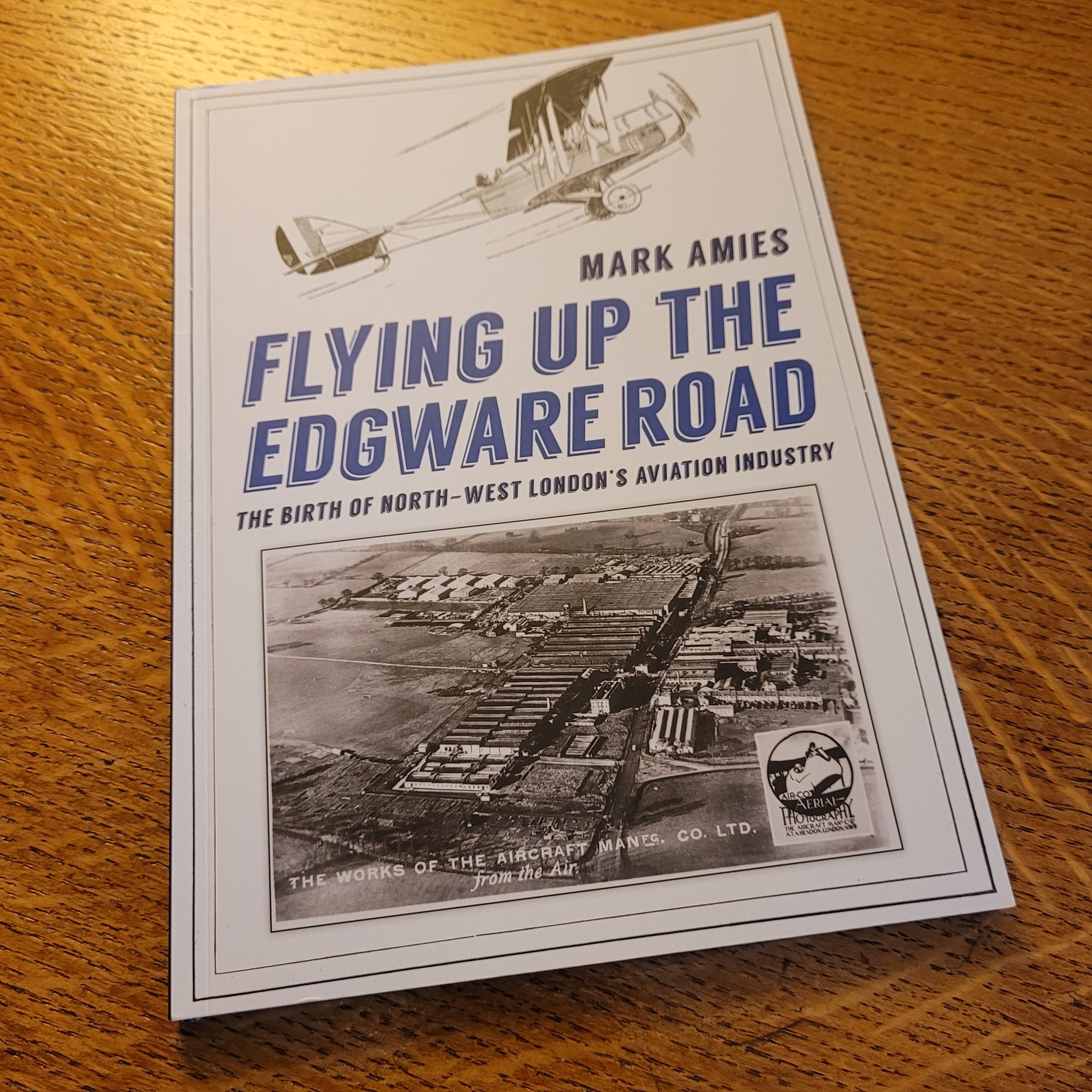
Local history - Flying up the Edgware Road by Mark Amies - Book Review

Regular readers of this blog will know of my various collaborations with Mark Amies, who runs some wonderful Twitter accounts, such as the @Time_NW account, which has become the go to account for anyone interested in local history. Back in 2020, Mark wrote his first book, a very good read entitled London's Industrial Past, of which I wrote THIS REVIEW.  Mark has just released another book, entitled Flying up the Edgware Road, detailing the development of the aviation industry on the corridor between Edgware and Cricklewood.

I've been looking forward to this book, since Mark first mentioned to me that he was writing it, possibly two years ago.  I'm happy to say that I'm not disappointed and can thoroughly recommend it. 

If you've heard Mark's regular feature on the Robert Elms show on BBC Radio London, you will know that the book is written in a snappy readable style and has wonderful illustrations and pictures. It is not a 20,000 page reference book for academics, it is a book for us non experts, who want to understand the history of where we live or have an interest in the subject just a little bit better.

For me, given my families links with the aviation industry (Dad was an RAF Officer and a commercial pilot), it was fascinating. My father learned to fly on a Tiger Moth in Australia. Reading how the plane was probably made a couple of miles from where he settled in London after the war was something that seemed rather poignant. Some of the names mentioned were also people my Father knew, such as Sir Geoffrey De Havilland, who's car he fixed on a couple of occasions. 

Another part of the book which I particularly enjoyed seeing the images of the area as it used to look. Mark put a huge effort into sourcing the images. The book is a clear labour of love and one aspect of Mark's writing I particularly like is how he's told the story of what happened to the buildings and sites mentioned. I was particularly interested in the section on De Havilland in Stag Lane as I worked in their old building on De Havilland Road between 1988 and 1991 when I worked for BACS Ltd. The building was adorned with many old pictures of the site when it was used for aviation. I wonder what happened to those when the company moved?

This is Mark Amies second book and he is really starting to find his feet as an author. Whilst the first book had a series of stand alone articles that were interesting and it was a good read, this has a lot more consistent feel. If you live in or around the area or have an interest in the aviation history of the North West London, it is well worth the cover price.

It is on sale at the RAF Museum in Hendon, as well as all good bookshops. If it's not in stock, it can be ordered. It is published by Amberley.

Back in January 2020, I made a short film with Mark when he was researching the book, where we looked at some of the artefacts from the Airco factory, the largest aircraft factory in the world in 1918. 

Tuesday, 15 November 2022

100 Years of the Burnt Oak - A Barnet Council film + three other amazing Burnt Oak films

 If you are interested in Burnt Oak and it's history, check out this out. It has been produced by Barnet Council and is a very interesting video. We've also added a collection of other great videos that feature Burnt Oak. We hope you enjoy them, it seems that the current and former residents of Burnt Oak love a bit of Burnt Oak history.

Barnet Council History of Burnt Oak Film


Another bit of Burnt Oak history you may enjoy is this short clip from The Professionals, speeding through Burnt Oak back in the 1970's

Going back to 1948, there was a tragedy in Burnt Oak, when a plane hit a trolleybus. This was recorded by Pathe News.

And finally, we have the latest Burnt Oak sensation, the Burnt oak Boogie, feeturing film from both 2022 and footage from back in the day.

IF you enjoyed the Burnt Oak Boogie, you can see the False Dots perform it live at The Dublin Castle in Camden Town on Weds 23rd November - Tickets in advance from here https://www.wegottickets.com/event/559671

Tuesday, 21 April 2020

#Lockdown stuff - The best short films by The Barnet Eye about our locality

If you are like me, in lockdown, in Furlough and getting a bit bored, it is always good to find "stuff to do" that is free and (hopefully) interesting. In normal life, often we skim through things, start to watch youtube clips, get distracted and move on. Now we have time, why not go back to those things? If like me, you've suddenly found all of the films you want to watch are behind paywalls, finding stuff that is free is great and if it's about your locality, what could be better?

The Barnet Eye has made many short films about our neighbourhood. Some on our own and some in association with other people. I've spent the last couple of days watching some of these again. Many of the items are very 'of their time' ( I can't imagine too many people viewing videos of councillors who the voters kicked out years ago, being too exciting), but some are well worth a revisit.

When I started making films for the blog, I made a conscious effort to make things in a very grassroots, localised manner. I had hoped that this would inspire other local film makers to also put footage out there. I had two criteria, the footage had to be interesting and/or relevant to what was going on. It put stuff on the public record. I think all of these films are both interesting and relevant. They are listed chronologically, oldest first. In their own way this tells a story, it chronicles our community and it shows how we've changed as a community over the years. 

Here's my pick for you, with a few words why I've chosen them.

1. I'll start with one of my favourites and one of the saddest. A short film I made on the day Church Farmhouse museum in Hendon closed. The interview with Gerrard Roots, the former curator is fascinating and heartbreaking.  The museum was a treasure and watching this now is quite hard. I've never really understood the logic the council deployed in closing such a gem. If we lose civic pride, what else is there. 


2. A Tale of Two Barnets.
Directed by Charles Honderick, produced by me. This film was an effort to show all of the things going on in Barnet in the year 2012. I think it does that successfully. It was perhaps a tad over ambitious and we learned a lot about the problems of filming people in noisy places who didn't really like talking to camera. We were editing this and adding to it until the night before the Premier at the Phoenix in Finchley and to some extent the sound quality suffered in places. I think it is fascinating to watch and to see how things have worked out. Sadly some of the people in this, such as Stan Davison and Susan Sullivan are no longer with us. It is nice to see them again. The intro is by Ken Loach.


3. Colindale Foodbank.
I made this to help Colindale Foodbank give our community a flavour of what the foodbank do. At this time, more than ever, their services are needed. I think this is a great little film. It is a film that does what it says on the tin rather well.


4. The Barnet Freedom Pass Scandal.
Back in 2016, the local council illegally cancelled Freedom passes for people with special needs. The first many of the users knew, was when they turned up to get the bus or tube and were refused access. This blog broke the story, when Amo, a friend of mine had the experience of turning up at Finchley Central tube station to use his pass and couldn't. Amo contacted me, I wrote a blog and a campaign started. In 2018, I thought it was important to remind people of the story. Amo kindly agreed to tell his story. I rather hope that I don't have to make another film like this.


5. They Cleared Out Your Desk.
My band wrote and recorded a song about outsourcing, as an anthem for the #KickOutCapita campaign against public sector outsourcing in Barnet. We made a video to emphasise the point. It is probably my favourite video by The False Dots. Have a watch, I think it's a great tune and an excellent video. We used footage of the destruction of the National Instittue for Medical Research as a metaphor for what is happening to UK industry. It is interesting to think that this building would be at the forefront of the Covid response, if it hadn't been knocked down. One or two pedants pointed out that the NIMR was relocated to the Crick Institute in St Pancras. The point is that a world class institution was demolished and will now be flats. Barnet has been systematically stripped of its jobs, culture and history. This is a theme I am keen to return to. I thought I'd only include one music video in the list, it had to be this one


6. This is one of several collaborations with industrial historian Mark Amies, who has made a name for himself with his slot on BBC Radio London on the Robert Elms show. This one featured a trip around the train depot at Cricklewood. I believe this will be a film that gains a lot of interest in years to come, as much of this will disappear when the new Brent Cross Station is built. This was the first documentary film I actually enjoyed making.


7. How the Town Team is building a better Cricklewood.
This film is a nice little effort, documenting how the Cricklewood town team are doing great things for their locality. Such people seldom get the accolades they deserve. I rather hope that anyone else wanting to put a Nieghbourhood Forum together might find this useful as it shows what you can do, if you have the right people on board.


8. The Airco Story in Colindale.
Another collaboration with Mark Amies, detailing the history of aviation production in Colindale. I think this is a great film, well worth watching if you have an interest in local history. I enjoy working with Mark. He is well informed and intelligent, so it is easy to put things together which are interesting and informative.


9. The Fall of Edgware.
This is another collaboration with Mark Amies, detailing the way Edgware has sunk from being a go to High Street to being run down, shabby with a rubbish dump visible from space. Heartbreaking for locals. We spoke at length about how we would get the message across. The footage really speaks for itself, but Mark managed to add a narrative that really brought home what we were trying to say. It worked, this is our most viewed documentary film on Youtube.


10. Aviation mural unveiled at Cricklewood.
If you have local councillors who care about your local history and wish to commemorate it, so that we can be inspired to greater things, you get a very different outcome to what has happened in Edgware. That is why Cricklewood has become nicer as Edgware has rotted. This mural is an example of what you can do it you have the will. I've always tried to show the good things in our community as well as the bad.


And finally, I finish with something that I did this week. A reading from my forthcoming autobiography. Unlike the rest of these, this was very much off the cuff, but I thought you might appreciate a little insight into the bloke who puts this blog together. This is the story of our first recording.


Monday, 30 March 2020

Memories of the M1 coming to Mill Hill - A Guest blog by Chris The Millhillian

Bunns Lane station car park site 1968
I was informed that you had recently posted pictures of Mill Hill and made reference to the days when the motorway came to town, I remember it well. It certainly changed our small town for ever and that peace that went with it at the time when the six lanes suddenly started appearing aloft on huge concrete pillars and beams constructed at the end of the Broadway. This certainly marked a noticeable change in the character of the town.

The old Midland Railway Cottages. Hunt’s boilers Merchants, the florist shop and several small shops in station Road were demolished very quickly as well as the railway bridge to make way for a huge hole which was dug in the ground. The best thing about it was that there was no more flooding under the old circular arch Victorian railway bridge and double decker buses could then travel on to Edgware, rather than turning around at Mill Hill.

I played on the motorway site with the other local boys who lived up a few doors from you in Millway. We accessed the site from the end of their garden and watched as the old allotments disappeared. I remember when the lanes were just laid with a gravel surface waiting for the concrete road surface to be poured. There was a huge pile of sand by Lilley Lane Foot Bridge and I was told that some kids jumped off the bridge onto it and sustained injury for their efforts.

My brother and I used to look at the futuristic picture placed under the emerging motorway bridge showing the modernistic bus station and supermarket soon coming to town in what is now the M&S supermarket car park. Your Dad’s MacMetals yard was also affected by the new motorway as it ran alongside and the old coal depot was used to house motorway construction workers in big grey sheds.

My brother took quite a few cine pictures of Bunns Lane and the Broadway and filmed a journey he made with in a truck travelling along the new motor ay,  passing behind your house whilst riding on the gravel surface,  proceeding to tip hard core for free as all local builders were invited to do that.

I attach a picture taken around 1968 of Fanning builders yard with its Thames Trader lorry parked outside. I hope that the Hendon Times will  at some point upload the picture of your family in January 1963 building an igloo in the back garden.
--------------------------------------------------------------------------------------------
Guest blogs are always welcome at The Barnet Eye. Chris the Millhillian was born and raised in Mill Hill.

Monday, 9 March 2020

The interesting local history of Scratchwoods in film and the M1 Junction 3

Many locals are familiar with Scratchwoods open space, across the UK, far more are aware of London Gateway services. It is quite interesting to note how many local people don't realise that this major hotel complex has a Mill Hill, NW7 post code, or have even stopped by there. This could well be because it is almost impossible to access from Mill Hill. Although I know many people who have worked at the site, it is completely off the radar of local residents. You actually can access the services from Mill Hill, there is a slip road, but it has an ANPR controlled access and only those on 'official business' are allowed to use it.

https://pathetic.org.uk/
Following our blog about the M1 and Mill Hill, many  people asked me why there is no junction 3 on the M1. The reason is that Scrtachwoods was meant to be the site of this. The idea was to connect the M1 and A1 at Stirling Corner. There is a great map of this proposed link on the Pathetic motorways site. Given that there is a constant stream of traffic on the A1, from Stirling Corner to the North Circular, whilst the M1 is normally relatively quiet, this seems a rather odd scheme to abandon.

The Pathetic Motorways site explains

Well, the first proposals for the Stirling Corner Link turn up in the late 1950s, when the M1 was still planned to head all the way to Marble Arch. In 1961, the Link was part of the firm proposals for the Hendon Urban Motorway - or what we know as the M1 today between Watford and the A406 North Circular Road. Indeed, if you look at that section of the M1 today, it's remarkably quiet, even at peak hours - simply because all of the junctions south of Watford point away from London. No traffic heading from London can exit the motorway until it gets to Watford. You're not allowed to escape!The Stirling Corner Link would have changed all that. Indeed, there are maps in existence that show a fork junction to and from the south only rather than the roundabout as constructed. Well, half-constructed.For some reason that I haven't yet got to the bottom of, it wasn't constructed along with the rest of that section of M1 in 1967, but it still appers in the roads programme all the way to April 1976 - but by August of that year it had been cancelled in the public spending cuts of the time.And that should have been the end of the story - and indeed as far as the motorway link was concerned, it was. However, the road would not stay dead forever. In 1989, the then-Government announced Roads for Prosperity, a sudden return to the roadbuilding programmes of the past. Hidden down amongst the "all-purpose schemes" was the Stirling Corner Link. Renamed, of course, to the Scratchwood Link just to keep us all on our toes and although it was planned to be a three-lane wide dual carriageway, it was not to be a motorway scheme. The Scratchwood Link was one of the schemes put out to private tender in April 1990, but progress in getting the road constructed was non-existent and the road itself was re-cancelled in the cuts of 1994, seemingly never to return.
Courtesy ;https://www.s-r-s.org.uk/html/lmsr/M193.gif

The services were constructed on the site of the old Scratchwoods ash sidings. Until the early 1960's, Britains railways was operated by coal fired steam engines. These produced a huge amount of waste ash. Much of this in North London was dumped at Scratchwoods Ash sidings. There is an old layout map of these on the S-R-S website (Hat Tip to Robin Morel at Network Rail for the map)

I must thank Murray Anderson for drawing my attention to the fact that a major film had sequences shot in these sidings in 1961. The film starring Dirk Bogarde saw an old LMS locomotive dressed up as a German ammunition train and blown up in the sidings. If you forward to around 13.30 you can see the sequence and how the London Gateway site looked in 1962!


There are also scenes filmed in Mill Hill on Milespit Hill and in Cricklewood Railway shed. You can see these at https://www.reelstreets.com/films/password-is-courage-the/.

The services and Motel were opened in 1970. The full history of the services is detailed on the Motorway services online site. Interestingly, there is an episode of Minder called The long ride back to Scratchwoods. Interestingly, it wasn't filmed at Scrtachwoods, but at Heston Services on the M4!

A fact that not too many people know is that the guns of HMS Belfast, preserved on the River Thames, are targeted on Scratchwoods Service station.  To quote the Londonist
According to the ship's Chief Yeoman, Kevin Price, Scratchwood was picked on because it was a well-known landmark on the M1 motorway. "We could also hit Cheshunt, or Gidea Park, or fall just shy of Dartford," he tells us. Scratchwood, though, has a certain quotidian monotony that invites comparison with Betjeman's "come friendly bombs" prejudice.

There is more to Scratchwoods than the services. The nature reserve is also a popular film location, being used in several Hammer horror films produced at Elstree Studios, including Taste The Blood  of Dracula with Christopher Lee


The opening sequence, before the credits was filmed at Scratchwoods.

Wikipedia tells us that Scratchwoods is part of what was once the Middlesex Forest
Scratchwood is a remnant of the once great Middlesex Forest, and has the largest area of ancient woodland which survives in Barnet. Parts of it may go back to the woods which grew up after the end of the last ice age, the Younger Dryas, 11,500 years ago.[2][5] The ancient woodland consists mainly of sessile oak and hornbeam, with some wild service trees, while secondary woodland areas are mainly birch, hawthorns and sycamore. In the view of the London Ecology Unit, "Scratchwood is the Borough's best woodland in terms of floral diversity, especially of ancient woodland indicator species". The herb rich grassland and the pond have a number of rare plants. Breeding birds include nuthatch, lesser whitethroat and cuckoo.[2][6]
The Mill Hill Historical Society put out a tweet with some interesting maps charting the decline of the Middlesex forest


It is a shame that with all of this history, locals don't always treat the park with the respect it deserves.

.In the Borough of Barnet we are lucky to still have such amazing green sites. The reasons I spend so many hours writing blogs such as this is to ensure that our heritage and history is preserved and people appreciate the blessings we have. So please, clean up your mess!

Wednesday, 18 December 2019

A few shady tales from the studio archives

The Barnet Eye is done with politics for the year (barring major stupidity or catastrophy). We are sick of the whole business and we are pretty sure you are. Between now and the new year, we'll be trying to have some fun and cheer you all up, or if you are already cheerful, to raise you to a state of ecstasy. There have been a plethora of people saying their writing books about our locality. Some of these, such as that by BBC Radio London industrial historian Mark Amies are eagerly awaited and promise to be a brilliant read. Some are less eagerly awaited, but I am sure that if nothing else, they will make good linings for our budgie cages. I recall the excitement when "Mill Hill as it was" was first released in the 1973 by Clive Smith. It is instructive to think that some of the pictures were less than 46 years old (how long since that book was published). Mill Hill changed beyond recognition between 1927 and 1973, although many things have changed since, it is still recognisably the place it was then.

Whilst I love old pictures (and new ones) of Mill Hill, I have always been far more interested in the stories behind them. That is one of the reasons that I love recounting the stories from local characters such as Richard Wilkinson, with his tales of Mill Hill in the 50's, 60's and 70's. Richard collated a list of local history sites that is well worth checking out. I've recently written a book about the history of the studios and my band. What I didn't include (maybe I should have) were some of the tales of the nefarious characters that used to frequent my music studios in the earlier days. These days we seem to have a far more respectable customer base. But these stories have long been told on drunken get togethers of old studio partners and customers. Here are a few of my favourites. No names named


The Gangster.
One of our best customers in the mid 1990's was a rather interesting chap, who started managing a bunch of herberts, who were actually a rather decent Mod band. He'd taken them under his wing and 'had contacts'. he thought the time was right for a new "The Who".  One day, after paying for a rehearsal, he asked myself and Ernie Ferebee (my old business partner) for a beer. He wanted to pick our brains on what we thought he should be doing to increase the bands chances of success. Once we got chatting it became pretty clear that not all of his cash had been acquired entirely legally, although given his name, we were not entirely surprised. His family were rather well known in certain circles. Anyone who has seen Slade in Flame will recognise the management technique. He was pretty good company, with many tales of nefarious deeds, most of which were shockingly believable. Ernie himself came from a rather well known East End family. His father Nod had been a bare knuckle boxer in the 1930's and was often used as security when bullion was being transported to and from the Bank of England, his reputation was built on the fact that no one had ever even tried to rob the money on his watch. Even when he was in his 70's, he was a fearsome man, although always great company with me. Ernie and his brothers were 6' 6" but Nod would pick them up and bang their heads together when they annoyed him. Ernie and the said chap were discussing tales of dodgy goings on. It turned out that an acquaintance in the motor industry of Ernie had fixed the said gentlemans car once and found someones nose in the ash tray. When asked what to do with it he replied "throw it in the bin, he won't be needing it". There had been a well known gangster who had been shot in the head recently. Ernie mentioned it and our new friend said "Never shoot them dead, once the funeral has gone it gets forgotten, if you cut their nuts off, then they'll spend the rest of their lives spreading the message not to mess with you". I think both Ernie and I clenched our buttocks together rather tightly at that. Sadly the band didn't last very long. They were rather good. The gentleman in question passed away several years ago. Much to my surprise of natural causes, surrounded by his family.

The Bank Robber.
Another interesting customer was a convicted bank robber. He'd shared a cell with the previously mentioned chap. When he was released, the above mentioned chap asked him to get a band together for a record label he was planning to set up. He recruited Graham Ramsey, the False Dots drummer and a bevvy of other musicians. He was actually a pretty damn good rock singer and the rehearsals were progressing well. One day, out of the blue, I got a visit from a Police Officer. The Officer said "I need to have a word with you, you've been given as an alibi by a suspect in a robbery". When I enquired, it turned out it was the singer in Graham's new band. The officer said that I could confirm his wherebouts between 7pm and 11pm on the day in question.  As I'd opened and closed the studio on the said day, I checked the diary and said "Yes, I can confirm I let the band in at 7pm and out at 11pm and he was there". He was a larger than life character and I was 100% sure. The officer then said "What about at 8.15pm?". I said "I wasn't there at the time, but if bands book a session, it would be pretty unusual if they didn't have a rehearsal and they definitely had as they played me a number they'd been working on when I came to lock up". The officer then showed me CCTV pictures and said "Do you recognise this man?". It was as clear as daylight that it was the singer of the band. The time was 20.14. All I could say was "Well it looks like him,but they definitely rehearsed and I took the payment for the session". I showed the officer the records and diaries. He informed me that I could go to prison if I was lying. I was rather affronted and said "how the hell could I forge these?". I suggested that he spoke to the band. The next time I saw Graham, he told me that the singer was back inside. Despite his watertight alibi, they'd arrested him and faced with the pictures, he'd owned up. He'd turned up for the rehearsal and just after 8pm, he'd told the band he had "dodgy guts and needed to go to the bog" and suggested they play through a number. His brother had picked him up, they'd sped around to the off licence in the Green Man and robbed it with a gun, zooming back to the studio. The band hadn't even really noticed he'd been gone. He might have got away with it, but a member of the public took his brothers car number and with the CCTV footage, he was bang to rights. Interestingly, despite having nicked a couple of hundred pounds in cash and some whisky, he'd claimed he was skint when it came time to pay for the rehearsal and promised to pay the rest of the band next week. This was actually a good thing as it meant I was in the clear with regards to receiving stolen cash. An interesting footnote was that a couple of years later, the copper who'd interviewed me had turned up at the studio and bought some strings. I asked him about the whole thing. He'd said that the reason he'd got caught was he took off his mask as he left the shop and this was right in front of the CCTV camera. He said that at first he thought myself and the band were in on it, but after interviewing everyone and when the truth came out, he realised that the whole thing had been carefully orchestrated. He said "It was a lot of effort to go to for a few quid and a couple of bottles of whisky".

The Scammer.
Now you may think that all of the dodgy customers are male. This is far from the case. There was one extremely beautiful and capable singer who used to frequent the studio. She was one of the most charming and alluring women I've ever met. One day she turned up and said "can you possibly give me a receipt for the last six months studio sessions?". This is a very normal request, but she then said "Look, I'm having some problems with the record label, they are being difficult. Could you put the receipt for the whole day rather than three hours on these dates. I'll be booking more sessions and some recordings soon.". Unlike today, where we have an online booking system and it's all electronically recorded, in the 1990's it was a paper diary. As our sympathy was with an artist being mucked about by the label (and because she was very persuasive), we agreed. She then booked up a couple more sessions. She then said "Listen the label require four copies". I asked who they should be made out to. She went in her purse, got flustered and said "Oh, I've left the details at home don't worry about that I'll fill it in". So we left it blank. I thought no more of it. About three weeks later, she told us she was moving to the states and bought me a bottle of Scotch. There was a major tour there and other opportunities. This was great news. I thought no more of it until about three weeks later. A very disgruntled gentleman turned up and demanded to see me. "Are these receipts genuine?" he enquired. "Who are you?". I was informed that he was the artists manager. I said "Yes" and said I could show him the diaries and asked why. He said that she'd moved to the states and knocked him for a fortune. I asked how. It seems that a lot of money had been advanced to book up recording studio time, that had to be "Paid for in advance" for a good price. She'd scarpered with the money. I asked "Did you have a contract with her?". He said "It's still with her lawyers". I simply replied "Oh Dear". After he departed, I couldn't help sniggering. Ernie said "Mugs and their money are soon parted, but we later admitted at the pub that she was rather convincing. Imagine our surprise over the the next couple of weeks when two other chaps turned up telling the same story. We kept pretty quiet and feigned surprise. We calculated that in total she'd cleared about £60,000 in cash. A couple of years later, I was having a beer with Ernie and out of the blue he said "You know what, she wasn't as clever as she thought as she was a great singer and really could have made a career out of it".  When I considered the whole thing, it was true. It is funny how many of these scammers would have actually made far more money if they'd put their efforts into actually being artists.

The "Owner's best mate".
I don't make a big song and dance of owning the studios. It is far less hassle to keep quite and sit in the corner most of the time. When Ernie was studio manager, we had one customer who was always trying to get a good deal. One day I was sitting at the desk trying to fix a guitar, when the said individual emerged. He wanted to book three days recording for a project he was working on. As is often the way, there is a discussion as to how much the session would cost. As Ernie was explaining why he couldn't give the discount that was being asked for, the said individual replied "Listen, I'm the best mate of the owner of this place and he told me that I'd be properly looked after". Ernie shot me a glance and I started to chuckle. As I'd been doing some building work, I was in overalls (running studios isn't all glamour). I just sat back and thought I'd listen to the tale. Ernie said "That's interesting, how well do you really know him?" The response "We were around their last night, our kids go to the same school". That was quite interesting as my eldest, Maddie was only two years old.
Ernie then said "Well, we'll book it in at the full rate and then when he comes in I'll ask him".  At this, he seemed to be quite pleased. About a week later, a rather amusing thing happened. Another customer of old turned up. He said "You took a booking from a mate of mine for recording, can you do anything on the price?". Ernie was a bit shocked (I wasn't in the shop). Ernie enquired why. Eventually the tale of woe emerged. The guy who'd booked the session had been lead to believe that the the other customer owned the studios. They had been doing some business together, and to enhance his credibility, one had mislead the other to believe that he was the owner, but he didn't spend much time at the studios as  the team did a good job. When he started pleading that if a discount wasn't applied, he'd lose face, Ernie said "well why don't you pay for half of it then?".  At this, he said "Why should I?". Ernie replied "Well if you don't you'll look like a prize plum".  Eventually, he paid £50 towards the session. He would probably have gotten away with the whole thing, apart from the fact that when the recording was taking place, it turned out that one of the musicians he'd recruited was a friend of mine. AS the recording was progressing, he mentioned that he'd got a discount as he knew the owner, at which my friend said "I didn't know you knew Rog?". The reply of "Who's Rog" was met with "He's the owner". At that they both trudged down to see Ernie. The customwer who booked the session enquired "Who actually owns this business?" Ernie replied "Rog does". Then he asked. And what does my friend ******* do here? Ernie, ever the diplomat, replied "Oh, he is out number one salesman, he brings loads of business in". Ernie explained that he always gets his customer a great discount, so we let him say he's a co-owner. Ernie then said, "He got you a pretty good discount didn't he?" that seemed to defuse the situation.

About two weeks later, I was in the shop when the said "Owner" popped in. Ernie cracked up when I said "Evening boss". He looked a little sheepish but after that it became a bit of a standing joke.

These days, we are all far more respectable. I miss the old days and the old characters. Sadly, all of the characters mentioned in this have either passed away or disappeared off the face of the earth.

Saturday, 9 January 2010

Unfinished London - A fantastic Youtube documentary

If you are interested in local history, check this out. It's superb. Thanks to Caroline Gold for the heads up