Showing posts with label Margaret Thatcher. Show all posts

Tuesday, 1 March 2022

Why it's all Margaret Thatchers fault!

 I'm sure all of you (except those who were locked up in prison with no access to the Internet) vividly recall the Saturday list I published on 13th April 2013. NO??? Let me jog your memory. It was entitled "10 things that changed as a result of Margaret Thatcher". What! You stlll can't remember? Let me remind you fo the list

1. The Conservatives became Eurosceptic Party. Under Ted Heath they were avidly pro European.

2.  Vital nationalised industries disappeared into foreign ownership. Steel, Rail, Airports, Electricity and Water companies, all formerly deemed vital national assets were privatised and flogged off to foreign owners.

3. Centralisation of power. Due to the political activities of local left wing authorities, huge swathes of decision making and tax raising powers were removed from local control. Metropolitan authorities were dismantled and tax raising powers were restricted. Although localism has been trumpted as "a conservative value" this is a sham as Councils cannot set taxes at levels they see fit.

4. The Europeanisation of Great Britain. Despite Margaret Thatcher claiming to be Eurosceptic, she signed the "Single European act". This piece of legislation secured the central role of Europe in British life and was the legislation that opened the way for the mass immigration from Eastern Europe.

5. Entrenched Mass unemployment. Before Thatcherism, unemployment was seen as evil and wasteful. Under Thatcherism it rose to over 3 million and has never truly recovered. One of the most unfortunate side effects of Thatcherism was the culture of benefits dependency. Whole swathes of the country had industries destroyed. In the absense of new jobs, generations of families have embarked on new careers as welfare dependents.

6. Downgrading of the Armed Forces. Thatcher presided over the biggest run down of military capability in the history of the British Armed forces. Had the Falklands been invaded two years later, the Navy would not have had the capacity to retake the islands. Despite the ever increasing number of commitments, budgets and capabilities have been trimmed virtually every year.

7. Destruction of the consensus on education.  Despite having presided over the near destruction of the Grammar School system of Education under Ted Heath, as education secretary, under Thatcher the decline of the Grammar system was halted and reversed. The political consensus that the Grammar system was not fit for purpose was destroyed. The concept of parental choice as adopted as the new holy grail in education.

8. The rise of homelessness in Great Britain. In the 1970's homelessness was virtually unheard of. Now it is part of daily life. This is all part of the long march of Thatcherism.

9. The demise of Social housing. Thatcher adopted the policy of selling council houses to tenants. This turned many working class people into Conservatives and introduced a previous level of aspiration unheard of in the working class. Perhaps the most contentious aspect of this policy was the fact that receipts from the sales were not reinvested in the housing stock. We now see the effects of this, with working class families unable to get accommodation.

10. The rise of the career in politics. Prior to Thatcher, most people entered politics after establishing a career elsewhere. Politicians were supported by non political civil servants. Thatcher didn't trust the civil servants and gave rise to a whole new breed of ideological appointees. This whole new race of people, living off the public purse, have grown into a very lucrative industry for all concerned. Of all the changes Thatcher brought about, I believe that this is the most dangerous and divisive. These advisers come are usually highly intelligent people, who come straight from University. They have little experience of life and no understanding of the constraints of working for a commercial organisation. They believe they "know better" and they are the people who draw up the "blue sky thinking" that influences policy.

When I reread this list, it struck me how it is the legacy of Thatcherism that has lead us to where we are today. She fostered Xenophobic anti Europeanism, that weakened the EU and encouraged Putin. The selling off of our energy industries, relying on the market desperately undermined our energy self sufficiency and made us vulnerable to reliance on Russian gas. We are not as exposed as some nations, but the UK used to be self sufficient and as it our enegery supplies were nationally owned, we were insulated against wild fluctuations in electricty and gas prices. The downgrading of the armed forces has made us impotent in the face of Russian aggression. And worsy of all "The rise of the career in politics" has lumbered with a bunch of totally useless idiots running the country. The demise of social housing, the rise of homelessness and the centralisation of power have resulted in a totally unaccountable elite whilst those at the bottom rot. Sadly the goodthings she did, such as the signing of the Single European Act, enabling us to live and work anywhere in Europe have been undone by her successors. It really is quite tragic.

Saturday, 1 August 2020

The Saturday List #273 - My top ten females with local connections

I've been meaning to do this list for a very long time. Our area has an extraordinary history in many areas, but often the contribution  of our female residents is much overlooked. It is about time that someone put that right. With Amy's anniversary it seems only fitting.

1. Amy Winehouse

A local girl, I sold her the guitar she played on her first TV appearance on the Jools Holland show, in our shop in Mill Hill. As we remember her anniversary, I am always tinged with sadness. RIP


2. Margaret Thatcher

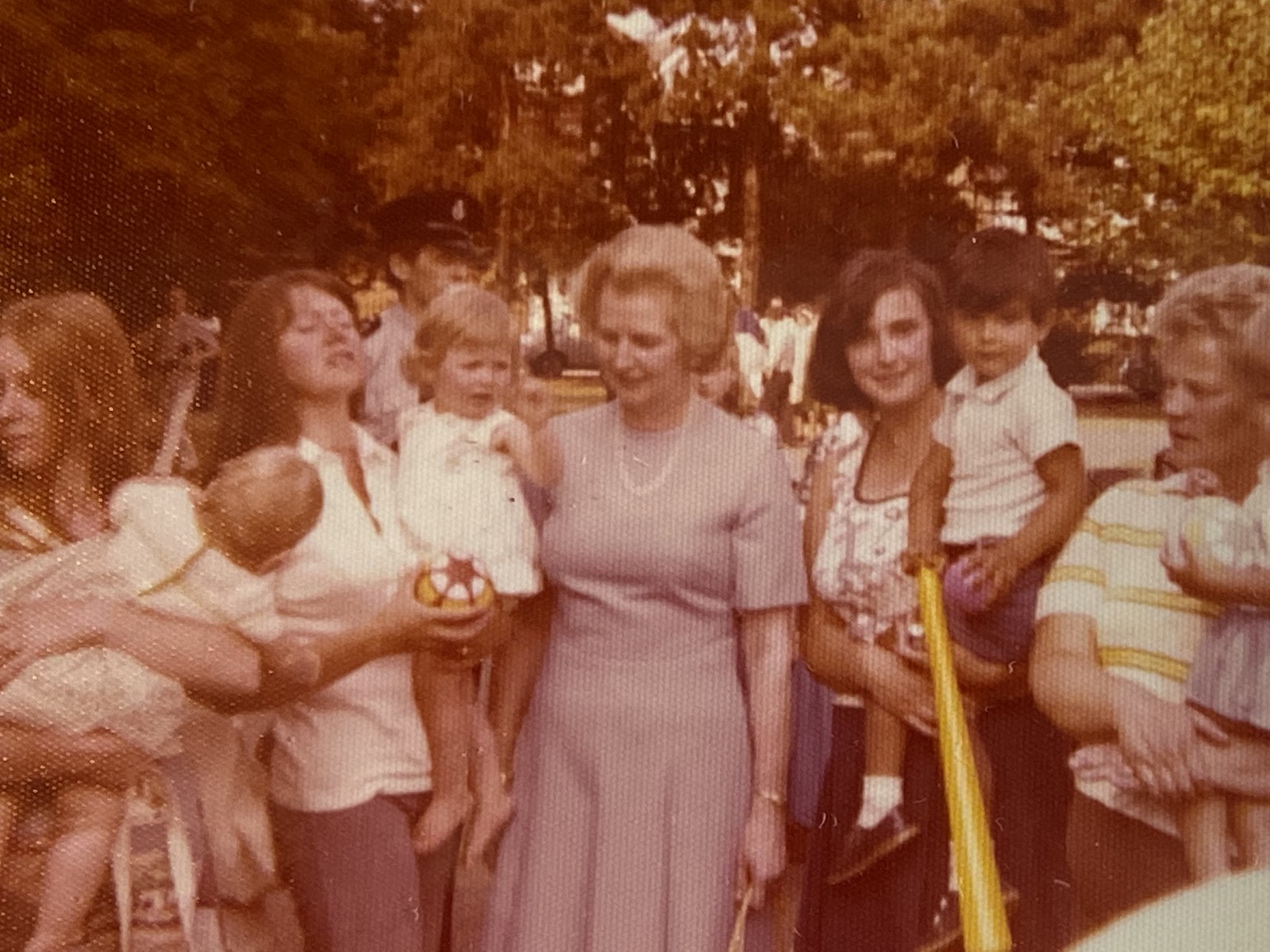
Lady Thatcher was the MP for Finchley for many years. She knew my mum and although she didn't like her politics, she admired her work rate and intelligence. Mum took this picture at Finchley Carnvival in 1972.

Margaret Thatcher at Finchley Carnival


3. Dame Vera Lynn

Dame Vera famously also lived in Finchley. It would be nice to properly commemorate the first lady of the forces locally.

4. Dorothy Squires

Dorothy was married to Roger Moore and used to live up the road from me in Millway, Mill Hill, until Roger Moore got fed up with fans spying on them when he became famous through The Saint.

5. The Beverley Sisters

Britains biggest selling female trio, all Barnet girls.


6. Kate Nash

Like Amy Winehouse, Kate won a Brit award and also bought a guitar from me at Mill Hill Music Complex, where she rehearsed and wrote most of her early albums (Her Dad is a good mate of mine). The family are from Harrow.

7.  Fenella Fielding

My brother Frank used to tell me that Fenella Fielding, of the Parish of Edgware, was the most sexy woman alive. If you watch this scene from Carry  on Screaming, I'm sure you'll agree.


8. Margaret Lockwood

Film Star Margaret Lockwood lived in Mill Hill. Perhaps most well known for the Hitchcock classic "The Lady Vanishes".

9. Lynsey De Paul

Lynsey was a Cricklewood girl. A mega star in the 1970's, source of many a teenage crush! Sadly missed


10. Enid Blyton

Did you know Enid Blyton ashes are in Golders Green cemetery. The list of the people she resides there with is fascinating, well worth a view. 

Have a great weekend!


Monday, 20 July 2015

Can Jeremy Corbyn win? Ask Margaret Thatcher

Image result for margaret thatcher wins election 1979

Firstly, let me start by saying I'm not a Labour Party member, so I won't be voting in the forthcoming leadership election. That said, I do have an opinion on the outcome. Personally, I see the only twwo credible candidates as Liz Kendall and Jeremy Corbyn. Cooper and Burnham lost any shred of credibility by going along with collective "head in the sand" strategy to the clear fact that Ed Miliband was taking the bus off the edge of the cliff. Unlike Cooper and Burnham, Kendall at least appears to have some understanding of the fact that you don't win elections if the voters haven't got a clue what you stand for.

Of the four, she's perhaps the nearest thing to an electoral banker, as she's a Blairite and whatever you think of Blair, he clearly knew how to win elections. She isn't perfect, but I suspect that with five years of practicing and with all the heavyweight support from business and the luvvies a Blairite can come to expect, she'd win. It was clear that Cameron won because he was able to scare the hell out of floaters, who didn't trust Miliband and didn't really know what they'd get. This wouldn't work with Kendall. We all know what we get with a Blairite. It isn't really my idea of Labour politics, but it is a damn sight better than a Cameron/Osborne full frontal attack on the welfare state and the weakest people in the country.

But what about the fourth candidate, Jeremy Corbyn. Labours Blairite flunkies have been queueing up to denounce him. They've been saying he'd make the party unelectable and that voters would run a mile from Labour if ever he became Leader. They say he is an extremist and he'd keep Labour out of power for a generation. The problem, as they explain it is that Corbyn is not in the centre and he is a man of conviction. They say that to win an election in the UK, you have to be in the centre. Corbyn is lodged firmly on the left.

So are these siren voices right? Perhaps the only example we can look at, of a leader who was a conviction politician, far from the centre was Margaret Thatcher. when she took over the Tory party, many of the old Tory Grandees fell into a state of shock. A new term was coined for what we may now consider the likes of Cameron. They were "The Wets". Those who allowed the concept of appealing to the voters to get in the way of hard right ideology. Thatcher had little trck with these, although she had to accomodate them in her cabinet, to ensure that she had the support of the party. The likes of Ken Clark, are the last of the old guard of wets. So how did the populace respond to Thatcher? Well they all knew where she stood. In 1979, she won  a small but workable majority. She embarked on the most radicle program of reforms our society had ever seen. By 1981, the economy was in virtual meltdown and the Tories looked to be heading for the door, at the first go. Then she got lucky. In 1982 General Galtieri in Argentina decided to invade the Falklands, Thatcher rallied and by the following year, the myth of the Iron Lady was secure and she won a landslide. Thatcher won three election. The siren Blairite voices site the failure of Michael Foot as the proof that a lefty can't win. However they overlook several factors. The 1979 crop of Blairite equivalents defected and formed the SDP. This ensured that Foot couldn't win. In the aftermath of the Falklands, Foot was on a hiding to nothing anyway, but the fact that his own party was at war finished his chances off. Had the likes of Williams, Owen and Jenkins stayed and fought and not split the Left vote, who knows what the reslt may have been. The only thing we could be sure of is that Thatchers majority would not have been bigger if the SDP rump hadn't split.

What Thatcher proved was that the British can elect a conviction politician who is not from the centre ground. If the electorate gets fed up with centrist conformity and fudging, then sooner or later they want someone to bring in a fresh approach and to shake things up. Could Corbyn do this? Well his announcement that he'd abolish student loans and go back to the old system of grants is one policy which is a definate vote winner. I don't know of a single parent who likes the system of loans. I hate the concept of my children being burdened for decades with debt. I also wonder how Cameron would deal at the despatch box with someone who actually believes what he says and has spent decades forming his opinions and researching them. I suspect that Cameron would find it a totally different sort of experience, than the current situation, where both leaders are given a short briefing on current issues and affairs.

Corbyn would energise the parts of the Labour movement that work hard, such as the Trades Unions and the local activists. There are many things we can't be sure about, but it is a safe bet that the one potential Labour Leader the SNP fear is Corbyn, as he is the type of Labour Leader who could see their huge victory in Scotland turn into a one parliament aberration.

The right wing press is seemingly licking its lips at the prospect of Corbyn vs Cameron at the despatch box. I am not so sure that this will work out quite how they expect. We've had 25 years of people facing each other off, trying to say what they think voters want to hear. All of a sudden, we'll have someone saying what they believe - something which hasn't happened since Thatcher was in charge. How will this work out? I think two things will happen. Firstly Cameron will start to apper very shallow and weak. Secondly people will start to take an interest, in a way they haven't for a long time.

I am quite taken aback by some of the vitriol and some of the dishonesty poured on the Corbyn campaign. I can give a couple of examples. One comment was that Corbyn would have the same disasterous effect on the UK economy as Syriza has had on Greece. This is completely dishonest. The problems of Greece are nothing to do with Syriza which has been in power only for a matter of months. The country has been mismanaged by governments of the left and right for decades. Syriza is just a desparate outpouring of anger at the fact that billionaires pay no tax, whilst ordinary people are forced into poverty by austerity. I've yet to see anyone suggest anything which could actually help the people in Greece suffering from austerity, so why is everyone saying Syriza has been a disaster. Anything would have been a disaster for Greek voters. The only difference is that Syriza have attempted to share some of the pain with EU financiers.

Another highly dishonest charge made against Corbyn is that Labour will go into meltdown and collapse. This is a myth Tory bloggers at the Spectator are keen to circulate. We can only speculate as to why.  Corbyn as Leader would pose a huge challenge to the Blairite faction of the Labour Party, but there are two reasons they will not immediately jump ship. The first is that they will think a Corbyn Leadership is likely to implode and leave the floor clear for a Blairite. If Corbyn doesn't work out, they will surely have won the argument for years as to the future direction of the party. As soon as Corbyn takes the keys to the bus, they will be in the back seat plotting. Whilst many recognise that at the moment a Blairite manifesto is a bridge too far for man, a Corbyn disaster may open the gates in a matter of months or years for a full scale coup. The second is that if Corbyn doesn't collapse and does catch the public imagination, they may get the old ministerial limo's back if they play ball. They will also at least get some sort of opportunity to shape the manifesto of a party of government.

Living in the London Borough of Barnet, there is one issue that cannot be ignored. Corbyn stated that he views Hizbollah and Hamas as friend and this has caused uproar in the local Jewish community. There is a feeling that a Corbyn leadership would destroy Labour locally. My view is that unless they elect a full on Blairite, this damage is already done. I personally find such statements to be ridiculous. I would have thought  that appeasement of such extremists would have long ago been discredited as a strategy for dealing with such organisations. Whatever you may think of Israel, I cannot see how fundamental Islam can be viewed as a positive force in finding a apeace settlement. Hamas and Hizbollah are commited by constitution to the complete annihiliation of Israel and its Jewish residents. I can't see how such a stance can be anything other than destructive.

However The London Borough of Barnet is not the UK and whilst such statements play badly with the local electors, in 99% of seats it will have no effect at all. Had Labour had Corbyn as Leader, I am certain Labour would have more seats than it has now, even if only because they would not have faced Scottish wipeout. I cannot see any circumstances Labour will win a majority in 2020 without a radical rethinl of what they are, who they appeal to and how they conduct their campaigns. In the election in May, most people saw them as irrelevant. They failed to connect with even their core voters. No one knew what Miliband really stood for and he made no case for any policies. At least Corbyn with his policy of abolition of Student loans has shown that he understands that you can't all sing from the same song sheet. It seems we only get a leader who is unafraid to break with a failing consensus once in a blue moon. Will Corbyn be the next Thatcher, a conviction politician, loved and loathed in equal part? I have no idea, but I for one think that any Tories who celebrate should Corbyn win, will live to bitterly regret it, just as all of the Labour Mp's who saw the election of Thatcher as Tory leader in the 70's saw here as "Keith Josephs puppet" and an abberation bitterly lived to regret the fact that they didn't realise people actually trust people who speak their mind and stand up for what they believe.


Sunday, 23 November 2014

The White Van Man problem - Thatcher Vs Thornberry

There are two pictures on the left. What can I surmise from them? Lets consider the image on the right first. What can we conclude without drawing any stereotypes? Well we can conclude that there is a house occupied by someone who has a job and likes football. The picture was taken a day after an England match, so the owner is likely to care about there national football. There is also a smaller flag with an emblem for West Ham United. This means that the owner supports a team that has a tradition of playing stylish football without winning too many pots.

In othere words, the owner is not a glory hunter or a fair weather friend for the team. You may say "How do you know they have a job?" Well you don't generally have a white van if you don't. The property looks to me like countless hundreds of thousands of other houses that have sprung up on estates all over the country over the last 50 years. At a guess, it's a three bedroom house. Having established the facts, now lets consider the image on the left. This is Labour MP Emily Thornberry (AKA Lady Nugee). What do we know about Emily?  Well until I started writing this blog, I knew the square root of F All. However like all good bloggers I've done my research (actually I just had a look at Wikipedia). It seems she's a barrister by trade. No problem there, my sister is a barrister.

It also reveals that she has an active interest in Social housing. Wikipedia states

Social housing campaign

During the course of a campaign run by Thornberry on the subject of social housing, the Islington Tribune, a local newspaper, discovered that her husband had bought ex-social housing stock for over half a million pounds and receives rental income from the property. It also emerged that the new residents are Labour Party activists.[48] Some related claims in the article regarding Emily Thornberry's involvement in the matter were later retracted by the paper.[49]
  So Ms Thornberry doesn't really mind people who living in ex Council houses, if they are Labour activists and pay her rent. What is 100% clear though is that Ms Thornberry is a bit of a snob. She clearly thinks that driving a white van, living in a terraced house and supporting your club and country are things to be derided and laughed at. But it gets worse. Ed Milliband was asked what he thought when he saw the image and he responded "respect". This to me is almost as bad as Thornberrys initial tweet. It is bad enough for Thornberry to take the mickey out of the image on her twitter feed but Miliband is just so patronising. So you may ask what was my first thought when I saw the image? I thought "Is that a West Ham emblem on the flag?"

When I stood for council in Mill Hill in 2010, I knocked on loads of doors in Mill Hill with England flags and white vans outside. What sort of reception did I get? A couple the door and told me to "F Off". One guy told me he was a BNP voter and to go away. The vast majority however were friendly and keen to let me know what issues they wanted resolving. Issues with school admissions, the Council not finishing work off, issues with care for elderly relatives were among the more common themes. In short, the concerns were exactly the same as anyone else.

If we consider the "white van man" stereotype for a second, a guy who has a job, drinks, smokes, bets and does a lot of driving, maybe the likes of Thornberry should be a little bit slower to look down their nose. As far as I can see, this is the man who will be paying a far greater proportion of his earnings in tax than anyone else. He gets up, does a days graft. Pays a fortune in fuel duty, cigarrette tax, alcohol tax and betting tax. Unlike the residents of £2million + mansions, he sits in the demographic that pays the highest amount of their earnings in Council tax. Due to the drinking and smoking, he's far more likely to drop dead and not be a burden on the welfare stated when he gets old. But most of all, it is the white van men who make the country work. They actually produce or deliver something. The Emily Thornberrys, Ed Milibands and rest of the political elite don't get their hands dirty. The real white van man problem is that the politcal class despise them and give them no credit at all for keeping the country on its feet.

England is a truly strange country in that I don't know another country in the world where the political elite are so allergic to our national flag. Even Alex Salmond unfurled the Saltire at Wimbledon. Can anyone imagine David Cameron draping himself in a falg of St George at a football match, or even buying some Union Jack Underpants to give Sam a cheap thrill? US presidents invariably wear badges with the stars and stripes, but the English ruling class see the flag as "something for the plebs".  What disturbs me most about this situation is that patriotism has almost become a dirty word in the UK. I am an English Patriot, as I would willingly take up arms and fight to preserve our country in the face of a threat. I'd be prepared to lay down my life if it came to it, to protect my wife, family, friends and neighbours. My father and my grandfather served in the forces in two world wars and I am immensely proud of their contribution. My patriotism is not one that wants to close the doors to the outside world, or send people home because they have a different accent. My patriotism is one that wants to see London, England and the United Kingdom be the best place in the world for all its citizens to live in. It goes further than that though. Having built the greatest nation on Earth, I think we should help other nations to reach the standards of freedom, democracy, prosperity and security we take for granted.

The reason we have net immigration is because there is inequality in the world. Until that is addressed, there will be immigration. People say "That is ridiculous, there will always be inequality". This isn't true. For centuries Ireland has seen net migration. Young people were forced to leave by lack of work and opportunities. When did this stop? When the economic situation improved.

As I was putting this article together, I thought back to the heydey of Thatcher. For all her sins, she was not someone who looked down her nose at "white van man". Yesterday was 24 years since the Tories deposed her, despite her never losing an election for them (unlike the present incumbent who has never actually won one). Thatchers secret of success with many "White Van Men" was that she realised that they were aspirational. They don't want handouts, they want the chance to work, earn money, have a house and enjoy life. Thatcher won elections because she connected with a whole section of society that had been completely out of bounds to the Tories before. Unless Labour takes swift action to address the snobbery of the Emily Thornberry Islington types, who currently run the party, they will lose the election because they have alienated a whole group of people who were previously their core voters.

Sunday, 19 January 2014

Thatcher vs Cameron - No comparison?

Margaret Thatcher was elected in 1979 and after 4 years sought re-election. David Cameron was elected in 2010 and so on the Thatcher timetable would be up for election this year. I thought it may be interesting to compare and contrast their records.

Wars
Thatcher presided over two major military conflicts in her first four years. The Falklands and Northern Ireland. The Falklands war was a major victory and will perhaps always be viewed as the defining moment of her career. At the time of the war, the USSR did not consider that the UK had the capability to mount such a campaign. The Argentinian generals did not even consider such an option, thinking Britain would roll over and say "kick me". At the time the USA had an aversion to foreign adventurism, having its fingers burned. Thatchers war changed all that. Reagan realised that a successful military excursion is good for votes. I believe the Iraq and Afghan adventures are a direct result of Thatchers PR victory. What is never discussed in such glowing terms is the Northern Ireland situation. Under Thatcher there was a terrible military stalemate, where the ordinary people suffered under a repressive state and terrorism. Thatcher never really had a clue where to start with Ulster. In my opinion her period was one of unmitigated failure, but due to the Falklands success, the airbrush has been applied.  Nevertheless, with her leadership during the Falklands conflict, no one could argue that Thatcher wasn't a proven leader in a time of war.

Cameron has presided over the Afghan debacle in much the same way. It is clear that Cameron doesn't know what to do, hasn't got a plan and is simply a passenger in the process. British servicemen die without a sense of what the mission really is. When the British and americans go, everyone knows things will soon degenerate. When the UK leaves Afghanistan, will it be a better place than when Cameron took over? I doubt it. The problem is that, unlike Thatchers Falklands war, there is no plan, no objective and no idea what we are really trying to achieve. In four years, I've yet to hear a single coherent sentence from Cameron on the subject. Whilst I believe history proved Thatchers non engagement with the IRA wrong, at least she was consistent and could elucidate why whe was persuing this course. Cameron simply comes across as vacuous.

Economy.
When Thatcher took over, Great Britain was in terminal decline. We were the "sick man of Europe". Whatever you may think of the UK when Cameron took over, we have maintained a high degree of economic prosperity and the problems with our country have not resulted in others viewing us as a complete basket case. In 1979, the UK was viewed as a spent force which had nothing left to offer. Thatcher believed that the key to fixing the economy was to cut the balls off the Trades Unions. She believed in "moneterism" (a phrase which seems to have disappeared). The first two years of her rule were met with a huge fiscal squeeze and spiralling unemployment. Thatcher despised socialism and sought about taking an axe to the low hanging branches on the tree of social government. What people don't appreciate about Thatcher was that she was firstly a pragmatist (most successful Tories are). She kept well away from the NHS and when she was looking to privatise, she picked off easy targets and by doing mass share offers that made the ordinary man a few quid, she made herself popular. The targets for privatisation were carefully picked. They were not picked for ideological value, but for the likelyhood of success. BT was the first. It was clear to all that Telecomunnincations needed deregulation. I don't think anyone can argue that privatising BT was successful. In this day and age, the concept of waiting three months for a telephone line is uniimaginable. However harsh, Thatchers medicine for the economy eventually worked. The economy was booming within ten years, Harry Enfield parodying Thatchers children with his Loadsamoney character.

Unlike Thatcher, Cameron doesn't seem to have a coherent plan or too many answers. The British economy has many structural issues to address, government debt, welfare dependency and a money supply crisis for small business. The economy has returned to strong growth in the last year, but oddly this even confounded George Osborne's own predictions from this time last year. There have been huge cuts to the benefits system, but so far this has had no effect on government debt. Unlike the Thatcher "Loadsamoney" boom, this recovery shows no signs of ending up in the pockets of anyone apart from rich bankers who started the problems. Like Thatcher, Cameron seems to like the idea of privatisation, however unlike Thatchers BT privatisation, he didn't see the Post Office privatisation as an opportunity to make the ordinary working man a bit better off. There was no TV campaign to persuade us all to buy shares and pocket a few quid. Wheras Thatcher always knew what she was doing, Cameron gives off the air of bending with the wind. I was talking to an economist, who was explaining that the most successful economic policy of the coalition was raising the income tax threshold to £10,000. He pointed out that this was actually one of the policies the Lib Dems brought to the table. No one seems to know what the basis for Camerons economic vision is. Least of all David Cameron. Unlike Thatcher, we suspect that Cameronism is a byword for bending with the wind.

Europe.

Perhaps the biggest misconception of people who haven't studied Thatcher is the concept that she was "anti European". This is complete baloney. She never advocated withdrawal. She signed every treaty put before her, most notably the single European act. This is the single most important pro euro piece of legislation. She never advocated a referendum. Thatcher recognised that the UK had to be "in the club" or our vital interests would have no protection from our European neighbours. She was a total pragmatist. She realised that the European commission was  democracy free zone, dedicated only to making itself ever more powerful. Her strategy was to limit the power of the commission in the UK as far as possible and to get the best deal possible for the UK in fiscal terms. She had no interest at all in the smooth running of Europe, she couldn't care less. She wanted free access to trade markets and as little European interference in UK affairs as she could manage. She also wanted the UK to keep as much of our cash as possible. That was her method for dealing with our EU partners. She was single minded and once they got over the initial shock, they found that they simply had to horse trade with Thatcher. To give her her dues, she was probably  the most effective UK Prime minister in protecting our interests.

Cameron suffers from a complete lack of authority in his party. Whatever he says on the Europe issue, no one believes him. He has made himself a hostage to the right wing of his party with his pronouncements, without actually buying himself any bargaining power. As with many issues, Cameron needs the Lib Dems to keep him afloat so he is stuck between a rock and a hard place. As a result he has no policy on Europe. Who knows what Camerons true position of UK membership of the EU is. Does he see any benefit? He is too scared to actually say so. Does he want to pull out? He is again too scared to say so. We expect some sort of Leadership from Cameron, but we get none at all. Our EU partners see Cameron as a man of straw, because they know he has no authority.

Social Responsibility.
Thatcher famously stated that "there is no such thing as society". She passionately believed that the UK was simply a group of millions of individuals and that we only cooperated with each other because it suited us to do so. She despised anything "co-operative". She saw no value in community and her response to the miners strike, which completely polarised the country exemplified this. Thatcher once commented that any man in his thirties on a bus was a failure. For her, the concept of having to share your personal space with a bunch of other bus passengers was an anathma. She believed that social care should simply be an act of personal charity. She despised other Tories who viewed the weaker members of society as people and people who required care. She referred to such Tories as "Wets". She despised them more than she despised Socialists and viewed them as the real enemy.

Again with Cameron, no one knows what his policy on social responsibility really is. Following the death of his disabled son, he gave interviews praising the NHS. I for one felt that given his experiences, there is no way he'd let the NHS come to harm as Prime Minister. I thought he'd see the value in what it offers. Being fair to Cameron, the NHS has had its budget ring fernced. Given the cuts elsewhere, it has to be conceded that he has shown a degree more care than may have been expected. This is perhaps the only area where Cameron has shown any social concern. The changes to the Benefit system have been cruel. The "bedroom tax" has caused real unhappinees and hardship for many. I cannot see how penalising families when a child goes to college can possibly be seen as socially fair. The rise in food banks is the most tangible sign that Cameron doesn't care. It is odd that even with Thatcher despising social responsibility, we never saw a mushrooming of food banks in the way we see today.

The working class.
Thatcher believed that the working class by and large wanted to become middle class. She believed that there were large numbers of votes to be had on council estates. She believed that the British working man was aspirational. She designed policies to try and tap into this belief. The two keynote policies were selling council houses to their owners, with the right to buy and the popularist share issues, with attendent advertisng campaigns. Millions took advantage of these policies and they voted Tory to show their appreciation. Labour never really got to grips with this assault on their core vote. This failure kept them in opposition for 17 years. Thatcher created a whole new subgenre of Tory voters.

Cameron just doesn't get the working class at all. I think it is probably fair to say they don't get him either. Wheras Thatcher always kept this group in the corner of her eye, to Cameron they are invisible. Thatcher ensured every budget in her raign always threw this group a bone of some sort, even if that was taken away elsewhere. Cameron and his buddies from the poshest public schools don't see this, so they don't know where to start. Cameron was widely expected to sweep the board at the last election. I believe the reason he failed so miserably was because he had no policy that talked to this group. Thatcher always recognised that there were working people who wanted to own their own homes, run a car and go on a holiday abroad. Cameron doesn't talk to these people. It is there children who have borne the brunt of the hike in student fees. It is them who have been fleeced by utility companies. It is them whos parents are hardest hit by cuts to Council Social care budgets.

Summary.
Whilst researching this blog, the Barnet Eye was struck by the fact that when you compare Thatcher to Cameron, the differences are huge. What is perhaps the most difficult thing to quantify is how the influence of the Lib Dems has tempered the policies of Cameron. We have to conclude that without the input from his coalition partners, Cameron would without doubt have been more harsh and more right wing. The Barnet eye believes that the Lib Dems have given Camerons uber right machine a small figleaf of social responsibility. We also believe that the influence of Vince Cable, an economist by trade, has managed to inject some sanity into the regime's economic agenda. It is impossible to be sure, but we believe that the economy would not be in recovery without this injection of sanity. The one thing we must give Cameron credit for, which I doubt Thatcher could ever have achieved is that he has managed to hold together a coalition for nearly four years of two very different parties. Whatever his faults, the UK is now experiencing strong growth, bucking the trend of the rest of Europe. I believe that Cameron is actually lucky that he has the Lib Dems as his partners. It gives him an excuse for all his errors and it gives him a safety catch on his most right wing nutcases. If Cameron loses the next election and a Milliband regime takes over, I suspect that this will be seen as a massive achievement. If the Tories win a majority, I would not be in the least surprised to see Cameron dumped in a palace coup, and replaced. Lets face it, if they could stab Lady Margaret in the back, having delivered three stunning election victories and an economic boom, why on earth would they persist with "Dave", who the vast majority of them despise.

Saturday, 13 April 2013

The Saturday list #37 - Margaret Thatcher Special - 10 things that changed as a result of Margaret Thatcher

When Margaret Thatcher became leader of the Conservative Party, back in the 1970's, Great Britain was a completely different place to the society we know and love today. Many things have changed. Here is a list of ten things which are completely different to the first day she sat down with her new shadow cabinet.

1. The Conservatives became Eurosceptic Party. Under Ted Heath they were avidly pro European.

2.  Vital nationalised industries disappeared into foreign ownership. Steel, Rail, Airports, Electricity and Water companies, all formerly deemed vital national assets were privatised and flogged off to foreign owners.

3. Centralisation of power. Due to the political activities of local left wing authorities, huge swathes of decision making and tax raising powers were removed from local control. Metropolitan authorities were dismantled and tax raising powers were restricted. Although localism has been trumpted as "a conservative value" this is a sham as Councils cannot set taxes at levels they see fit.

4. The Europeanisation of Great Britain. Despite Margaret Thatcher claiming to be Eurosceptic, she signed the "Single European act". This piece of legislation secured the central role of Europe in British life and was the legislation that opened the way for the mass immigration from Eastern Europe.

5. Entrenched Mass unemployment. Before Thatcherism, unemployment was seen as evil and wasteful. Under Thatcherism it rose to over 3 million and has never truly recovered. One of the most unfortunate side effects of Thatcherism was the culture of benefits dependency. Whole swathes of the country had industries destroyed. In the absense of new jobs, generations of families have embarked on new careers as welfare dependents.

6. Downgrading of the Armed Forces. Thatcher presided over the biggest run down of military capability in the history of the British Armed forces. Had the Falklands been invaded two years later, the Navy would not have had the capacity to retake the islands. Despite the ever increasing number of commitments, budgets and capabilities have been trimmed virtually every year.

7. Destruction of the consensus on education.  Despite having presided over the near destruction of the Grammar School system of Education under Ted Heath, as education secretary, under Thatcher the decline of the Grammar system was halted and reversed. The political consensus that the Grammar system was not fit for purpose was destroyed. The concept of parental choice as adopted as the new holy grail in education.

8. The rise of homelessness in Great Britain. In the 1970's homelessness was virtually unheard of. Now it is part of daily life. This is all part of the long march of Thatcherism.

9. The demise of Social housing. Thatcher adopted the policy of selling council houses to tenants. This turned many working class people into Conservatives and introduced a previous level of aspiration unheard of in the working class. Perhaps the most contentious aspect of this policy was the fact that receipts from the sales were not reinvested in the housing stock. We now see the effects of this, with working class families unable to get accommodation.

10. The rise of the career in politics. Prior to Thatcher, most people entered politics after establishing a career elsewhere. Politicians were supported by non political civil servants. Thatcher didn't trust the civil servants and gave rise to a whole new breed of ideological appointees. This whole new race of people, living off the public purse, have grown into a very lucrative industry for all concerned. Of all the changes Thatcher brought about, I believe that this is the most dangerous and divisive. These advisers come are usually highly intelligent people, who come straight from University. They have little experience of life and no understanding of the constraints of working for a commercial organisation. They believe they "know better" and they are the people who draw up the "blue sky thinking" that influences policy.

The reason that Thatcher changed Great Britain so radically is because every single one of the policies listed above have been adopted as the way things are in Great Britain. We had 12 years of Labour rule under Blair and Brown and Blair and not a thing changed in relation to any of them. I believe that the bile poured out by the left towards Thatcher this week is misdirected. Her legacy was not reversed by Labour despite landslide victories and huge majorities. It would be perverse for us to expect the Conservatives to reverse Thatcherism when Labour has adopted much of it. The one lesson I learned from the coalition is that the Lib Dems are the same as Labour and the Conservatives when it comes to Thatchers legacy.

I personally believe that each point on the list has damaged the interests of Great Britain, with the exception of point 4. I also believe that until the Labour Party comes up with firm proposals to throw off the Thatcherite legacy, we may as well have a Conservative government, because at least we know where we stand with them. I would urge that the most important change we could make is to reverse the Thatcherite trend described in #10 on the list. Until we get people advising ministers who have experienced the rigours of working and the stresses and strains of family life on a tight budget, we will never see any improvement with regards to the rest of the points.

Monday, 27 August 2012

Barnet Eye Mythbusters #1 - The NHS is not a free service

This is the first in a series of blogs destroying some of the myths and misconceptions we all seem to have about public services. The subject? The NHS and the commonly held belief that it is a free service. It is not. It never has been and it never will be. Every single man woman and child who has ever had money has in some way shape or form paid a contribution towards the running of the service. Ah, you say. Not true, what about the single teenage mum on benefits, who has never done a days work, spending all of her benefits on fags and booze? How much tax has she paid? Well surprisingly, probably quite a lot. Alcohol and cigarattes are taxed to the hilt. When little Johnny and Gemima go to the sweetshop, 20p of every £1.20 they spend on sweeties, goes to the taxman in the form of VAT. If you give little Johnny a pound a week pocket money and he spends it on sweets and toys, £8.67 of what he has spent goes to the treasury every year.

Then there is the argument "I never use the health service, so why should I pay?". I doubt there is a single reader of this blog who hasn't benefitted from the health service. Most of us had innoculations as children, which have gone on protecting us. Diseases such as TB, Diptheria and Smallpox have disappeared (sadly TB is making a comeback). Some selfish parents do refuse to innoculate, but they are given a degree of protection by the fact that society in general has been, removing plagues of these diseases. The people who say they would rather take responsibility for their own health care and sod everyone else, neglect to acknowledge the fact that in the USA, people become uninsurable. What happens then?

In the UK we spend about 8% of our GDP on healthcare. The Americans spend 15%, yet we have universal coverage. It is true that there are some specialism, especially in the cancer field that we don't have, but for the average person in the street, you are far safer here. Why do the Americans pay nearly twice as much for a system which delivers far less to the man on the street? Because it is run by insurance companies and private hospitals. It always amuses me when right wing pundits say "I'd rather pay for my own healthcare" and cite insurance schemes. This is because in the American system, like our you don't. The healthy people in the scheme pay for the sick people in the scheme. It is like car insurance. I must have it by law. I have never (touch wood) had an accident, so I've paid thousands for nothing. If I did have a major accident, then the dynamics would change. I would become subsidised by everyone else. This is how healthcare in America works. The insurance companies make huge profits, which are paid as dividends to shareholders. That is where much of the money goes. Americans claim that their hospitals are more efficient, but a significant portion of the money is siphoned off to the shareholders of the insurance companies before it even gets to the hospitals.

The hospitals themselves are corporations. They make money by supplying services. Many tests are run, which would never get run here, purely to avoid the minute possibility of malpractice lawsuits. This ramps up costs (and profits for the hospitals). The difference between a taxpayer funded health service and a private health service is not that you only get what you pay for. It is that in the NHS, you will get treated. In a private health service, there are a million reasons why you may not. If you have ever had an break in and had to claim on your insurance, a loss adjuster comes around and tries to minimise your claim. The same thing happens in private healthcare. The companies are far keener to take the cash than pay it out.

Getting back to the point I made at the start of this blog. The NHS isn't free. We all pay for it. If a single man, who is a layabout and has never worked for a single day, has also never been ill, he will have paid a fortune into the NHS by the day he dies. He still pays VAT on most of his purchases, as well as duty on alcohol and cigarettes.

Another point about the NHS, which right wing comentators never mention is that it is good for business. Many multinational companies will locate in the UK, because there are no costs associated with healthcare for staff. In the USA, many people are tied into jobs they hate, because they need the medical cover supplied by the firm. This restricts peoples life options. Losing a job can mean losing healthcare benefits. In some major cities, such as Detroit, the death of the US motor industry, lead to the partial death of the city. People could not stay in a city without healthcare. That meant that by the time new industries were attracted to the city, the workforce had left.

We are blessed that the government after the second world war set up the NHS. For all it's problems, it is by far the best way to manage the nations health. Anyone who says otherwise, probably has a vested interest. During the last US election campaign, I was in America. Various republican figures would appear on the TV every single day, denouncing Obama and claiming he wanted to "introduce a socialist healthcare system like the British NHS". They would then claim the NHS was evil, didn't work and was hated. They would quote obscure right wing pundits (most of whom no one has ever heard of). In short, they would talk complete bollocks. I was chatting to one rather rabid, right wing American about the subject. I asked him what he thought of Margaret Thatcher. He was fullsome in his praise. I then asked if he realised that NHS budgets had massively increased in the period of her rule. He was quite taken aback. I then also pointed out that Winston Churchill had been a supporter, during his time as Prime Minister. I suggested that it was quite unlikely that the NHS was a "communist plot" as these two had not abolished it.

What Margaret Thatcher, Winston Churchill and every other Prime Minister since 1945 has known is that the NHS is the one institution that is sacred to the British people. Even the slightest hint that it may be dismantled is enough to end a political career. In some ways, I actually believe the Tories get away with many things, because in a Faustian pact with the British people, they leave the NHS alone. Whatever the truth of it, just remember, it is not free. We pay for it and we should be bloody proud of it to boot.


Thursday, 20 May 2010

A message to Labour supporters - Vote for Diane Abbott

I was asked today who I wanted to be the next Labour leader. I replied Diane Abbott. The question was re asked "Who do you want out of the serious candidates". Now the correct response to this rephrased question would have been a punch in the face, but I'm a pacifist. Diane Abbott is a Cambridge graduate. She was the first black female MP. When she first became an MP, she was regularly asked if she was a cleaner. My guess is that to have got to Cambridge and become the first black female MP, she'd probably have to have been about 20 times as good as many white male mp's. She hasn't played the game, which is why she's a backbencher and she hasn't sold out. She got pilloried for sending her kids to private schools, but her response was one I respect - "Yes it may be hypocritical, but I want the best for my children".

Diane has all of the attributes I want in a politician, clever, honest, decent, witty, principled and pragmatic. She tells it how it is. Some may say "Labour could never win with Diane Abbott. Why? because she's black, because she's female? Well they said Thatcher couldn't win because she was female and Obama couldn't win because he was black. They won. Diane would be the perfect antidote to the Cleggerons. I don't want to live in a racist or a sexist country. I want to take pride in the fact that we as a nation rise above such things. John McDonnell aside, all of the contenders are, shall we say cut from a similar sort of block. They offer no choice and no hope. They won't take the Labour party forward and they won't take the country forward either. The Conservatives had twelve years under Thatcher where they actually had someone who was committed to Conservative policies, had  the balls to challenge the status quo and had no care for who she upset. I couldn't stand the woman, but I admire her drive and conviction. I believe that only Diane Abbott will offer the Labour party such drive, honesty and passion. If they really believe in their principles they will choose her. If she wins she'll do for Labour what Thatcher do for the Tories.

Saturday, 9 May 2009

Time to slaughter the sacred cows !


The woman pictured to the left is not someone I am a fan of. I disagreed with her politics, her world view, her attitiude to society and her divisive methods. There is one area that I have admiration, she was prepared to deal with tough issues even if it upset people (usually people like me).

What have we got today. We've got Gordon Brown - the less said the better. We've got David Cameron, who no one knows what he stands for, what he believes in and what he want's to change (apart from the tenancy of no 10).

Due to the policies of successive governments, we are now faced with a situation where we are in recession, we have ballooning national debt and our economic cash cow, the finance industry, is seriously unwell.

What we need are solutions and rather like the early 1980's, whoever administers these, they will be rather unpleasant for someone. In simplistic terms, the solutions are likely to be

a) The Tory Solution - Kick the poor - Massive cuts to social programs and services
b) The Labour Solution - Kick the rich - Massive hikes in taxes

As every family now owes £25,000, a figure more than most people earn in a year, whatever happens someone is going to suffer. Gordon Brown has proved a master of raising taxes by stealth. Hitting dividend payments to pension funds being the classic example. No one noticed a hole in their pay packet so there was no political price to pay. The trouble is that he used up most of these cunning wheezes when times were good. Windfall taxes on banks can't be done as they are all broke. Sadly the most dangerous part of the current crisis is that the general election will be next year, so Gordon Brown is deferring all the pain until then, in the hope that by some miracle his luck changes. Even if it doesn't David Cameron is likely to face some horrible decisions & I suspect that within a couple of years, through no fault of his own, he'll be the most unpopular Prime Minister for many a year, making us all wish good old Gordon was back in charge.

I happen to think that there are plenty of scope for changes, which would actually improve the country, which will massively reduce the need for welfare cuts or huge tax rises. Before I started this blog, I only had a passing interest in council & government finances. I was too busy running a business & playing music. What I have found is that Barnet Council is completely inept. Mismanagement is rife. A prime example is this weeks news that the £12 Million pound Aerodrome Road bridge project is £11 million over budget. The verdict of the Barnet roads supremo, Andrew Harper "No one is to blame". Sorry, but he's wrong. A council official has already walked the plank for this. I'd be interested to know what payoff he received to keep quiet. In my opinion, if someone cocks something up on such a grand scale, they should get the absolute legal minimum payoff. That would focus their minds. As to the issue of political control. I'd say that the people responsible for wasting Taxpayers money should be identified and stripped of all allowances and responsibility.

The big issue is scrutiny. Who should do this? Well this is the job of the opposition. They should chair all committees and they should get their pick of the councillors to undertake the job. Their reports should be made public, in all cases except those with security considerations. Commercially sensitive paragraphs could be expunged. Scrutiny committees should be able to recommend that councillors be fined (ie stripped of allowances) if they've failed to do their job. A good example of this is the Iceland saga, where the head of the resources committee failed to ensure that their was any mechanism in place to ensure our cash was being invested according to the council's own rules. This was despite him receiving extra cash in the form of a responsibility allowance. Not only does that person, Councillor Mike Freer still hold his post, still receive a responsibility allowance and still hold the job of Council leader, he's still the Tories Candidate for Finchley. Would this be the case if the scrutiny committee had truly been independent?

Barnet is just one of thousands of Councils. This profligacy is being repeated up and down the country. I'm sure that there are some truly well run councils, but if Barnet is in any way representative, money is being wasted on a grand scale.

You may wonder why this hasn't been addressed? If anything, the last local government act made things far worse, bringing in the cadre cabinet system. The reason is because to the political classes, local government is a sacred cow. It provides jobs for the boys for local activists. Mike Freer can in effect be a full time PPC because he has all of his juicy allowances. If the scrutiny committee had real teeth, he'd have been out on his ear six months ago.

For all my dislike of her, what we need is a Thatcherite approach to these local government sacred cows. We need someone who is not afraid to upset people, someone brave enough to explain to their supporters that this will be good for the country and good for them. Make them earn their allowances, open them up to scrutiny and strip them of their cash if they screw things up. It would save us all billions. Before I chose either of the options above, I'd like to ensure that the cash which is being collected at the moment is not being wasted by incompetent fools with no scrutiny and no sanctions.

This isn't Toryism or Labourism, this isn't Brownite or Cameronite. This is plain common sense and if one of those gentlemen grasped this nettle, maybe I'd change my mind and say they deserved the job.